
BAL Rated Windows in Australia: Grades, Complete Systems and Import Orders
Choose a bushfire window assembly for the assessed exposure and the project's adopted construction route. CFA describes BAL-29 as 19–29 kW/m² radiant heat and BAL-40 as 29–40 kW/m², with BAL-FZ addressing flame-zone exposure. In NSW, BAL-FZ follows the separate performance-based provisions in Planning for Bush Fire Protection. CFA exposure bands · NSW PBP
What do the six BAL categories tell an importer?
CFA lists BAL-LOW, BAL-12.5, BAL-19, BAL-29, BAL-40 and BAL-FZ. The assessment considers the building and its surroundings, including ember attack, radiant heat and direct flame exposure. CFA glossary
Keep each opening mark attached to its elevation's approved BAL. Different elevations can use different assemblies when the accepted project design establishes them.
CFA describes radiant-heat exposure bands of 12.5–19 kW/m² for BAL-19, 19–29 kW/m² for BAL-29 and 29–40 kW/m² for BAL-40, so match the window assembly to the assessed band. Use these published bands as exposure descriptions. The formally adopted assessment determines an opening’s category at a boundary value, including any state-specific assessment tables.
How does the complete window follow its compliance route?
Start with the project’s adopted design standard and state variations. AS 3959:2018 is the construction standard identified in the NSW Planning for Bush Fire Protection framework. The approved route must identify the assessed BAL, opening type and complete assembly. The project approval determines whether the specified construction provisions or a performance-based solution apply.
For an aluminium opening window, identify the outer frame, sash, glazing retention, gaskets, external operating hardware and any protective screen or shutter. A fixed light has different joints from a casement. A sliding arrangement adds meeting stiles, tracks and drainage openings. Those distinctions make a generic material label too broad for production.
A casement window has operating joints, seals and hardware to include in the bushfire assembly. Record its wind, water and air results in the separate weather-performance schedule.
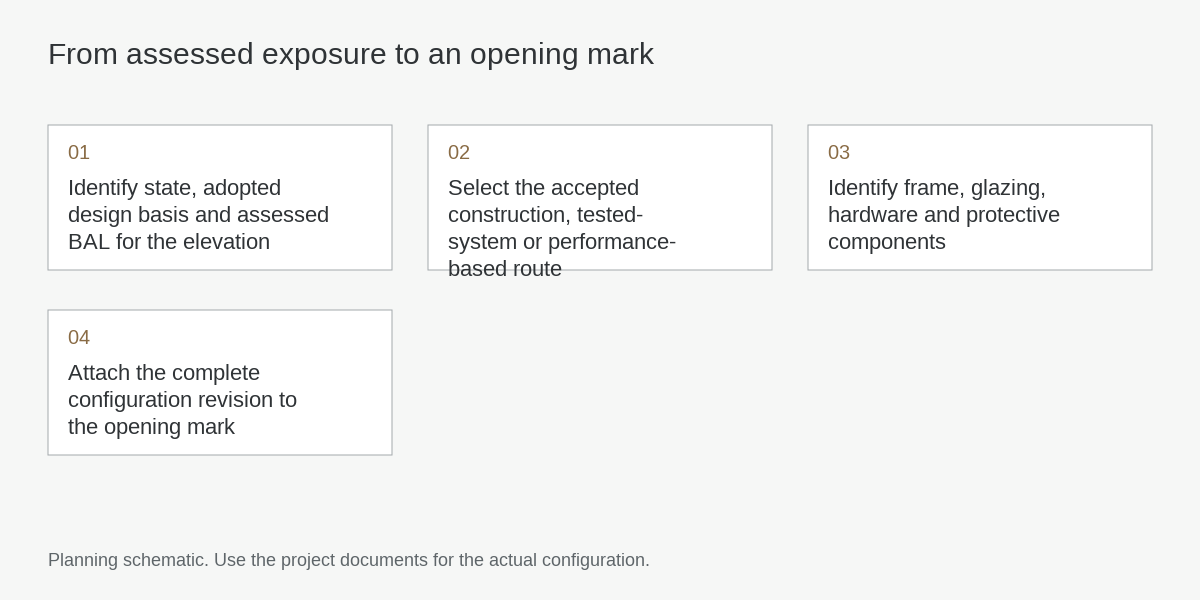
Keep the site category connected to the accepted complete-window route.
Three numerical BAL bands at a glance
| BAL designation | Lower band figure, kW/m² | Upper band figure, kW/m² |
|---|---|---|
| 19 | 12.5 | 19 |
| 29 | 19 | 29 |
| 40 | 29 | 40 |
Which route applies to BAL-FZ windows in NSW?
In NSW, PBP section 7.5.3 excludes AS 3959 and the NASH Standard as Deemed-to-Satisfy solutions for buildings required to be constructed to BAL-FZ. Their relevant construction provisions can form the basis of a performance-based solution demonstrating the NCC and PBP performance requirements.
For NSW BAL-40 and BAL-FZ development, section 7.5.4 considers systems tested to AS 1530.8.1 and AS 1530.8.2 respectively, with additional flaming conditions. The provision generally requires no specimen flaming. Passing window frames may be approved where their flaming is considered not to compromise other building elements, and the text separately addresses minor elements. Keep that approval decision attached to the proposed assembly under NSW RFS sections 7.5.3–4.
A report for a fixed light represents its documented frame, glass, retention and joints. For an opening unit, the sash, hardware, seals and protection details also belong in the matched configuration. A change in dimensions or opening type needs the report’s permitted-variation basis and the project’s accepted design record.
What does a council screen example actually establish?
The Clarence Valley Council BAL-29 addendum is a legacy screen-detail example whose parent page identifies AS 3959-2009. It connects mesh, perimeter fit, supporting material and fixings. Those fields help describe an assembly, while the current project’s adopted provisions determine its required construction.
The Busselton all-BAL summary groups glazing, frame, hardware, screening and seals in its window row. Its directory date and incomplete edition details limit its role to a local summary example. Neither local sheet supplies a current nationwide window specification.
The screen selection guide covers ordinary insect-screen operation. A bushfire screen or shutter keeps its own documented material, attachment and coverage details.
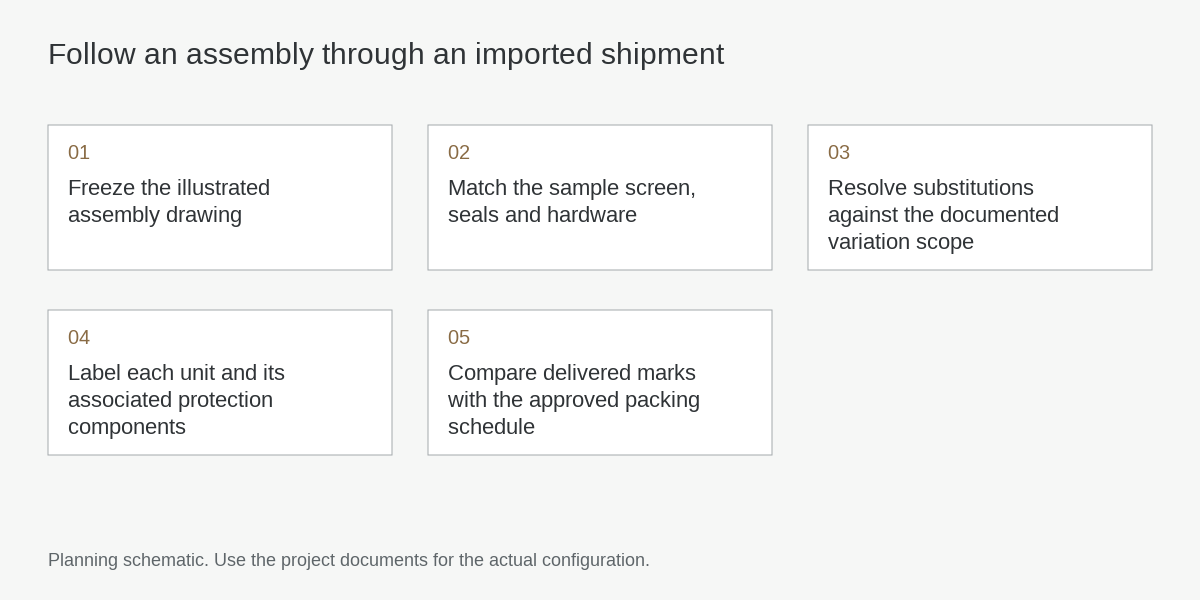
Trace the same component identities from sample to delivery.
Why do fire-glass hours answer a different question?
A Chinese issuing body’s 2026 fire-glass rules classify endurance as 0.50, 1.00, 1.50, 2.00 or 3.00 hours. The same rules distinguish insulation categories and application conditions. These are concrete glass-evaluation classifications, with a different exposure description from the Australian BAL bands.
The Chinese sampling rule specifies an exposed specimen at least 1900 × 1100 mm, with the supporting frame matching the actual project. The frame specified in an overseas report is part of its mounting arrangement. Copying its endurance figure into an Australian window schedule discards that scope.
Which changes can break the link between design and delivery?
A thicker glass option can alter glazing beads or seals. A different insect screen can change mesh material, perimeter fit or fasteners. Reversing the opening direction can reposition exposed hardware. Evaluate these substitutions against the documented system before releasing the affected mark, even when the revised component looks stronger in isolation.
Keep a component schedule with drawings with the approved production drawings. Photograph the assembled screen edge, corner joints and operating hardware on the sample. Carry the same identifiers into packing records so a mixed shipment does not exchange similar-looking screens between opening types. The repeat-order specification guide supports this continuity across later releases.
Edition control also has a geographic dimension. The NSW government adoption notice identifies NCC 2022 Amendment 2 as its current local edition and schedules NCC 2025 adoption for 1 May 2027. The Standards Australia bushfire update dated 8 May 2026 describes AS 3959 revision work. Match the adopted edition and accepted window detail to the project approval before releasing production.
FAQ
Does a BAL-40 window designation automatically include BAL-FZ?
BAL-40 covers the 29–40 kW/m² band described by CFA. BAL-FZ is a separate category. In NSW, section 7.5.3 requires the separate performance-based route described for BAL-FZ, and the accepted assembly must address that project’s exposure and construction requirements.
Can a one-hour Chinese fire-glass classification establish an Australian BAL rating?
A 1.00-hour result belongs to the particular fire-glass evaluation and mounting arrangement. BAL describes bushfire exposure and the accepted window construction, so there is no supported conversion from that duration to a BAL category.
Is a fine screen mesh enough to define the protected window?
Mesh aperture leaves the material, edge gaps, supporting frame, fixings and protected portions unspecified. The Clarence legacy example combines those details, while the applicable complete window or shutter alternative remains a separate part of that template.
Let YULUX review your drawings before pricing.
Send us your window schedule, floor plans or photos. We review opening sizes, system direction, glass, hardware, finish and packing scope before quoting.