
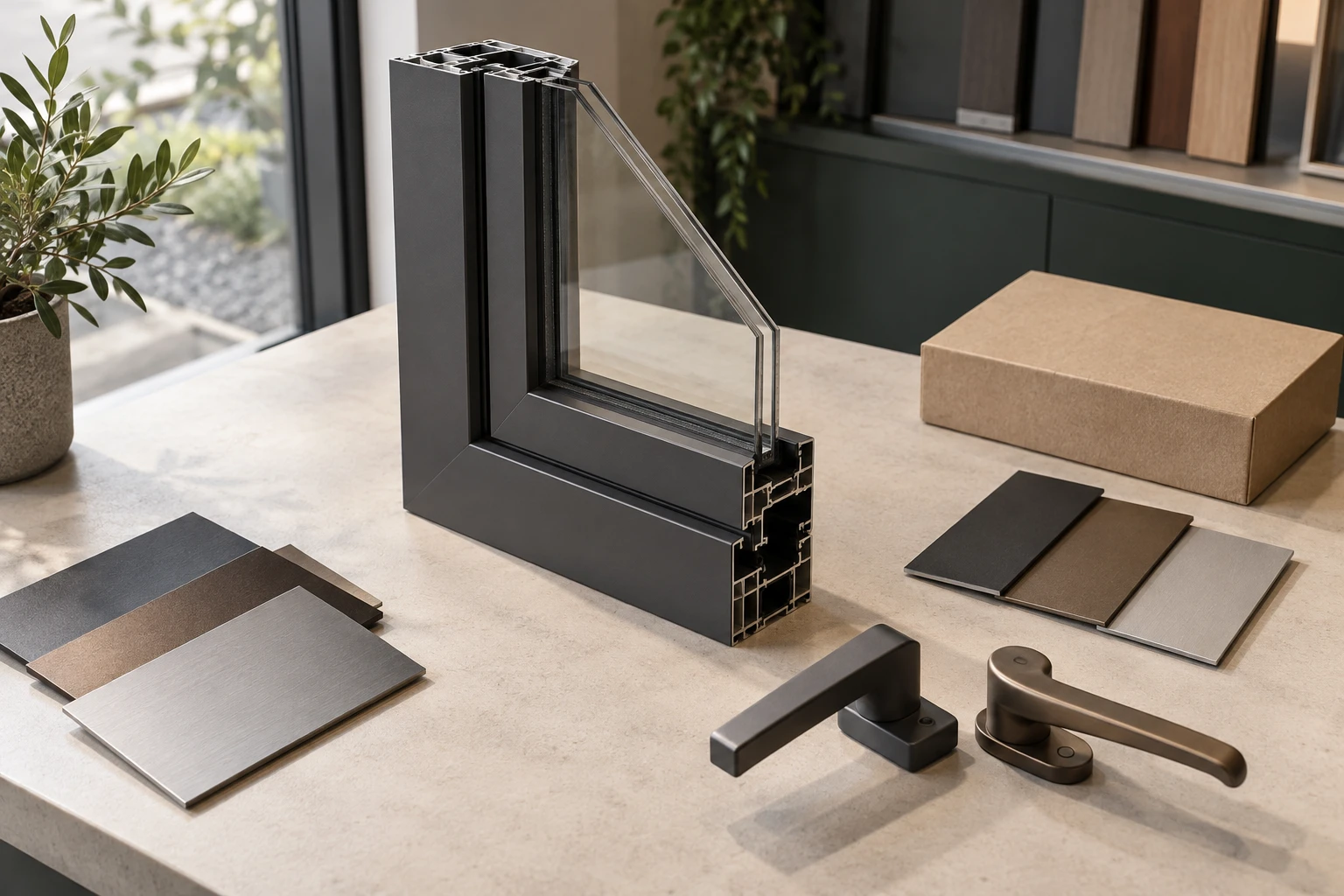
How should distributors control repeat aluminium window orders?
Maintain a master configuration with its own ID and revision, separate from each purchase order. Compare every repeat supplier return against that baseline. Record substitutions by old and proposed reference, affected lines, review owner and approval scope. A one-order exception should stay attached to that order; a permanent change needs a new master revision and an explicit effective boundary. Preserve earlier revisions so old and new inventory remain traceable.
The second order can become a different product
A distributor replenishes a successful window line using the instruction “same as last order.” The new quotation keeps the familiar sales name, but a handle set is unavailable and a different profile detail appears in the returned drawing. Purchasing sees a repeat price; the warehouse expects interchangeable stock. Neither has a reliable way to decide whether these are still the same saleable configuration.
The failure starts when an order number becomes the product specification. A previous purchase order also contains one customer's quantities, dimensions, destination and exceptions. Copying it can carry those exceptions forward. For repeat supply, keep a master configuration separate from each order, then record every difference against that master. The method below is an editorial procurement recommendation for distributors managing recurring aluminium window and door purchases.
Give the repeat configuration its own identity
Create one configuration ID for the combination your sales team actually sells. Attach the agreed frame-system reference, drawing revision, glass specification, finish reference, hardware schedule and included accessories. Link to the approved documents instead of shortening them into labels such as “standard glass” or “premium hardware.”
Separate fixed attributes from variables that require confirmation on every order. Dimensions, handing and quantities may vary, but that does not make every size valid for the same configuration. Ask the supplier to identify where a changed opening needs a separate technical review.
| Master field | Entry to complete | Control purpose |
|---|---|---|
| Configuration ID / revision | [ID] / [revision] | Identifies the product definition across orders |
| Fixed document set | [frame] [glass] [finish] [hardware] [accessories] | Links to the complete agreed specification |
| Order variables | [permitted variables] / [review triggers] | Separates routine order detail from a change |
| Effective boundary | [first applicable PO and lines] | States where the revision starts |
| Custodian / approval reference | [person] / [dated record] | Names who maintains the master |
Keep superseded revisions readable. An installer servicing an older shipment needs the configuration supplied then, not whichever version is current today.
Treat substitutions as a proposal with a defined scope
A change request should answer three different questions before purchasing accepts it.
- What exactly changes?
- Name the old and proposed references, the reason, and the affected order lines. A replacement handle, revised profile or different glass build-up is a configuration change even when the supplier describes it as equivalent.
- What must be checked again?
- Request the relevant comparison for fit, operation, appearance, maintenance and project requirements. Route technical questions to the responsible reviewer. A purchasing approval should not silently replace a required designer or customer decision.
- Where is the approval valid?
- Choose one order only, named lines only, or a new master revision for future orders. Record any price or timing effect separately. Agree the response deadline and what happens to affected lines while the decision is pending.
“No objection” in an unrelated email is a poor revision boundary. Use an explicit approval reference that the returned quotation and production documents can repeat.
APPROVAL DESK
Decide what a change approval affects
| Decision | Record | Effect on the next order |
|---|---|---|
| No specification change | Returned schedule references the master | Continue with the same revision |
| One-order exception | Approved exception plus affected PO lines | Do not carry it forward automatically |
| Recurring configuration change | New master revision and first applicable PO | Quote future orders against the new revision |
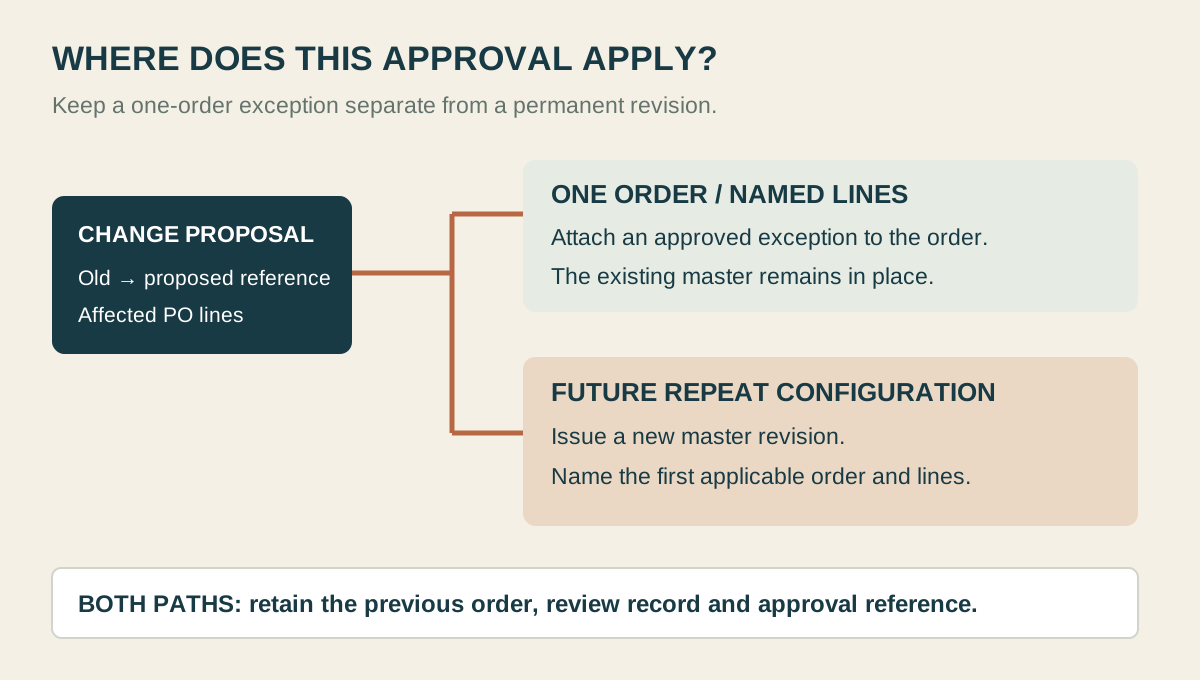
A one-order exception does not automatically redefine the distributor’s future stock.
Fictional worked example: one substitution, two orders
Fictional procurement example, not a YULUX customer order. A distributor uses configuration DIST-C07 revision 2. PO-410 is already recorded against that revision. During PO-428 review, the supplier proposes hardware set H-B instead of H-A. The codes below are invented; no technical equivalence is implied.
| Comparison field | Previous PO-410 | New PO-428 | Buyer disposition |
|---|---|---|---|
| Master reference | DIST-C07 / revision 2 | DIST-C07 / revision 2 | Retain the baseline |
| Hardware reference | H-A | H-B proposed | Technical review pending |
| Profile and glass references | P-2 / G-4 | P-2 / G-4 returned | No difference declared |
| Approval scope | Original order record | Affected lines 06–09 | Hold those lines until resolved |
| Future replenishment | Revision 2 | Not decided | No automatic master update |
If H-B is later accepted for this purchase only, attach exception EX-01 to PO-428 lines 06–09. Do not overwrite revision 2. If it is accepted as the new recurring configuration, issue revision 3 with an explicit first applicable order. In either case, preserve what PO-410 actually contained.
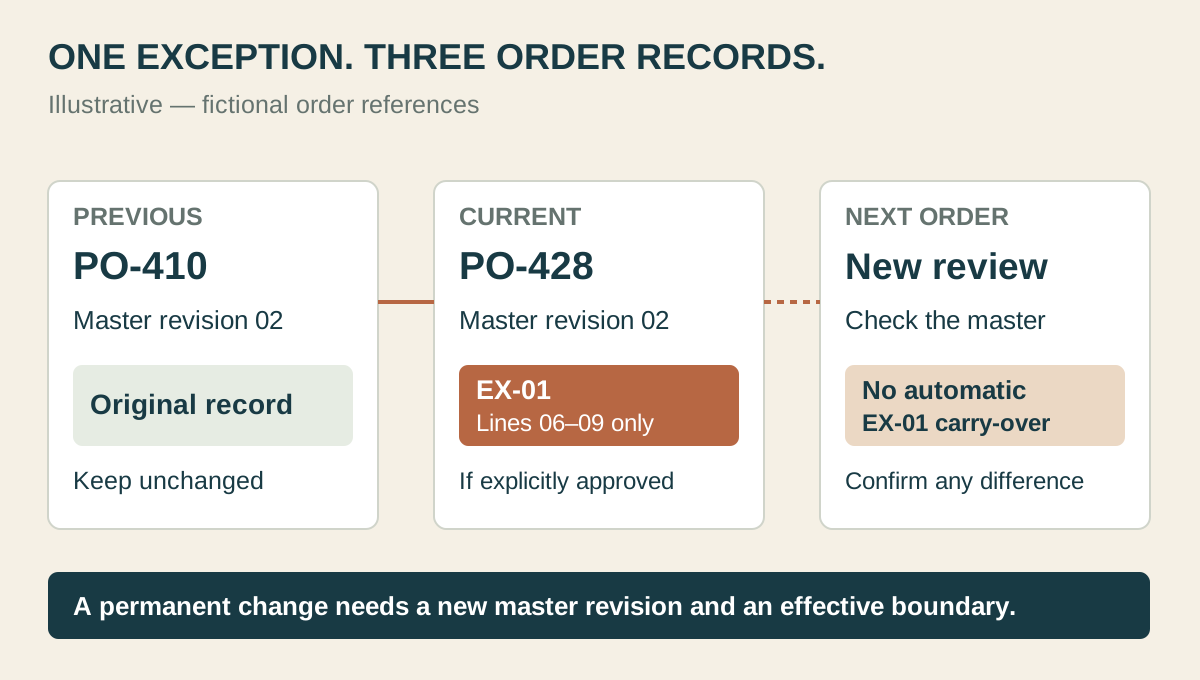
Illustrative order comparison: retain PO-410, record the PO-428 exception for named lines, and review the next order against the master.
Manage the period when old and new stock coexist
Revision control continues after the purchase order. Ask the receiving team to retain the order and configuration revision in the stock record, so two similar-looking versions are not merged under one undifferentiated inventory description. Sales should know which revision is being offered when customers are adding windows alongside an earlier purchase.
Use an order-to-master difference sheet even when the answer is “no differences.” Compare the new supplier return against the master, not only against the last invoice. A previous one-off exception should appear as a question, not as the new default.
The hardware and spare-parts guide explains component identification. This repeat-order record adds the missing commercial relationship: which configuration and approved change belonged to which shipment.
Send a repeat-order brief that can be answered
Send YULUX the master configuration reference, the new order schedule and a difference sheet with these blank fields: [old value] → [requested or proposed value]; [affected lines]; [reason]; [review owner]; [approval scope]; [price/timing response]; [decision reference]. Ask for a returned schedule that confirms the baseline and lists exceptions explicitly.
YULUX coordinates custom aluminium window and door requirements around the confirmed order. Use the quotation enquiry to request that review. Before release, check that the purchase order, approved configuration revision and supplier return agree. Repeat purchasing becomes easier when the next buyer can reconstruct the decision without searching through a sales conversation.
NEXT ORDER / HANDOVER
Repeat-order change request fields
- Master ID / revision and new purchase order
- Old reference and proposed replacement
- Affected lines and reason for change
- Review owner and approval scope
- Commercial response and dated decision reference
Keep with the order
- Current master configuration and linked specification documents
- Previous order reference and new supplier return
- Line-specific substitution decisions and effective revision boundary
Approval boundary
The register controls repeat-order scope. Acceptance of a substitution must follow the relevant technical and commercial review for the affected configuration.
Still requires confirmation
A familiar product name does not establish that a changed profile, glass or hardware set is equivalent or interchangeable.