
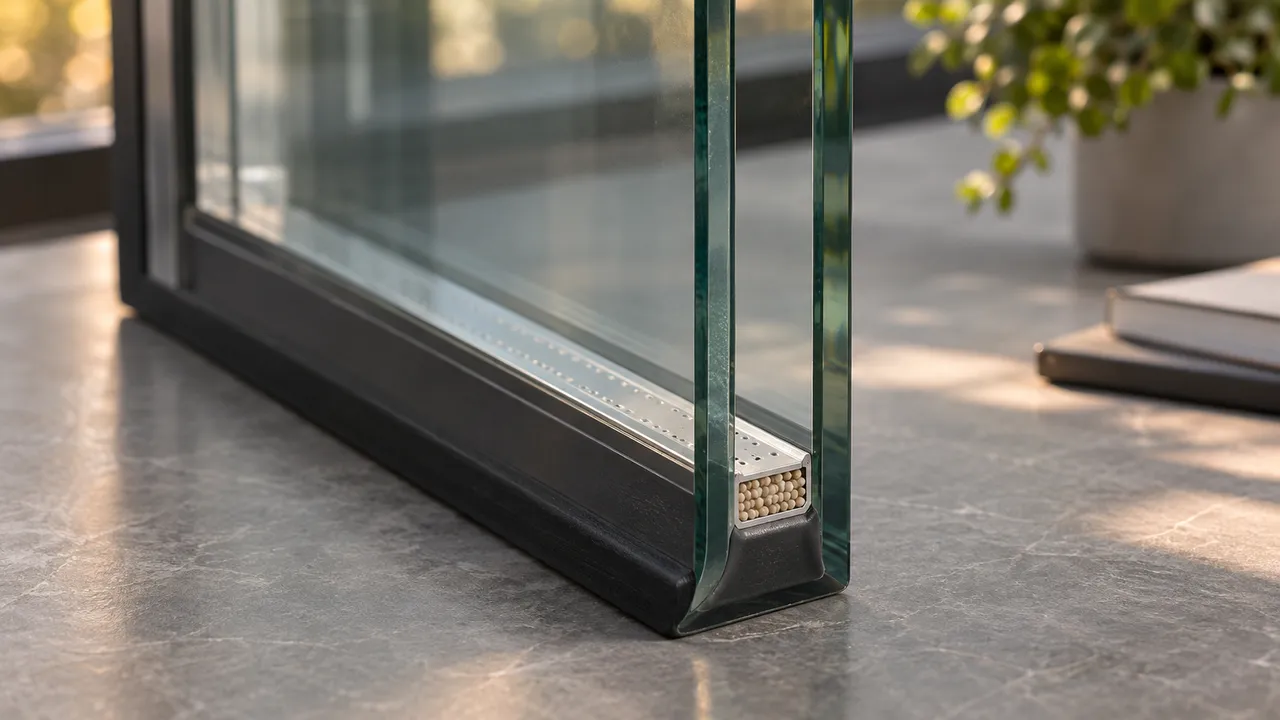
Argon Gas Windows: Is the Upgrade Worth It?
Argon reduces conductive heat flow through a matched insulating-glass cavity. NGA's 6.35/12.7/6.35 mm Low-E example gives centre-glass U-factors of 0.29 for air and 0.24 Btu/(h·ft²·°F) for 95% argon, about a 17% reduction under its stated calculation conditions. Compare the quoted upgrade with the project's heating demand and ownership period. NGA matched calculation
What must stay identical when comparing air and argon?
The matched calculation holds outdoor temperature at 0°F (−17.8°C), indoor temperature at 70°F (21.1°C), wind at 12.3 mph (5.5 m/s) and low-E emissivity at 0.04. Keep those conditions with the result when comparing another glass package.
The roughly 17% centre-glass improvement is a result for that glass calculation. Frame area, frame insulation and the glazing edge also contribute to the whole-window rating. Annual building energy use additionally reflects climate, solar gains, air leakage and the heating or cooling system. Use the actual opening size and whole-window U-factor to evaluate the purchased assembly, with the NFRC label explanation identifying the US rating.
Does the European test require every unit to start at 90% argon?
Under EN 1279-3:2018 clause 5.2, the concentration before and after the clause 6.3 test must be at least the nominal value used to calculate the manufacturer’s declared U-value minus 5 absolute percentage points. A 90% nominal value therefore gives an 85% minimum. The national standards publisher’s original preview provides the clause. The order still needs its own stated nominal fill and agreed acceptance method.
The same standard limits mean accelerated-test leakage to 1.0% a⁻¹ and each individual result to 1.20% a⁻¹. Its test procedure includes climate exposure before gas leakage is measured. The standard expressly prevents using that laboratory limit to forecast the installed unit's gas concentration over its service life.
Xinchang Dahua's warm-edge IGU page specifies an initial argon fill of at least 85% for its listed supply. Set the ordered nominal fill and acceptance method for the actual glass unit. Fabricator specification
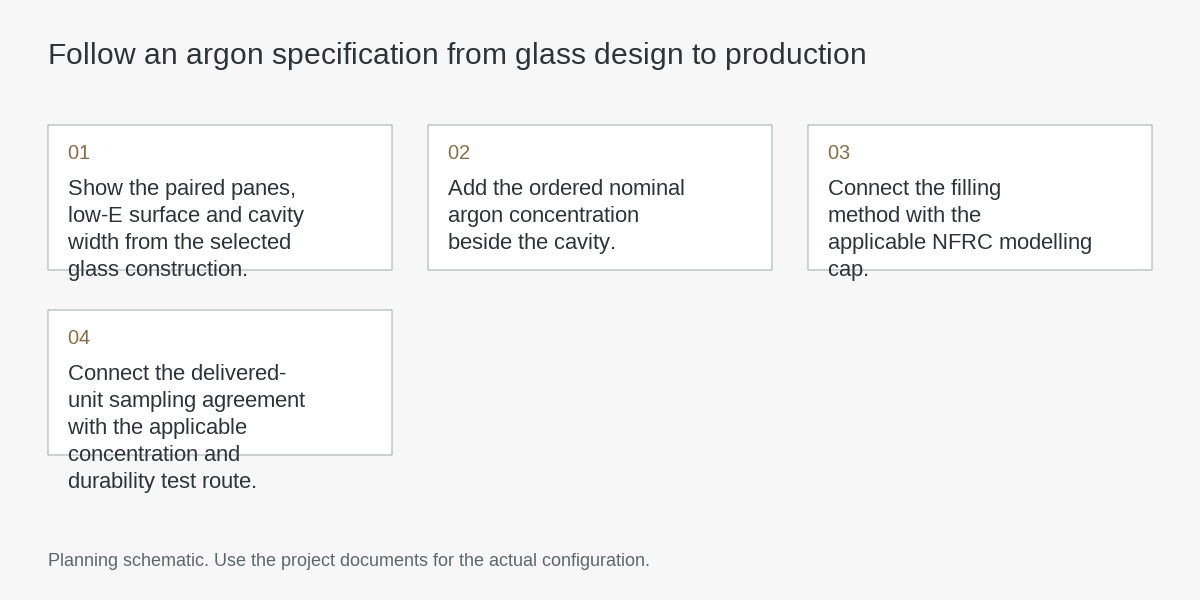
Nominal concentration, filling method and test route each have a distinct role.
How much does argon change otherwise matched glazing?
| Cavity fill | Centre-glass U, Btu/(h·ft²·°F) | Converted U, W/(m²·K) | Inside centre-glass temperature |
|---|---|---|---|
| Air | 0.29 | 1.647 | 54°F / 12.2°C |
| 95% argon | 0.24 | 1.363 | 56°F / 13.3°C |
What do the North American gas-retention thresholds measure?
GCIA certification requires an average initial argon concentration of at least 90%, an average after-weathering concentration of at least 80%, and every tested unit to contain at least 50%. The certification body's March 2025 notice sets out those thresholds.
These thresholds evaluate the laboratory test set under its certification route. The delivered concentration and shipment sampling agreement belong on the purchase order alongside the certified construction.
ASTM E2190-19 evaluates the durability of applicable preassembled IGU test specimens, including specified argon content before and after testing to E2188. Its publisher’s scope covers the applicable double- and triple-glazed constructions and assigns thermal properties to separate evaluation.
For GCIA gas measurement, the IGCC/IGMA laboratory manual specifies ASTM E2649 spark emission spectroscopy. Its procedure uses 10 randomly selected units for initial gas content and the 6 weathering specimens for the after-weathering result. Both triple-pane cavities are filled and tested. Damaged units and units containing internal components such as grilles are excluded under that procedure. These are laboratory-program sample rules, with shipment checks specified separately.
Why does the filling method change the modelled concentration?
The October 2026 Chinese NFRC manual gives modelling caps of 97% for vacuum-chamber filling, 95% for sensor-controlled dual-probe argon filling and 90% for timed single-probe filling. The exact table appears in the NFRC-hosted Chinese simulation manual.
Use the manufacturer's stated concentration within the cap for its filling method. Record the process beside the glass model so that the quoted performance and the manufacturing route describe the same product. For a Canadian window order, carry the destination's applicable whole-window rating through the same configuration schedule.
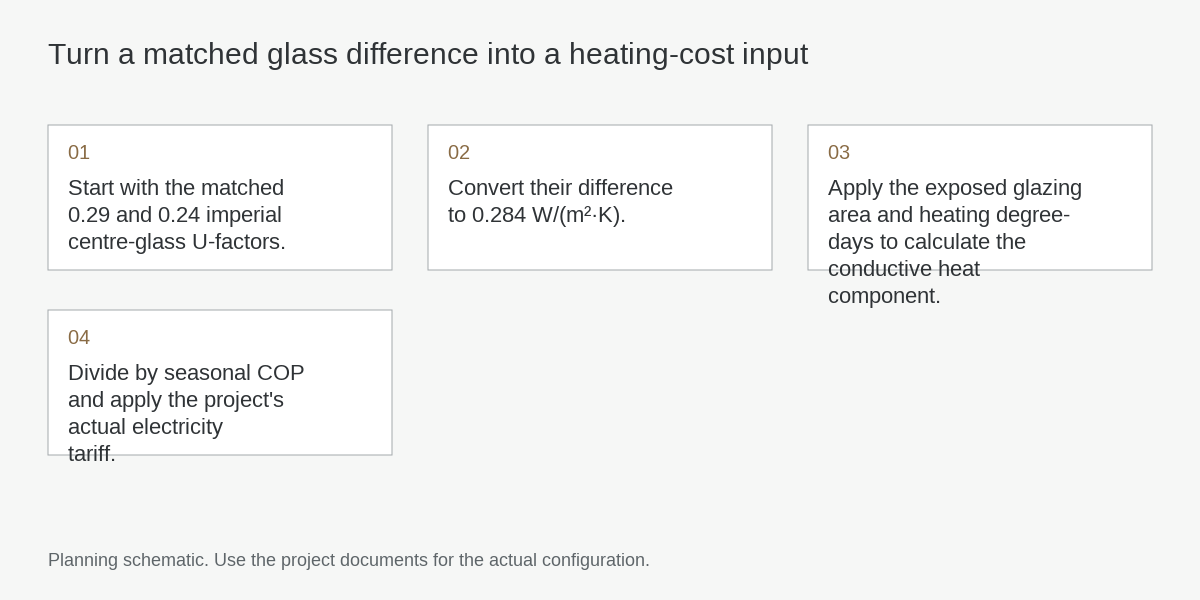
The declared 18 m², 2,400 kelvin-day and COP 3 case gives 294.36 kWh of heat and 98.12 kWh of electricity.
What can the gas upgrade save over a heating season?
Assumptions: 18 m² (194 ft²) of exposed glazing, 2,400 kelvin-days of heating demand, the matched glass constructions in the opening table, and a seasonal heat-pump COP of 3. Frame and edge effects, solar gains and air leakage stay fixed in this glass-only heating sensitivity.
The U-factor difference converts to 0.284 W/(m²·K). Multiplying by glazing area, degree-days and 24 hours, then dividing by 1,000, gives the change in conductive heating load.
The stated glass-area and climate assumptions give a conductive heating-load reduction of 294.36 kWh per year, equivalent to 98.12 kWh of electricity at a seasonal COP of 3.
For this sensitivity, the annual electricity-cost component is 98.12 multiplied by the project’s tariff per kWh. Weigh that component over the expected ownership period against the separately quoted gas-upgrade price. Fewer heating degree-days or a more efficient heating system reduce the heating-cost benefit of the same glass change.
Use a cooling calculation with the actual solar conditions for a cooling-led project. Keep the quoted air and argon options otherwise matched so the decision remains about the gas upgrade.
How should gas retention enter the delivery decision?
Gas retention follows from the complete edge seal, spacer, adhesion and production workmanship. Keep the IGU construction and batch identification traceable to the ordered configuration. The fabricator's production checks and the agreed delivered-unit sampling connect the tested design with the shipment.
Specify moisture observations by location. The window condensation diagnosis separates room-side moisture from moisture within the sealed cavity. Pair the gas choice with a suitable warm-edge spacer specification for the complete glazing edge.
Which gas configuration belongs on the quotation?
The glass line distinguishes pane thickness, coating surface, cavity width, nominal gas fill, spacer and seals. The 5+20A+5 notation guide explains how layer dimensions add to the total.
GB/T 11944-2025 is the relevant Chinese insulating-glass specification cited for this comparison. Put the selected test and acceptance provisions in the order alongside the complete IGU construction.
FAQ
Does a 95% argon model mean the factory uses that concentration for every order?
95% is the cited NFRC cap for sensor-controlled dual-probe argon filling. Model the manufacturer's actual declared concentration within that process limit and put the ordered nominal fill on the quotation.
How does a heat pump change the value of the same argon upgrade?
At the stated 18 m² and 2,400 kelvin-day assumptions, the calculation reduces conductive heating load by 294.36 kWh per year. A seasonal COP of 3 turns that into 98.12 kWh of electricity, which can be priced using the project's tariff.
Should a triple-glazed order state the gas in both cavities?
A triple-glazed IGU has 2 cavities. Specify the intended gas and nominal concentration in each cavity. The IGCC laboratory procedure fills and tests both cavities when evaluating triple-pane units.
Let YULUX review your drawings before pricing.
Send us your window schedule, floor plans or photos. We review opening sizes, system direction, glass, hardware, finish and packing scope before quoting.