
ENERGY STAR Windows by Climate Zone, U-Factor and SHGC
For US residential windows, ENERGY STAR Version 7.0 uses 4 climate zones with prescriptive U-factor limits of 0.22 in Northern, 0.25 in North-Central, 0.28 in South-Central and 0.32 in Southern areas, measured in Btu/(h·ft²·°F). Northern windows also need SHGC of at least 0.17, while the other zones impose maximum SHGC values.
Which ENERGY STAR zone covers my county?
The installation county determines the zone. Select the state, county and window category in the official finder. A freight forwarder’s delivery address can differ from the building location. EPA climate-zone finder
Version 7.0 took effect on October 23, 2023. Multiply a US U-factor by 5.678 to obtain W/(m²·K), so 0.22 becomes approximately 1.249 W/(m²·K). Windows, doors and skylights have separate eligibility tables. EPA specification, Tables 1–3
U-factor measures heat transfer through the whole window. SHGC measures the fraction of incident solar energy entering through it. Low U-factor limits winter heat loss, while low SHGC reduces summer solar gain.
US window thresholds under Version 7.0
| Climate zone | Maximum U-factor, Btu/(h·ft²·°F) | Maximum U-value, W/(m²·K) | SHGC requirement |
|---|---|---|---|
| Northern | 0.22 | 1.249 | ≥0.17 |
| North-Central | 0.25 | 1.420 | ≤0.40 |
| South-Central | 0.28 | 1.590 | ≤0.23 |
| Southern | 0.32 | 1.817 | ≤0.23 |
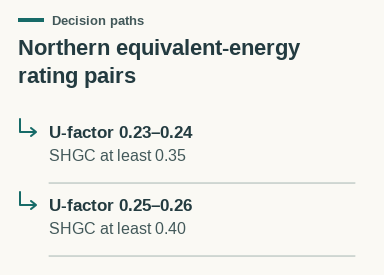
Northern equivalent-energy rating pairs
Can Northern windows qualify above U-factor 0.22?
Northern windows with U-factor 0.23 or 0.24 can use the equivalent-energy route with SHGC at least 0.35, while U-factor 0.25 or 0.26 requires SHGC at least 0.40.
At U-factor 0.24, SHGC 0.30 misses both Northern routes. Raising SHGC to 0.35 reaches the equivalent-energy route without changing U-factor. EPA Northern alternatives
The Northern equivalent-energy route credits useful heating-season solar gain. Shaded elevations receive less of that benefit, while exposed west-facing rooms need stronger control of summer afternoon gain.
What happens when only one rating changes?
Assumptions: certified whole-window rating pairs, with all other product properties unchanged. Lowering SHGC from 0.20 to 0.15 removes Northern thermal eligibility because the minimum is 0.17.
Reducing U-factor broadens eligibility without raising summer solar gain. On an exposed west elevation, that can be preferable to increasing SHGC to reach a Northern equivalent-energy option.
| Starting U / SHGC | Single change | Result against zone thermal thresholds |
|---|---|---|
| 0.22 / 0.20 | SHGC falls to 0.15 | Northern minimum missed, three warmer zones retained |
| 0.24 / 0.30 | SHGC rises to 0.35 | Northern equivalent route reached. North-Central retained |
| 0.30 / 0.23 | U-factor falls to 0.28 | South-Central added to Southern |
| 0.28 / 0.23 | U-factor falls to 0.22 | All four zones reached |
How much does a U-factor change affect heat flow?
Assumptions: 100 ft² (9.29 m²) of window area and a 40°F (22.2°C) indoor-outdoor temperature difference. Heat flow = U-factor × area × temperature difference, so reducing U-factor from 0.30 to 0.22 changes steady heat loss from 1,200 to 880 Btu/h, a reduction of 320 Btu/h or about 27%. EPA U-factor definition
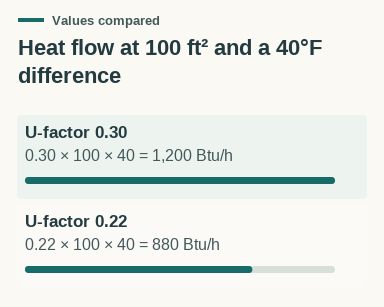
Heat flow at 100 ft² and a 40°F difference
How should Chinese glass quotations be read against US ratings?
Chinese glass fabrication literature defines shading coefficient, SC, relative to 3 mm (0.118 in) clear reference glass. The same technical literature defines its K/U value at the glass centre, excluding edge effects. A quotation can therefore show a glass-only thermal result alongside a solar coefficient with a different basis from SHGC.
Read SC and whole-window SHGC as separate entries on a glass quotation. The 5+20A+5 glass notation guide explains pane and cavity dimensions; frame, spacer and edge losses enter the assembled window rating.
Can aluminum windows made in China be ENERGY STAR certified?
Yes. Chinese-made windows can qualify through an ENERGY STAR partner and an EPA-recognized certification body, using NFRC-certified whole-product ratings and the required product labels. EPA partner commitments and certification rules
Published DOE examples of thermally broken aluminum windows span U-factor 0.31–0.47, approximately 1.76–2.67 W/(m²·K). These are older commercial-building examples drawn from 2011 guidance, so they provide a configuration comparison rather than a current residential market range. Every example exceeds the Northern prescriptive ceiling of 0.22. DOE window upgrade guide, Table 1
In that sample, 0.31 can satisfy the Southern U-factor ceiling of 0.32, but its paired SHGC of 0.39 exceeds the Southern maximum of 0.23. The complete rating pair controls eligibility. Advanced aluminum configurations need their own certified values, which the NFRC label guide explains.
At U-factor 0.22–0.23, EPA’s common technical pathway uses triple glazing, two Low-E coatings and argon. EPA also confirms that some double-pane products meet Version 7, so glazing selection follows the certified result. EPA technical pathways, slides 18 and 22
The federal Section 25C credit ended for property placed in service after December 31, 2025, according to the IRS instructions, so windows placed in service in 2026 are ineligible regardless of when they were ordered. IRS Form 5695 instructions
Can the same window specification cover all four zones?
A whole-window U-factor of 0.22 or lower combined with SHGC from 0.17 through 0.23 satisfies the thermal thresholds in all 4 zones.
Window air leakage must be at most 0.3 cfm/ft², and the certified product label identifies the qualifying regions. EPA air-leakage and certification requirements
FAQ
Is SHGC 0.15 suitable for Northern ENERGY STAR windows?
The Northern prescriptive route requires SHGC at least 0.17. A value of 0.15 also falls below the 0.35 and 0.40 minimums used by the equivalent-energy options.
Does a U-factor of 0.25 qualify in the North-Central zone?
It meets the U-factor ceiling. The window also needs SHGC at most 0.40, plus the other applicable certification requirements.
Does ENERGY STAR require triple-pane glass in every zone?
For the Northern prescriptive U-factor of 0.22, EPA’s typical pathway uses triple glazing with two Low-E coatings and argon. Some high-performance double-pane products qualify, and the Northern equivalent-energy routes allow U-factor 0.23–0.26 with higher SHGC.
Let YULUX review your drawings before pricing.
Send us your window schedule, floor plans or photos. We review opening sizes, system direction, glass, hardware, finish and packing scope before quoting.