
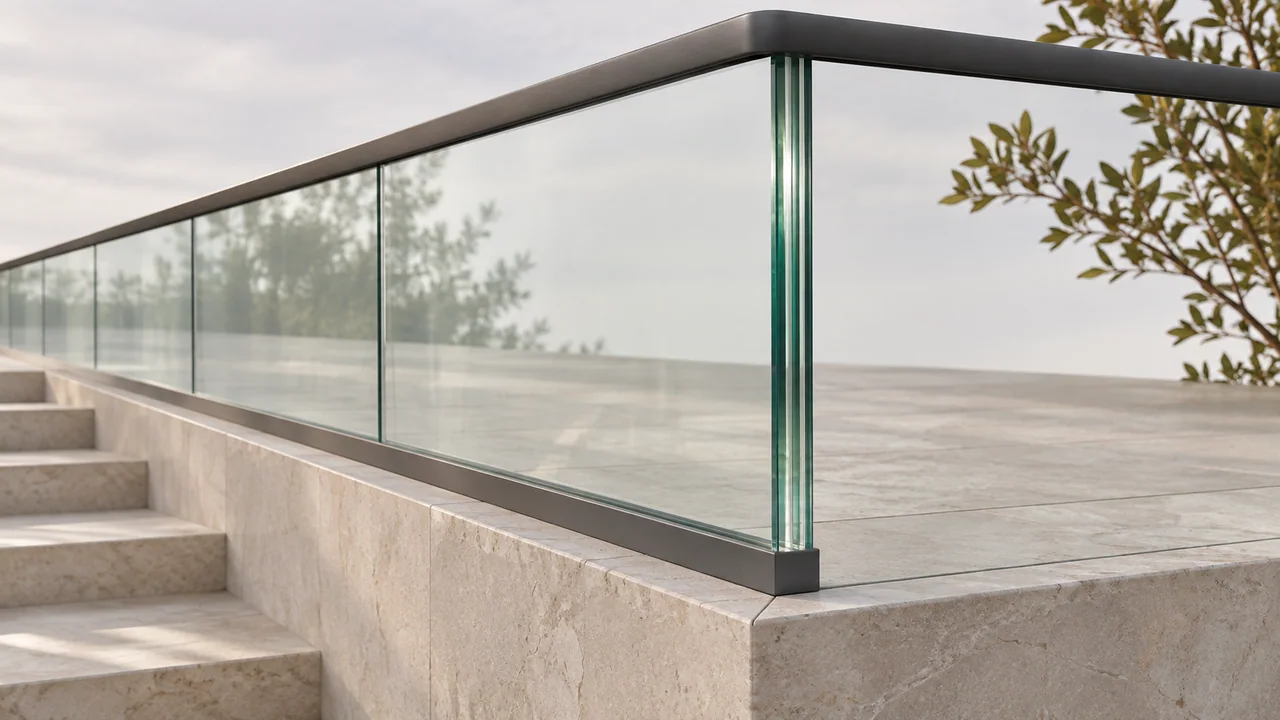
Glass Balustrade Specification by Country, Thickness and Guard Height
Specify glass balustrades as complete glass, support and handrail assemblies: England's external-balcony height benchmark is 1100 mm, while the cited Australian NCC provisions use 1000 mm at general floor edges.
The details behind the answer
One published UK bottom-clamped PVB system uses 17.5 mm glass at 0.36 kN/m and 21.5 mm at 0.74 kN/m, with a continuous top handrail and a maximum height of 1100 mm.
How high must a glass balustrade be?
England's Approved Document K gives 900 mm for guarding inside a single-family dwelling and 1100 mm at external balconies and roof edges. Heights are measured from the relevant finished surface. Height guidance, Diagram 3.1
Australia's NCC 2022 Volume One D3D17 generally requires a barrier where a trafficable surface is at least 1 m above the surface beneath. D3D18 sets 865 mm on stair flights and qualifying ramps, and 1000 mm at general floor edges. It also addresses short landing barriers and auditorium seating. Heights are measured vertically above the finished surface or stair-nosing line. NCC D3D17 and D3D18
The general US IBC 2024 guard height is 42 inches (1067 mm), with specified residential exceptions at 36 inches (914 mm). IBC 1015.3
China's GB 55031-2022 section 6.6.1 gives 1100 mm. A foothold at least 220 mm wide and no more than 450 mm high moves the measurement datum to its top. The governing edition, building class and local variations determine the project's applicable provisions. GB 55031 section 6.6
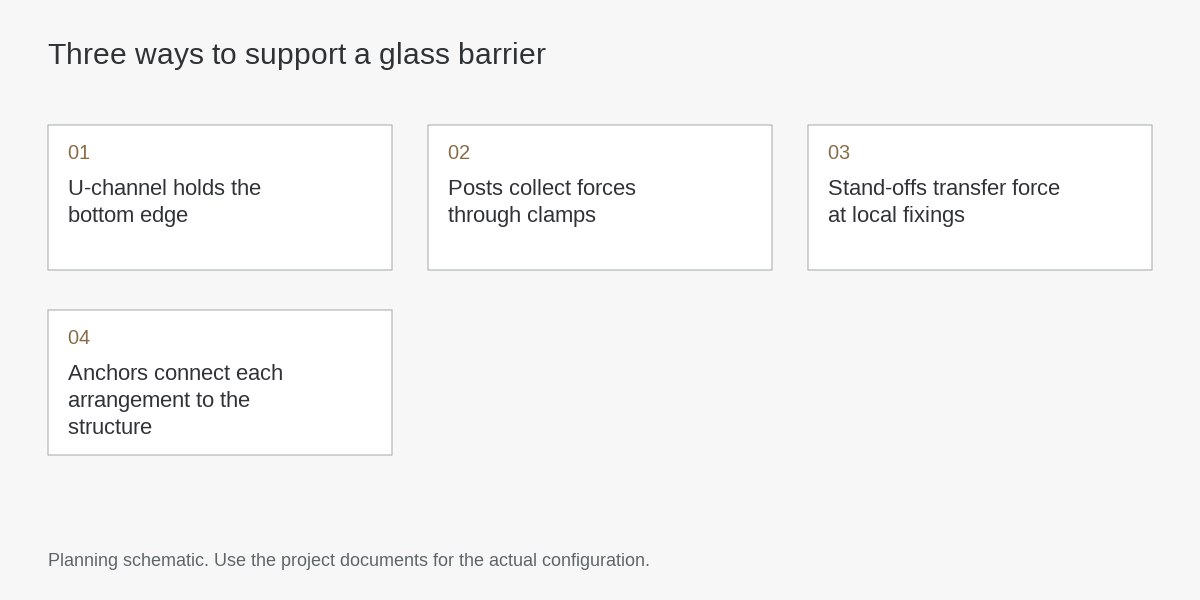
Original comparison of load paths. The support positions distinguish the three assemblies.
Four-market dimension reference
| Location / application | Guard height (mm) | Glass thickness (mm) |
|---|---|---|
| England, dwelling interior / external balcony | 900 / 1100 | a published UK system PVB 17.5 / 21.5 with continuous handrail |
| Australia, stair / general floor edge | 865 / 1000 | one Australian supplier 12 / another Australian supplier 15 with system handrail |
| US, specified residential exception / general guard | 914 / 1067 | Engineered glass build-up |
| China, general guard / indoor structural glass | ≥1100 | Commentary example ≥16.76, indoor directly load-bearing scope |
What loads apply to homes, offices and schools?
GB 55001-2021 requires 1.0 kN/m horizontal top load for housing and offices, and 1.5 kN/m horizontal plus a separately considered 1.2 kN/m vertical load at the listed primary and secondary school edges.
The school provision covers accessible roofs, external corridors, stairs, platforms and balconies. Canteens, theatres, cinemas, stations, auditoriums, exhibition halls and stadiums use 1.0 kN/m horizontally and 1.2 kN/m vertically, assessed separately. These are section 4.2.14 categories. GB 55001 section 4.2.14
US IBC 1607.9.1 and 1607.9.1.1 distinguish the 200 lb (0.89 kN) concentrated action from the 50 plf (0.73 kN/m) line load. The line and point cases are assessed separately, with stated occupancy exceptions. Australian design combines the AS/NZS 1170.1 occupancy category with relevant wind actions. A busy school edge and a private balcony therefore start with different design inputs. IBC line-load provision AGWA barrier guidance
Which glass thickness and top-rail arrangement should I specify?
Chinese supply examples include 6+1.52PVB+6 at 13.52 mm and 8+1.52PVB+8 at 17.52 mm. Each expression includes both plies and the polymer layer. Heat treatment and interlayer type accompany that sum. The laminated versus toughened glass guide explains how these constructions behave after breakage.
GB 55031 section 6.6.2 requires laminated glass at the listed exposed edges. Its commentary describes indoor glass fixed directly to the structure and carrying human loads, using at least 16.76 mm toughened laminate where the lowest glass edge is no more than 5 m above the lower floor. Above 5 m, that directly load-bearing arrangement is excluded. Outdoor applications also require wind design. Clause and commentary
one Australian supplier publishes a 12 mm toughened, heat-soaked glass system with a compatible handrail. another Australian supplier's 15 mm fully frameless spigot catalogue uses a suitable rail and engineer-defined parameters for falls up to 5 m. AGWA guidance excludes monolithic toughened glass above a 5 m drop and structural barriers without an interlinking or load-supporting rail. one Australian supplier system · another Australian supplier system · AGWA guidance
Base shoe, posts or point fixings
A continuous bottom clamp makes the glass act as a cantilever. Posts collect glass loads through the clamps and transfer them into their bases. Stand-offs concentrate reactions around individual fixings. The substrate, panel geometry and exposed height belong on the same section as the support.
| Support | Load path | Controlling detail | Coastal material option |
|---|---|---|---|
| Continuous base shoe | Glass to channel to anchors | Embedment and exposed height | Anodized aluminium shoe with exposure-rated anchors |
| Posts and clamps | Glass to posts to post bases | Clamp locations and rail connections | Anodized aluminium posts or 316 stainless steel |
| Point-fixed stand-offs | Glass fixing points to brackets | Hole geometry and bearing isolation | 316 stainless steel fittings, with higher grades for severe exposure |
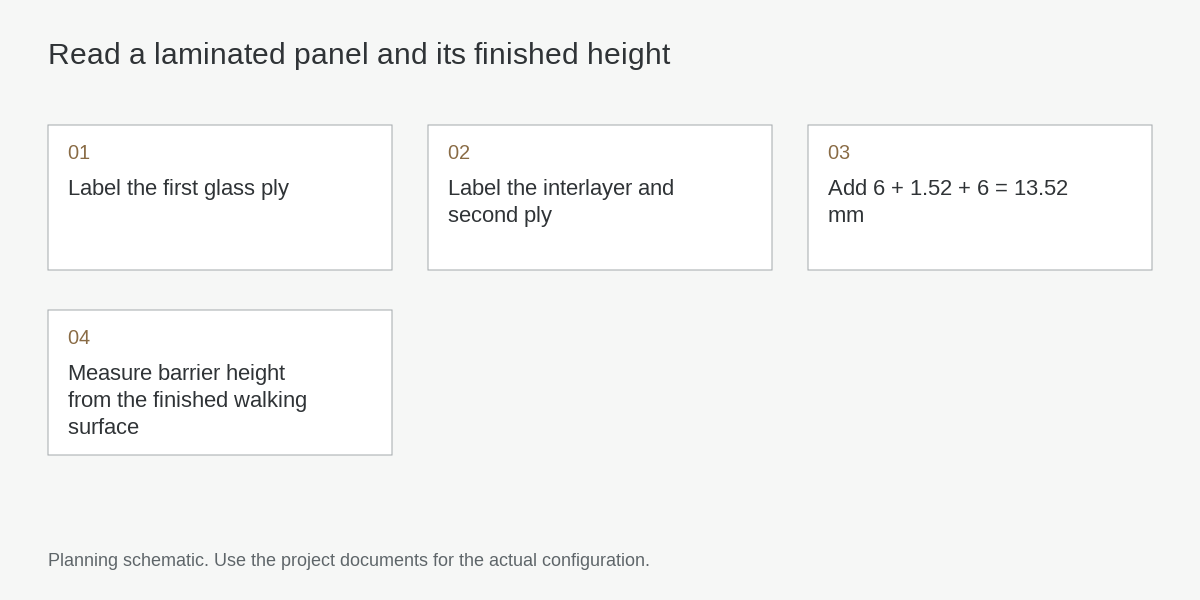
Nominal laminated thickness and installed barrier height are shown on different dimension lines.
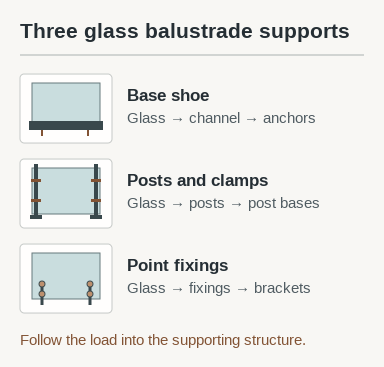
The support determines how the glass load reaches the anchors, post bases or brackets.
What reduces spontaneous glass breakage?
Nickel-sulfide inclusions can trigger spontaneous breakage in fully tempered glass. Heat-soak treatment encourages susceptible panes to break during processing, reducing the risk of later failure. EN 14179-1 addresses heat-soaked thermally toughened safety glass and requires treatment of every lite covered by that process. Residual breakage risk remains, so laminated retention and the rail arrangement remain part of the barrier design. NGA heat-soak technical paper
Glass edges also need protection during handling and assembly. Finishing, isolation at metal contacts and the specified glazing blocks help the installed system preserve the support conditions used in its design.
Coastal finishes and the final drawing
ASSDA recommends grade 316 or equivalent corrosion resistance for marine exposure, with higher grades for critical splash or poorly washed areas. Drainage, smooth finishes and access for salt removal remain important. Anodized aluminium is another established marine-exposure option when the finish and cleaning regime suit the location. ASSDA coastal corrosion guidance Aluminum Anodizers Council guidance
The powder-coated versus anodised aluminium guide explains the finish choices relevant to exposed aluminium supports. Show finished paving, waterproofing and drainage around the barrier base before fixing the final rail height.
FAQ
How thick should glass balustrade panels be?
A published UK bottom-clamped, continuously handrailed system uses 17.5 and 21.5 mm PVB glass at 0.36 and 0.74 kN/m respectively. Separate Australian supply examples use 12 and 15 mm toughened glass with the specified rail and support arrangement.
Can an IBC glass guard omit its rail?
For structural glass balusters, IBC 2024 §2407.1.2 requires an attached top rail or handrail unless the laminated panels have at least 2 equal-thickness plies of the same glass type and ASTM E2353 testing demonstrates barrier retention after impact or breakage.
Are school balustrade loads higher than home loads in China?
Yes. GB 55001-2021 sets 1.5 kN/m horizontal load at the listed primary and secondary school edges, compared with 1.0 kN/m for housing and offices. The school vertical case is 1.2 kN/m, assessed separately.
Is 1100 mm the required balcony height in every country?
The selected provisions give 1100 mm in England and China, 1000 mm at general Australian floor edges, and 1067 mm for the general IBC guard. Each figure applies within its stated building and location category.
Let YULUX review your drawings before pricing.
Send us your window schedule, floor plans or photos. We review opening sizes, system direction, glass, hardware, finish and packing scope before quoting.