
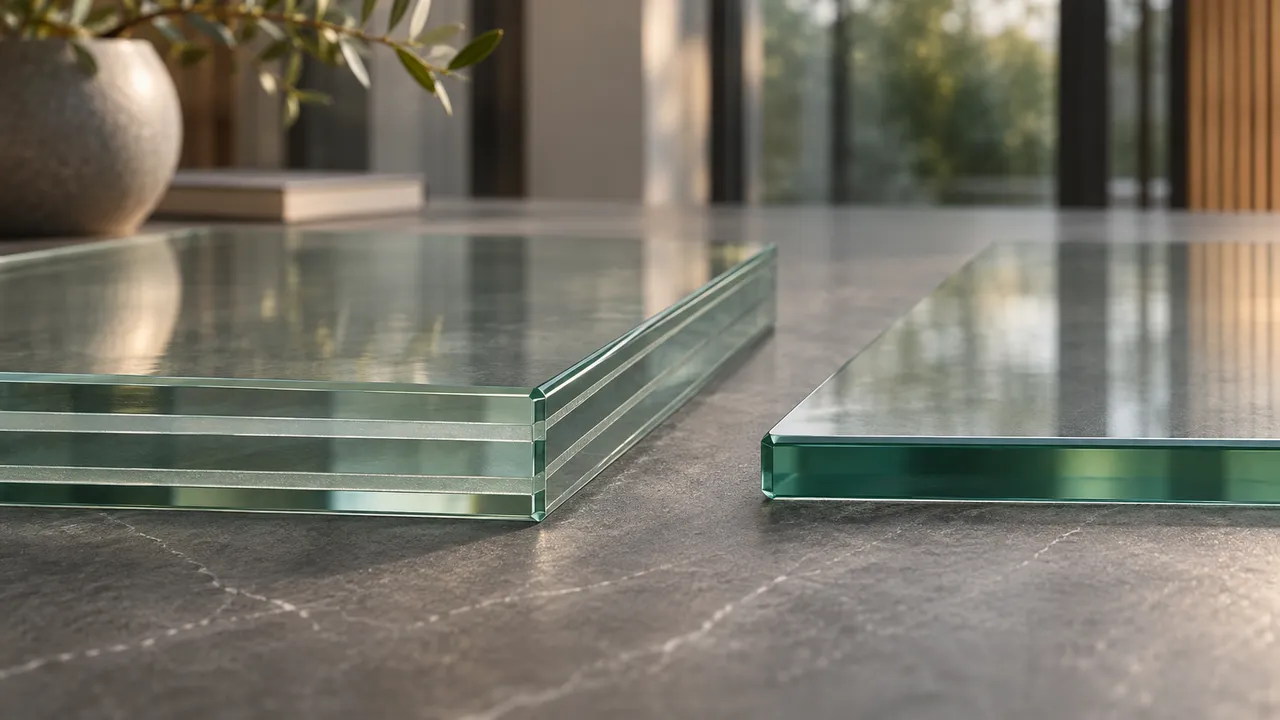
Laminated vs. Toughened Glass for Windows and Doors: Failure Modes, Build-Ups, and Quote Wording
Use toughened glass where strength and granular breakage suit the application, and laminated glass where bonding fragments after breakage is part of the design. Viridian describes VTough as 5 times as strong as ordinary glass of the same thickness. Its VLam range uses a standard 0.38 mm PVB interlayer, with thicker options for different impact and security requirements.
Match the glass build-up to the job requirement
| Design requirement | Choose | Trade-off |
|---|---|---|
| Strength and safety breakage for an impact-risk opening | A suitably specified toughened safety-glass pane | Breakage can clear the opening, so assess the consequence at that location |
| Fragment retention after breakage | A specified laminated construction with suitable edge support | Interlayer and support design determine the retained assembly's behaviour |
| Strength plus fragment retention | A designed toughened-laminated build-up | Adds an interlayer and requires the complete thickness and support detail |
| Noise reduction alongside safety glazing | A named acoustic-laminated construction | Compare acoustic results for the actual glass and complete window |
Compare the failure behaviour
Toughening locks compressive stress into the glass surface, causing it to dice into small cubes if broken. Lamination bonds two or more glass plies to an interlayer so broken shards stay adhered in place. You can laminate annealed, heat-strengthened, or toughened plies.
Post-breakage load capacity depends on the full glazing and framing assembly, not just the glass. For overhead glazing or barriers, specify retention requirements, edge bite, and framing support together. Writing a glass type on its own leaves those critical mechanical details open.
Call out every layer in an IGU
A toughened-laminated pane pairs heat-treated plies with an interlayer. Inside an insulating-glass unit (IGU), that laminate sits across a sealed cavity from a second pane that may have a completely different treatment. Specify every layer from exterior to interior, including coating surface numbers and gas fill.
For a dimensional example, 6 mm outer glass plus a 12 mm cavity plus a 6.38 mm laminated inner pane totals 24.38 mm nominal thickness. This calculation describes the stack only. Select its glass treatments and support for the intended opening.
YULUX's confirmed standard insulated-glass make-up is 5+20A+5 with both panes toughened.
Decide early if heat soaking is required
Heat soaking weeds out toughened panes with unstable inclusions that could cause spontaneous breakage on site. Flag the exact panes that need heat-soak testing in your glass schedule—especially where falling glass poses a hazard or post-handover replacement requires cranage or scaffolding.
Protect edges and corners during site handling and glazing. Set the unit on the specified setting blocks and prevent any glass-to-metal contact. If a pane fails in service, photograph the break origin and record its frame location before ordering a replacement build-up.
Specify the laminate build-up and keep its edges dry
Viridian lists PVB thickness options of 0.76 mm and 1.52 mm in its VLam guidance. Specify the selected interlayer product and thickness together with each glass ply. An acoustic interlayer and a security-oriented construction serve different stated requirements.
Keep standing water away from laminated edges with free-draining rebates or dry-glazed gaskets. Viridian specifies compatible neutral-cure silicone and warns that linseed-oil or putty sealants can trigger edge delamination.
Complete machining before toughening
All cutting, drilling, notches, and edge polishing must happen before the glass goes into the toughening furnace. If a pane size or hole location changes on site, you cannot trim it—a new pane has to be remade from scratch.
Heat-strengthened glass breaks into larger shards than fully toughened glass and is not a standalone safety glass. Where code calls for safety glazing, specify a compliant build-up—typically laminated heat-strengthened or toughened glass.