
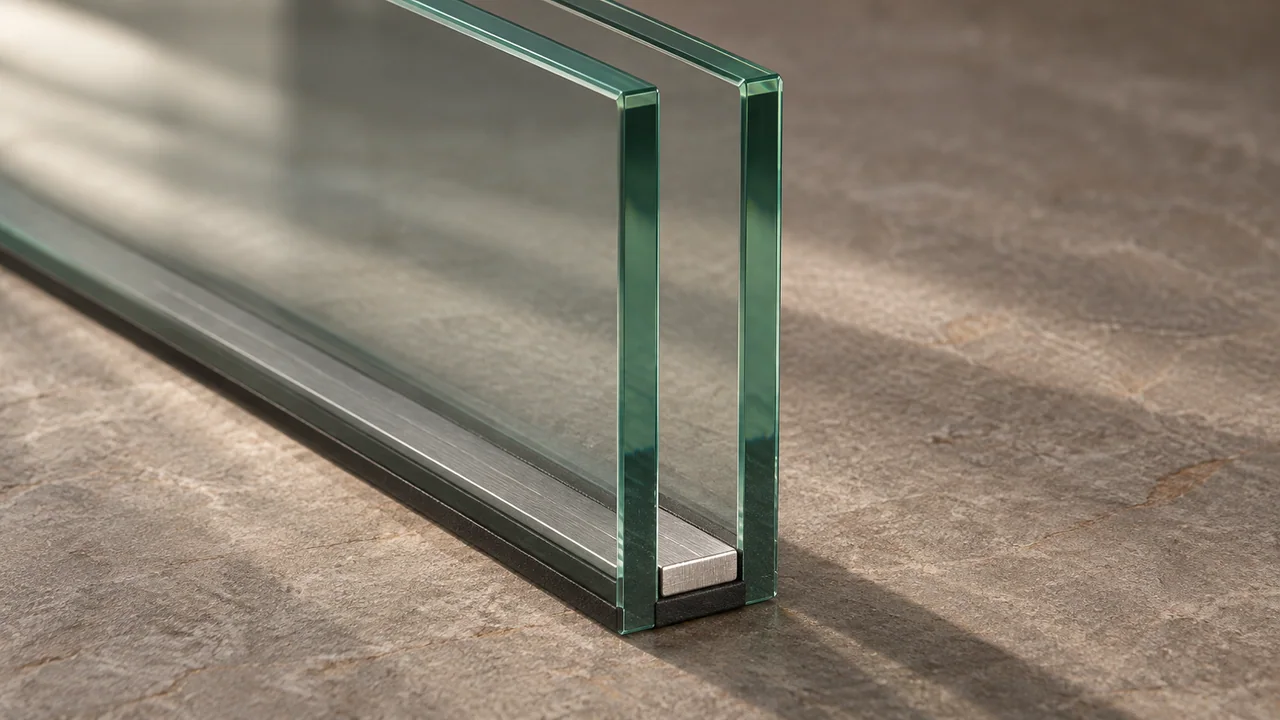
5+20A+5 Insulated Glass Explained, with Air, Argon and Low-E Comparisons
5+20A+5 means two 5 mm glass panes separated by a 20 mm air cavity, giving a nominal total thickness of 30 mm. In the cited Beijing atlas notation, A denotes air and Ar denotes argon. Low-E identifies a coating on a specified glass surface. Atlas table 21 and notation
How do I read A, Ar and the pane numbers?
A spacer maintains the distance between the panes, and the edge-seal assembly encloses the cavity. Pane thickness, cavity width and the seal construction are separate parts of the unit.
Beijing construction atlas 23BJ13-5 defines A as air and Ar as argon. Its example 5 Low-E+12Ar+5 describes a coated pane, a 12 mm argon cavity and another 5 mm pane. Chinese fabrication literature also lists 5+9A+5, 5+12A+5 and 6+12A+6. Atlas table 21 and notes
Read a glass schedule from outside to inside. The NGA description method separates pane type, surface coating, gas, spacer and edge seals, making each element identifiable. This matters when one quotation abbreviates the spacer as A and puts the gas fill elsewhere in the specification. NGA architectural glass descriptions
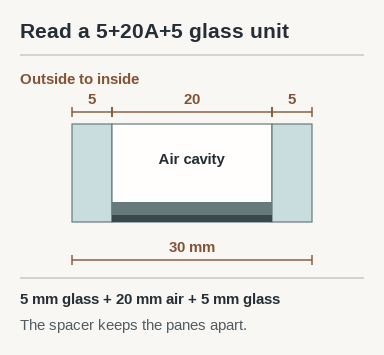
Two 5 mm panes with a 20 mm air cavity give a nominal unit thickness of 30 mm.
Change one variable in a 5 mm two-pane unit
| Glass configuration | Total (mm) | Total (in) | Change being compared | Thermal calculation input |
|---|---|---|---|---|
| 5+12A+5 | 22 | 0.866 | Baseline clear air-filled unit | Clear glass, 12 mm air |
| 5+16A+5 | 26 | 1.024 | Cavity increases by 4 mm | Same glass, 16 mm air |
| 5+20A+5 | 30 | 1.181 | Cavity increases by another 4 mm | Same glass, 20 mm air |
| 5 Low-E+12A+5 | 22 | 0.866 | Add the coating at the baseline gap | Coating emissivity and surface |
| 5 Low-E+12Ar+5 | 22 | 0.866 | Replace air in the coated unit | Same coating, specified argon concentration |
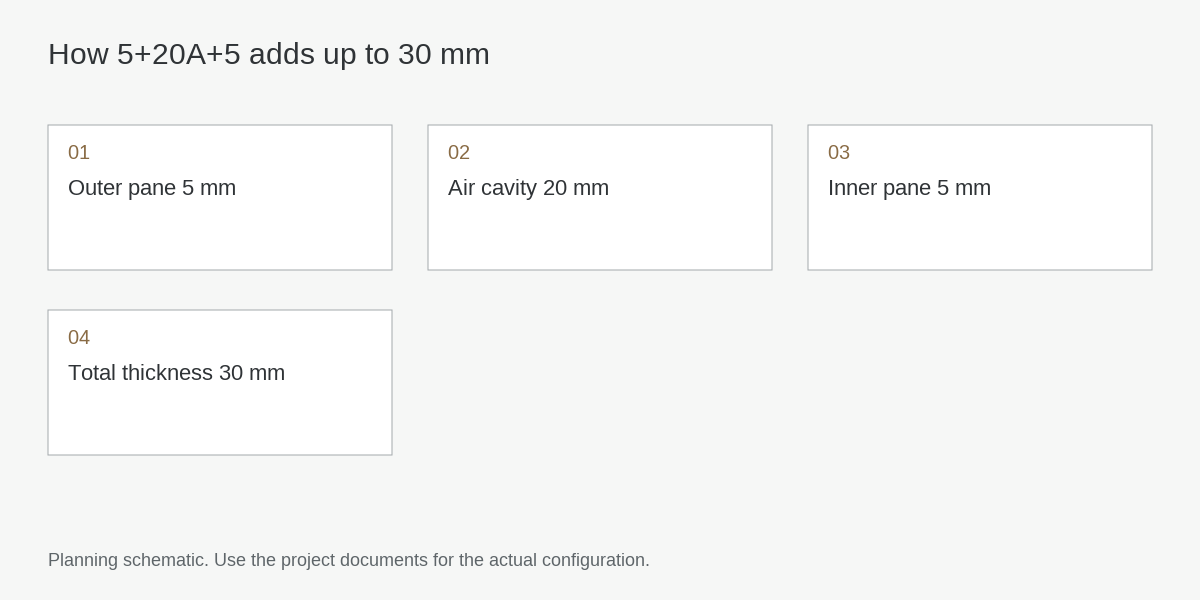
The cavity dimension occupies the space between the two glass panes.
Is 20A better than 12A or 16A?
For thermal selection, 20A has no automatic advantage over 12A or 16A because the optimum cavity changes with gas and calculation conditions. Gas circulation eventually offsets the benefit of increasing the separation. NGA gives typical nominal gaps of approximately 13 mm for air and 11–12 mm for argon, and explains that warmer calculation conditions can favour wider gaps. NGA cavity-gap guidance
A 5+20A+5 construction provides a 30 mm nominal unit for a frame designed to accept that thickness. Changing the cavity from 12 to 20 mm adds 8 mm to the unit without increasing glass thickness. The bead, gasket and glazing-pocket geometry must accommodate the resulting section.
Acoustic selection considers the assembled glazing, including pane thicknesses and any laminated interlayer. A 20A entry gives the cavity dimension. The acoustic rating belongs to the specified tested construction. The laminated versus toughened glass guide covers the pane choices that can be combined within an IGU.
What U-value can an air-to-argon change achieve?
In NGA's NFRC 100 example, changing air to 95% argon reduces centre-glass U-factor from 0.29 to 0.24 Btu/(h·ft²·°F) for the same 6.35/12.7/6.35 mm Low-E unit.
The published calculation uses outdoor 0°F, indoor 70°F, wind speed 12.3 mph and coating emissivity 0.04 on surface #2. The metric equivalents are approximately 1.65 and 1.36 W/(m²·K). NGA calculation table
A calculation for the five 5 mm constructions above needs its own coating properties, gas concentration, glazing orientation and boundary conditions. Ug describes the glazing's central region. Whole-window Uw also includes the frame and edge effects. The U-value and SHGC guide explains how those values fit the window selection. NGA energy-performance definitions
| NGA reference construction | Gas | Centre U, Btu/(h·ft²·°F) | Centre U, W/(m²·K) |
|---|---|---|---|
| 6.35 / 12.7 / 6.35 mm, Low-E #2 | Air | 0.29 | ≈1.65 |
| 6.35 / 12.7 / 6.35 mm, Low-E #2 | 95% argon | 0.24 | ≈1.36 |
Does Low-E belong on surface #2 or #3?
Count surfaces from outdoors. Surface #1 faces the weather, #2 faces the cavity on the outer pane, #3 faces the cavity on the inner pane, and #4 faces the room.
Solar-control Low-E commonly uses surface #2, and heating-oriented Low-E commonly uses surface #3. NGA describes #2 as the usual location when limiting solar gain and #3 when useful solar gain accompanies reduced radiant heat loss. The coating's optical properties still determine the resulting SHGC. NGA glazing manual, coating placement
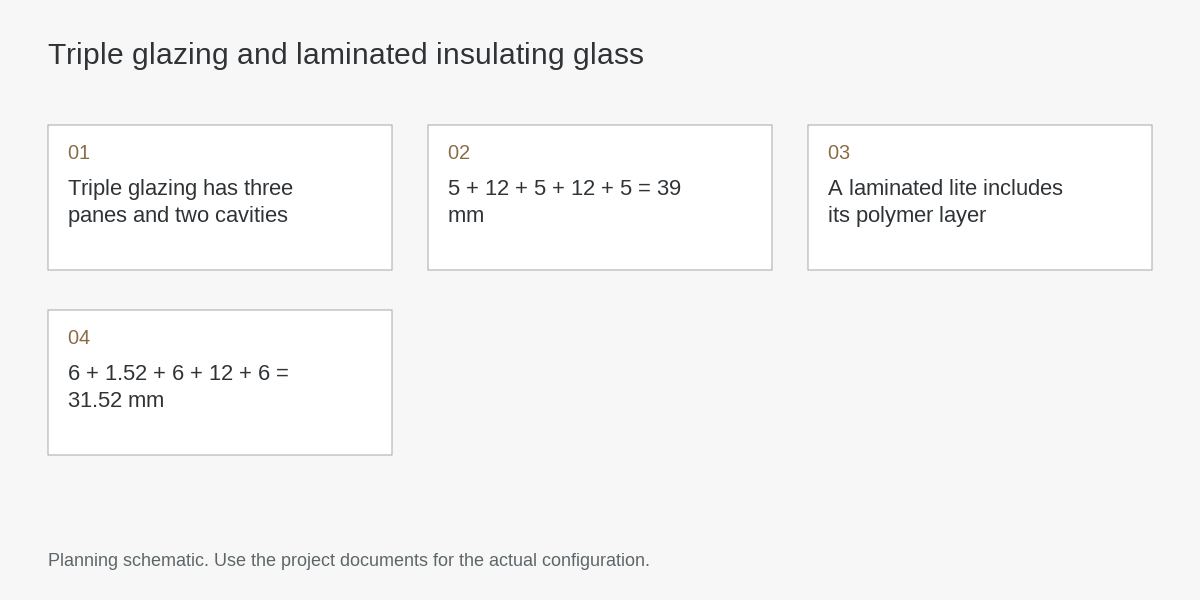
Two construction examples show how every solid layer and every cavity contributes to the nominal total.
Which metric unit is closest to US 1-inch glazing?
Among these 5 mm two-pane examples, 5+15A+5 totals 25 mm and is closest to US 1-inch glazing at 25.4 mm. The difference is 0.4 mm. The matching bead and gasket system still uses the manufacturer's specified glazing tolerance.
Nominal inch descriptions can conceal a different pane split. NGA's 1-inch calculation example uses two 1/4-inch panes and a 1/2-inch cavity, equivalent to 6.35+12.7+6.35 mm. Metric overall thickness and the individual layer schedule should therefore travel together when converting a US quotation.
Chinese technical tables also document a 5 Low-E+15A+5 construction, providing a 25 mm coated option. Shanghai glass-configuration table C.0.2
How do triple and laminated units change the sum?
Triple glazing adds a pane and another cavity. A published Chinese atlas construction, 5 Low-E+12A+5 Low-E+12A+5, totals 39 mm, or approximately 1.535 inches. It contains 15 mm of glass and 24 mm of cavity space. Atlas construction table
A laminated lite also adds its interlayer to the sum. The published construction (6+1.52PVB+6 Low-E)+12A+6 totals 31.52 mm, approximately 1.241 inches. The outer laminated group contributes 13.52 mm, the cavity 12 mm and the inner pane 6 mm. Parentheses make the bonded group clear. Chinese construction material schedule
Pane strength, safety and the final configuration
Large panels require thickness selection for their dimensions, edge support and design wind pressure. Toughening is one possible part of that design. Glass in doors and hazardous door-adjacent locations uses approved safety glazing, commonly toughened or laminated glass, according to the applicable impact provisions. England's Approved Document K section 5 describes critical locations and safe-breakage approaches. Impact safety guidance
For an opening sash, the glazing weight also affects the hardware selection. Retain the full outside-to-inside construction when comparing aluminium casement window options, so a change in coating or gas can be priced against the same pane sizes.
GB/T 11944-2025 is the current Chinese insulating-glass standard, published on 2 December 2025 and effective from 1 July 2026. Official SAMR record
FAQ
Does 5+20A+5 glass total 30 mm?
Yes. Two 5 mm panes plus a 20 mm air cavity total 30 mm nominally, approximately 1.181 inches.
Is 20A double glazing better than 12A or 16A?
A 20 mm cavity makes the unit thicker, but thermal improvement follows the gas and calculation conditions. NGA's typical nominal gap guidance is about 13 mm for air and 11–12 mm for argon.
What is the difference between 20A and 20Ar?
Both specify a 20 mm cavity. In the cited Chinese atlas notation, A means air and Ar means argon.
Can a laminated pane be used in a double-glazed unit?
Yes. The construction (6+1.52PVB+6 Low-E)+12A+6 totals 31.52 mm and combines a laminated outer lite with an air cavity and an inner pane.
Let YULUX review your drawings before pricing.
Send us your window schedule, floor plans or photos. We review opening sizes, system direction, glass, hardware, finish and packing scope before quoting.