
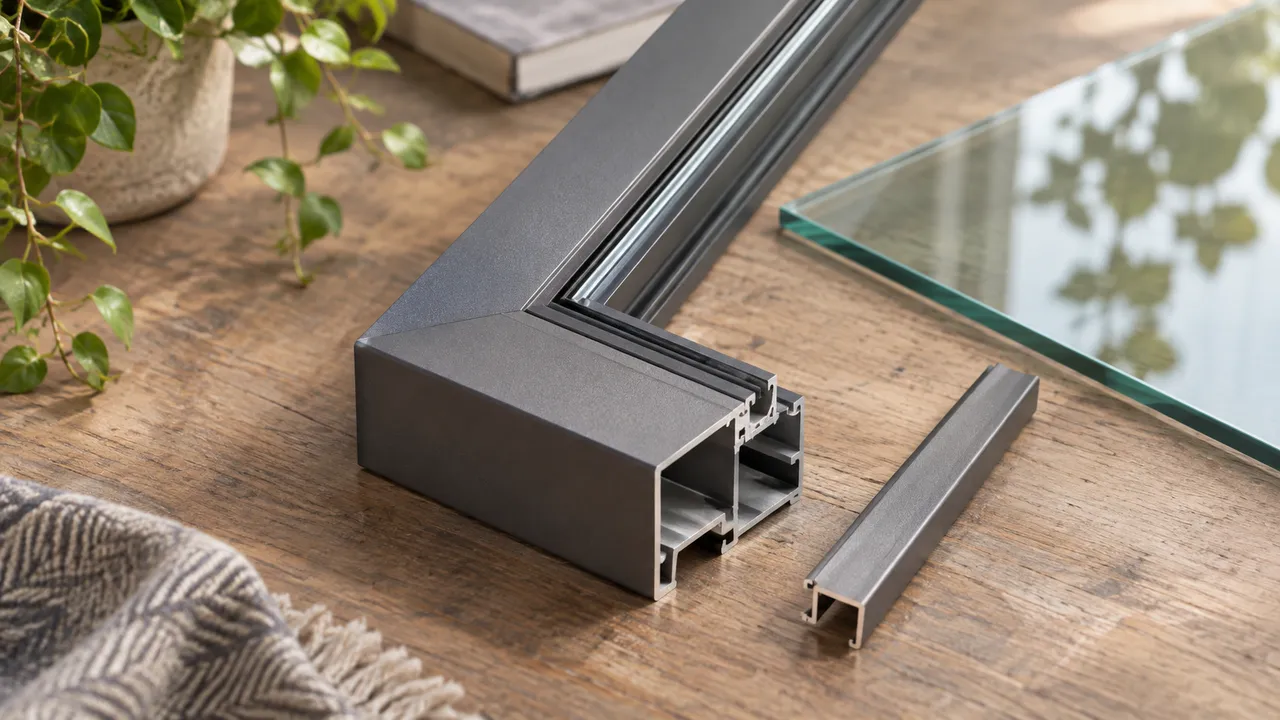
How to Replace Glass in an Aluminum Window and Keep the Frame
Glass-only replacement is suitable when the aluminium frame, sash and retaining parts remain serviceable. A 4 + 12 + 4 mm sealed-unit example totals 20 mm, while a 1 in unit is 25.4 mm thick, a 5.4 mm difference requiring compatible beads, gaskets and pocket depth. Identify the retaining system before ordering the replacement.
Glass-replacement diagnosis
| Symptom | First inspection | Likely replacement | Who handles it |
|---|---|---|---|
| Cracked glass | Impact point, glass edges and frame pressure | Single pane or complete sealed IGU | Local glazier |
| Mist inside the sealed cavity | Location of moisture and edge-seal failure | Complete sealed IGU | Local glazing repair company |
| Water on the room-facing surface | Humidity and surface temperature | Address condensation first | Occupant and ventilation technician |
| Binding after an earlier glass change | Setting blocks, sash alignment and rollers | Correct supports or damaged hardware | Window technician |
Is the glass broken, misted inside, or wet on the room side?
Moisture that wipes off the room-facing surface leads first to humidity and ventilation checks. Persistent moisture inside the cavity points to sealed-unit failure. The Glass and Glazing Federation repair guidance describes replacement of the failed sealed unit.
An IGU combines panes, spacer and edge seals into one sealed assembly. Replace that complete unit when one of its panes breaks.
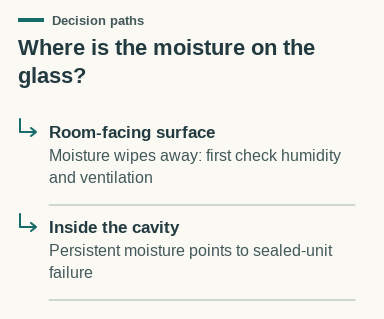
Where is the moisture on the glass?
Can the existing aluminum frame stay?
A square, securely fixed frame with sound joints and compatible glazing parts can stay during glass-only replacement. A distorted rebate, failed joints or damaged retaining channel can make sash or complete-window replacement the better route, as the retrofit double glazing and full-window replacement guide explains.
How do you measure replacement glass in an aluminum window?
The order needs glass width, height and overall thickness, plus the required safety treatment, coating, tint and cavity specification. Measure to the actual glass edges or use the documented glazing-pocket dimensions and system clearances. The daylight opening hides glass behind the bead and gives an incomplete cutting dimension.
Use the system drawing for edge clearance, glass overlap and support positions. The replacement order also identifies the outdoor face and coating orientation. Order heat-treated glass at its finished size because the NGA fabrication guidance, Section 10, places cutting, drilling and edge fabrication before heat treatment.
How do you take apart an aluminum sliding window sash to replace the glass?
A glazier should handle broken, heavy, elevated or structurally bonded glass with suitable equipment. The following bench sequence is limited to the removable sliding sash and snap-in glazing-bead construction documented in one supplier's identification guide.
1. Identify the retaining profile, sash-removal arrangement and replacement glass specification. Release the documented anti-lift parts or stops, support the sash and move it to a stable padded bench.
2. Support the glass and disengage the bead retaining leg from its sash groove using the appropriate tool. Label each recovered strip by position and compare its section with the replacement strip.
3. Release the bedding seal while supporting the pane. Lift out the glass assembly and mark the setting-block positions. Keep reusable gaskets and corner components with their original sash.
4. Clean the seating surface and inspect the grooves, joints and seals. Measure the exposed glass and verify the replacement width, height, thickness and build-up against the order.
5. Fit compatible bedding materials and the specified supports, then seat the replacement glass. Restore matching gaskets and beads with full engagement around the perimeter.
6. Refit the sash, stops and anti-lift parts. Check full travel, locking, glass support and drainage outlets, and allow fresh sealants to cure for their specified time.
The identified sash construction determines how its corners and gaskets are released. A snap-in bead releases from a groove. A screw-assembled, gasket-wrapped sash needs its own system dismantling instructions. If movement remains stiff after glazing, the sliding-door movement troubleshooting guide helps distinguish roller, track and alignment symptoms.
What changes when replacement glass is heavier or in a safety location?
For this mass calculation, assume 1.0 × 1.2 m panes, two 5 mm float-glass sheets and density approximately 2,500 kg/m³, excluding the spacer, seals and sash.
Glass mass is approximately 1.0 × 1.2 × (5 + 5) × 2.5 = 30 kg, or about 66 lb. Add the spacer, seals and sash when assessing the moving assembly and hardware load. Increasing thickness changes both the glazing fit and the weight carried by the supports.
An article republished by the Shanghai Silicate Industry Association, credited to Glass Industry Network, describes setting blocks at least 5 mm thick, about 100 mm long and 2 mm wider than the glass thickness in section 2.1. The particular sash system determines its support layout.
For US projects, the IRC R308.4 hazardous-location provisions govern safety glazing at specified locations. Select the replacement safety-glass specification against the adopted code and the actual opening. In England, Approved Document K, Diagram 5.1, includes window glazing within 800 mm of floor level among critical locations, with compliance routes in paragraph 5.2. The laminated and toughened glass comparison explains the material choices.
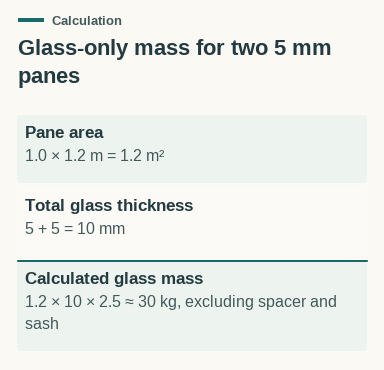
Glass-only mass for two 5 mm panes
What does aluminum-window glass replacement cost in the US?
Angi's September 2026 guide lists USD 181–414 for professional standard double-pane replacement. HomeGuide's February 2026 guide lists USD 300–650 per window across its repair mix. Their project scopes differ. Angi double-pane repair survey HomeGuide window-glass costs
A repair estimate should itemize the glass, fitting labour, replacement beads or gaskets, access equipment, disposal and emergency protection. Larger safety-glass assemblies and upper-floor access change handling costs. Include taxes and any temporary boarding in the total.
A measured replacement IGU can require a survey followed by a later fitting visit. Agree who protects the opening between visits and whether installation labour is covered by the repair warranty. Compare the complete repair scope with a replacement aluminum sliding window when damaged sash components also need renewal.
FAQ
Can you replace only the glass in an aluminum window?
Yes, retain a serviceable frame and sash with compatible glazing parts, replacing the complete failed IGU to size and safety requirements and checking the 5.4 mm thickness increase if changing from 20 mm to 1 in.
Do all aluminum windows use the same glass edge clearance?
The clearance comes from the particular glazing system and its cutting-size instructions. Measure the actual glass or use the documented pocket dimensions and allowances before ordering.
Can a 1 inch IGU replace a 20 mm unit?
A 1 in IGU is 25.4 mm thick, which adds 5.4 mm to a 20 mm unit. Its fit needs compatible beads, gaskets, pocket dimensions and supports.
Let YULUX review your drawings before pricing.
Send us your window schedule, floor plans or photos. We review opening sizes, system direction, glass, hardware, finish and packing scope before quoting.