
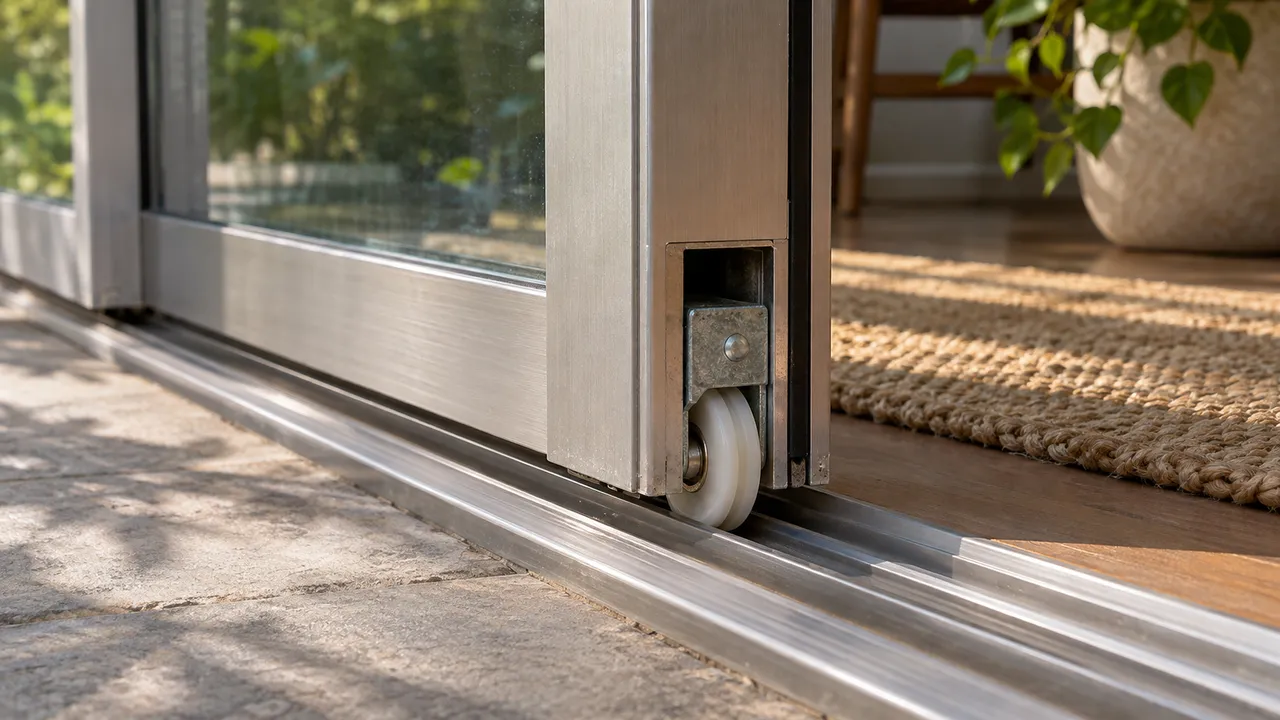
Fix a Sliding Door That Is Hard to Slide: Track, Rollers and Load
Clean the track, check the jamb gap and inspect the rollers when a sliding door becomes hard to move. A 1.2 × 2.4 m panel with two 5 mm panes contains an estimated 72 kg of glass, or 87 kg with the worked 15 kg frame-and-hardware allowance.
The details behind the answer
That load makes the roller rating and supported sill part of the repair decision. NGA glass-density basis
Which symptom determines the first repair?
| Symptom | Check first | Replace if damaged | Who does it? |
|---|---|---|---|
| Heavy throughout travel | Track dirt, bottom clearance and roller rotation | Matched roller assemblies | Owner cleans, technician services rollers |
| Stops at one location | Grit, dent or raised track edge | Compatible track cap | Owner clears dirt, technician repairs track |
| Slides well but will not latch | Jamb gap and keeper alignment | Worn keeper or lock component | Installer or service technician |
| Changes between winter and summer | Ice, seal contact, frame alignment and sill support | Damaged seal or distorted component after diagnosis | Owner checks exposure, installer checks geometry |
| Track is visibly flattened | Running ridge and support underneath | Track cap or sill assembly | Service technician |
| Only the insect screen sticks | Screen guide, corner rollers and mesh interference | Compatible screen roller, guide or damaged mesh | Owner cleans, screen technician adjusts |
How do you clear the track without masking the fault?
Move the panel gently to expose the accessible track. Brush loose grit into a vacuum nozzle, then wipe remaining dirt with mild soapy water, rinse carefully and dry. Clear the drainage outlets as well. The dry-brush and vacuum method is included in the Fenestration and Glazing Industry Alliance’s care guidance.
Run the door again and note the position of any remaining resistance. A repeat hard spot directs inspection to that section of rail. Persistent roughness throughout travel directs inspection to rolling parts and clearance. Treat these as inspection routes, with component condition deciding the repair.
Construction grit and unsupported sills need attention before new rollers go in. Sliding-door sills should be straight, level and fully supported according to the Australian Glass and Window Association’s residential installation guide.
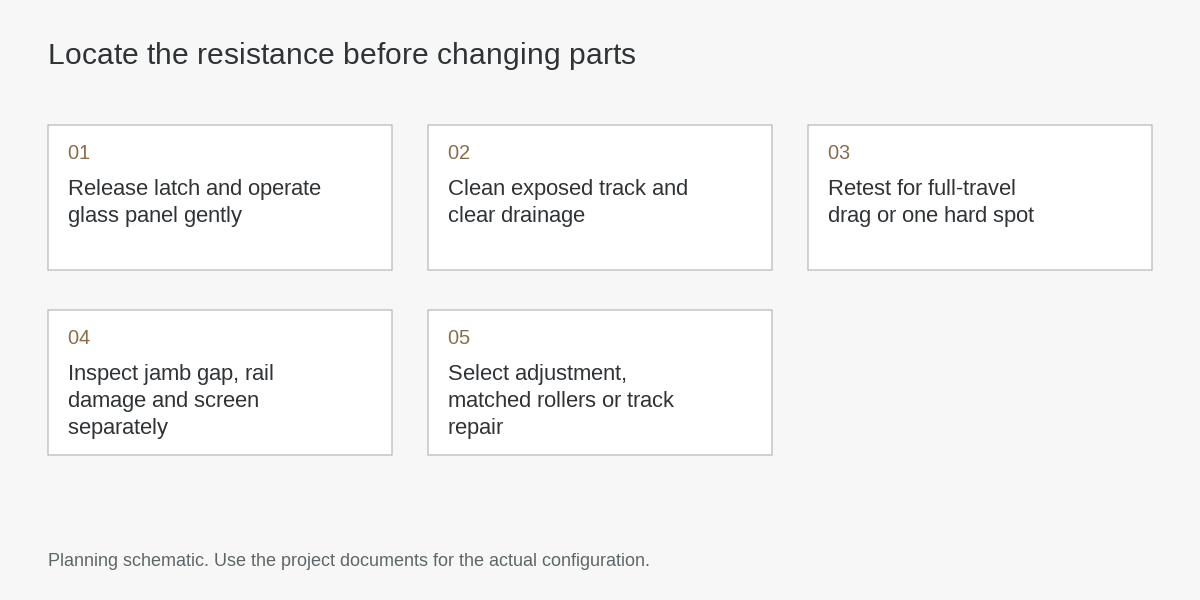
Separate glass-panel, latch and screen faults while the panel stays installed.
Where are the roller screws, and which way should they turn?
One wood patio-door manual specifies a hand screwdriver and 1/4-turn adjustments for its covered sliding/gliding arrangement, with the panel supported and the roller unloaded. Use the specified manual tool for this procedure. Its access holes are near the lower face or end of the moving panel, sometimes behind caps.
In that wood-door procedure, clockwise rotation lowers a face-adjusted panel with a plus sign or no sign, and a minus sign reverses the direction. Clockwise rotation raises its end-adjusted panel. Work in small increments until the bottom clears the sill and the jamb gap is even from top to bottom, then check the latch receiver.
Lift-and-slide mechanisms require their own hardware procedure. Keep tilted, unstable or off-track glass panels stationary for qualified service. Concealed roller replacement belongs in the separate sliding-door roller replacement procedure.
Should the track stay dry, or receive silicone lubricant?
One door maker's gliding-patio-door care guide applies dry spray to the rollers through the adjustment opening and keeps the track clean and dry. The guide excludes oil-based lubricants for that assembly. Use only a dry lubricant approved for the installed door and application point.
Use dry silicone only where the installed product’s care instructions specify it. A dry PTFE spray also needs explicit approval for the assembly and application point. Moving-hardware maintenance follows the product instructions in the Fenestration and Glazing Industry Alliance guidance.
Clean first, apply any approved lubricant sparingly, and wipe away overspray. A damaged running ridge or cracked wheel still requires repair when movement remains rough. Record the lubricant used with the door’s service history so the next visit starts from the actual treatment.
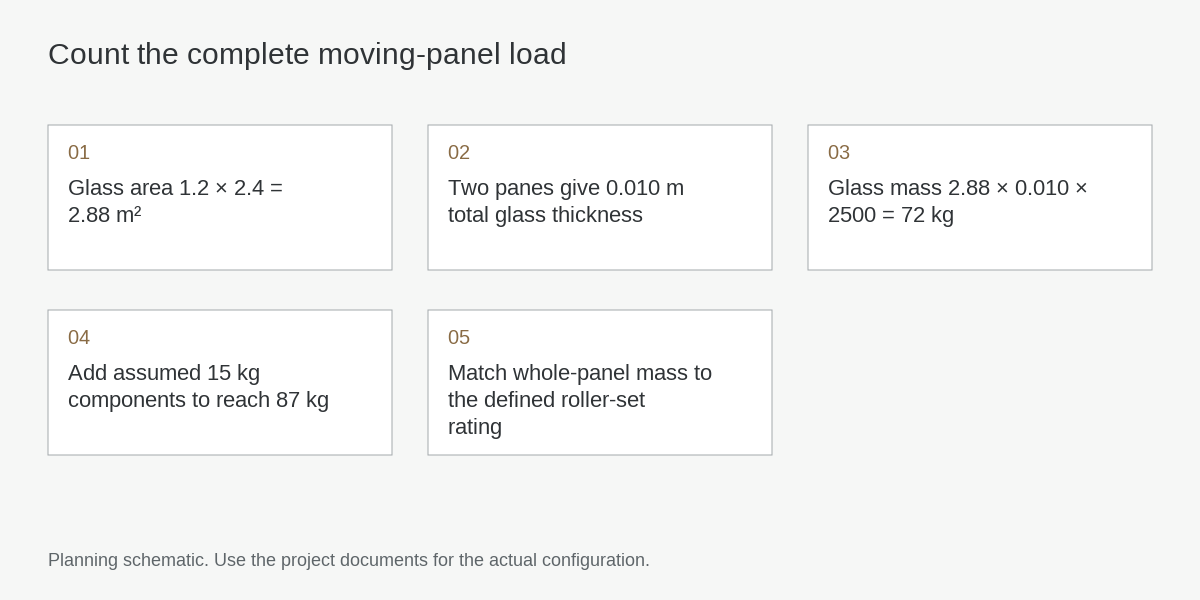
Worked estimate for two 5 mm panes using a 1.2 × 2.4 m estimating area.
Can an 87 kg door overload its replacement rollers?
Assumptions: a nominal 1.2 × 2.4 m (3.94 × 7.87 ft) panel, its full envelope used as the glass estimating area, two 5 mm glass panes separated by a 20 mm air cavity, an estimated 15 kg allowance for frame, hardware, spacers and seals, and two roller assemblies sharing the load equally.
The 5+20A+5 glass estimate is 72 kg (159 lb), and the added 15 kg allowance gives an estimated 87 kg (192 lb) panel. The glass calculation uses 1.2 × 2.4 × 0.010 × 2500, applying the 2500 kg/m³ flat-glass density stated by the National Glass Association.
| Load component | Calculation or allowance | Estimated mass |
|---|---|---|
| Two glass panes | 2.88 m² × 0.010 m × 2500 kg/m³ | 72 kg / 159 lb |
| Frame, hardware and remaining components | Assumed allowance | 15 kg / 33 lb |
| Complete panel | 72 + 15 | 87 kg / 192 lb |
| Each roller under equal static sharing | 87 ÷ 2 | 43.5 kg / 96 lb |
What does a roller’s capacity actually cover?
One Chinese standard-sliding roller catalogue lists a 12 mm body width, 22 mm minimum height, 7 mm adjustment and 90 kg load capacity for a single model, with the per-wheel, per-carriage or per-set rating basis unspecified. Confirm that basis and match the profile interface before selecting a replacement.
Assumptions: a catalogue explicitly defines a 90 kg rating as the capacity of one complete two-roller set. The set then carries 90 kg in total, leaving 3 kg above the estimated 87 kg panel. A rating expressly stated per roller would require the manufacturer’s paired-assembly conditions before assigning a combined capacity. A per-set rating read as per-roller can cause repeated failures, while an undiagnosed rail or installation defect can produce the same symptom.
Use actual glass cut sizes and the finished panel mass for hardware selection. Unequal support, a dented rail, poor adjustment and an incompatible wheel profile all merit inspection when replacement rollers deteriorate again. Preserve glass changes in the service record using the aluminium-frame glass replacement guide.
When should a track cap or the complete door be replaced?
A replaceable cap with dents or deep wear can be renewed with the correct matching profile. Inspect the supporting sill before fitting it, because a new running surface needs stable support. A flattened structural sill, distorted frame, unavailable compatible parts or damage extending through several assemblies calls for a complete-system assessment.
Operate the screen separately to isolate screen drag from glass-panel drag. Screen rollers and guide systems have their own adjustment method, covered in the insect-screen guide. For a wider opening redesign, use the sliding-versus-bifold comparison.
What spare rollers should an importer order with sliding doors?
Order matched service sets identified by the production part code, profile interface, wheel diameter and shape, mounting-hole positions, adjustment access and stated load basis. Separate glass-panel rollers from insect-screen parts. Include matching fasteners and any replaceable track caps in the parts schedule, with photographs showing the scale and installed position.
What should the door do before you call it fixed?
- Travel through the normal opening without a repeat hard spot, scraping or grinding.
- Remain seated and stable in its running and upper guides.
- Meet the jamb with an even closing gap and latch normally.
- Leave drainage outlets clear and weatherstripping correctly seated.
- Allow the insect screen to move independently without catching the glass panel.
FAQ
How often should a grit-exposed patio-door track be cleaned?
One door maker's gliding-patio-door care schedule specifies cleaning at least every 12 months, increasing to at least every 3 months in coastal, industrial or agricultural exposure. For the installed door, follow its own care schedule and remove grit when it causes rough travel.
Does the 1/4-turn adjustment apply to an aluminium lift-and-slide door?
The 1/4-turn procedure is specifically for a wood patio door with the covered sliding/gliding roller arrangement. An aluminium lift-and-slide door follows its own carriage and lifting-mechanism instructions.
Does 5+20A+5 glass alone weigh 87 kg at 1.2 by 2.4 metres?
The two 5 mm panes calculate to 72 kg at that estimating area and a density of 2500 kg/m³. The 87 kg panel estimate includes a further assumed 15 kg for the frame, hardware and remaining components.
Let YULUX review your drawings before pricing.
Send us your window schedule, floor plans or photos. We review opening sizes, system direction, glass, hardware, finish and packing scope before quoting.