
Replace Sliding Door Rollers From Fault Report to Dealer Handover
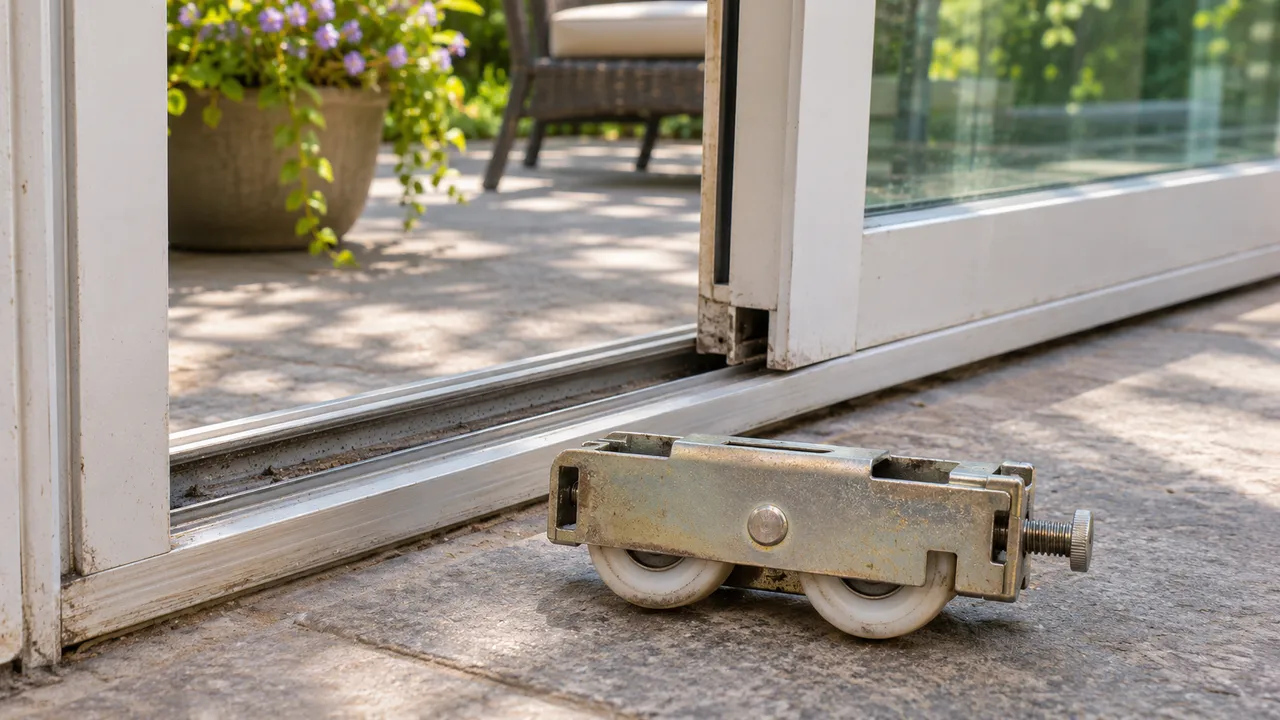
Match a replacement sliding-door roller to the rail-contact profile, complete housing and fixing positions; matching wheel diameter alone leaves the housing and installation fit unresolved.
At intake, does the door need new rollers?
Stop forcing the handle when the leaf catches. Note whether resistance occurs at one rail location or throughout the travel, then use the fault table below.
Chinese manufacturer maintenance guidance warns that excessive lubricant attracts dirt and that over-turning adjustment screws can damage the roller or other components. Use the specified lubricant only at the permitted points. The Chinese guidance concerns older aluminium-window rollers, so its maintenance cautions support fault triage without defining a patio-door dismantling method.
| Observed symptom | First action | Repair route |
|---|---|---|
| Grit visible along the running rail | Clean accessible track using the system’s maintenance method | Retest before ordering rollers |
| Leaf rubs at its lower edge, with uneven jamb clearance | Inspect permitted adjustment and leaf alignment | System-trained technician adjusts within the available range |
| Grinding persists on a clean, sound rail | Inspect bearings, wheel tread and housing | Replace a damaged or seized assembly |
| Binding at one rail location or visible leaf/frame distortion | Inspect rail damage, frame alignment and glazing support | Correct the structural or track fault before final roller setting |
Before ordering, which roller measurements must match?
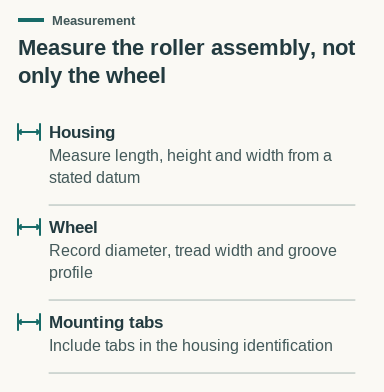
Identify the complete housing, including its mounting tabs. Measure housing length, height and width against a stated datum. Record wheel diameter, tread width, groove shape and depth, axle arrangement, and whether the housing contains a single wheel or a tandem pair. Add fixing-hole centres, screw thread and access direction to the sketch.
One published tandem replacement has 2 concave steel ball-bearing wheels of 31.75 mm diameter in a housing 28.575 mm high and 19.05 mm wide. Its mounting tabs, fixing layout and housing length still require a drawing or removed-part comparison.
Photograph the old part beside a scale from the side, end and underside after authorised removal. Include any stamped code in the dealer record. A front-facing photograph hides the housing depth and attachment features that often decide whether a part fits.
The wheel groove must seat correctly on the rail crown. A similar outside diameter can conceal a different contact profile. A tandem unit also needs clearance for its full housing and movement. For wider track and drainage interfaces, use the separate track guide. Large sliding door track and drainage guide
Measure the roller assembly, not only the wheel
Can the replacement carry the complete glazed leaf?
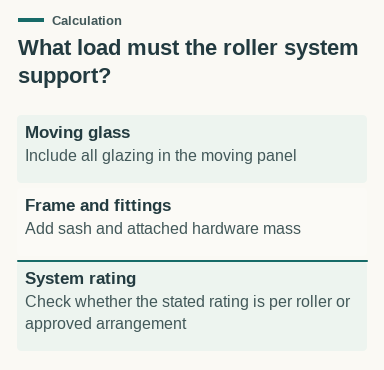
Use the complete moving-leaf mass, including glass, frame and attached hardware, together with the system’s approved roller arrangement. Establish whether the stated capacity applies to a wheel, one housing, a pair or a complete system. Keep that unit beside the capacity in the parts record.
Record the minimum and maximum installed heights and the permitted loaded adjustment range. The proposed assembly needs enough adjustment to restore sill clearance and latch alignment while retaining the required head engagement and seals. Where those values are missing, hold the substitution for a system-specific technical decision.
What load must the roller system support?
What happens while the replacement parts are in transit?
Keep the opening secure throughout identification and procurement. If the technician judges the original assembly safe for temporary reinstatement, restore the leaf and its restraints using the system procedure, then record any operating restriction. A door with unstable support needs restricted access and a safe temporary closure arranged locally, with required escape access preserved.
Which replacement sequence applies to a removable head-track door?
This is one documented removable-head-track/panel-stop and screw-fixed-roller arrangement, not a universal sliding-door removal method. Match the actual retaining construction before using its sequence. The separate tandem-roller size example does not establish compatibility with this door.
Support the panel throughout removal and installation. Provide enough people capable of safely lifting and carrying it. HSE identifies handling injuries and falling objects as glass-work hazards. HSE glass and glazing safety
Roller fixing screws secure the housing. The separate adjustment screw faces indoors. Head-track screws retain the upper track/stop.
1. Open the leaf, remove the exposed head-track screws and save them. Close and lock, remove and save the remaining head-track screws, then reopen halfway.
2. Support and tilt the leaf top and head-track stop inward. Remove the stop, lift out the leaf and lay it interior-face-up on a flat surface.
3. Save roller fixing screws, extract old rollers with needle-nose pliers, insert replacements with adjusters indoors and refasten.
4. Centre the leaf in the frame with its rollers on the sill track and its top tilted slightly inward. Place the head-track/panel-stop on top of the leaf with the stop facing indoors, then tip the leaf top back into the frame.
Glazing retention stays assembled through this sequence. Other removal structures and lift-slide doors need their own system manuals.
When is the repaired door ready for handover?
Close and lock, refasten the stationary-side head track, reopen and refasten the operating side. Finally close, lock and check lock operation. The technician verifies that the upper retaining track/stop is reinstated before handover.
Run the leaf over its full travel and revisit the original catching points. Check for scraping, instability, latch engagement, seal contact and drainage clearance. For doors with additional anti-lift components, the local technician records their reinstatement and any prescribed setting against that door’s own instructions.
A lock that needs the leaf pulled upward still points to an alignment problem. Revisit support and setting before changing the keep position. Record the fitted part reference, technician’s final setting and any track repair against the opening ID, then save a movement video from the same viewpoint as the intake record.
FAQ
Should both roller assemblies be replaced together?
For a door using a paired support arrangement, assess both assemblies and follow its replacement instructions. Matching the wear condition and adjustment capability helps avoid leaving the new assembly to compensate for a worn partner.
Can I order a roller using only the wheel diameter?
The housing, fixings, wheel groove, rail profile and adjustment range must also match. The published 1-1/4 in wheel example has a 3/4 in-wide housing, so wheel size alone leaves an important fit dimension unresolved.
How long does a sliding door roller replacement take?
Schedule the job after identifying the assembly and access method. Parts delivery, safe handling, track condition and any temporary closure determine the service timeline. Separate the identification visit from the fitting visit where the old part must first be exposed.
Let YULUX review your drawings before pricing.
Send us your window schedule, floor plans or photos. We review opening sizes, system direction, glass, hardware, finish and packing scope before quoting.