
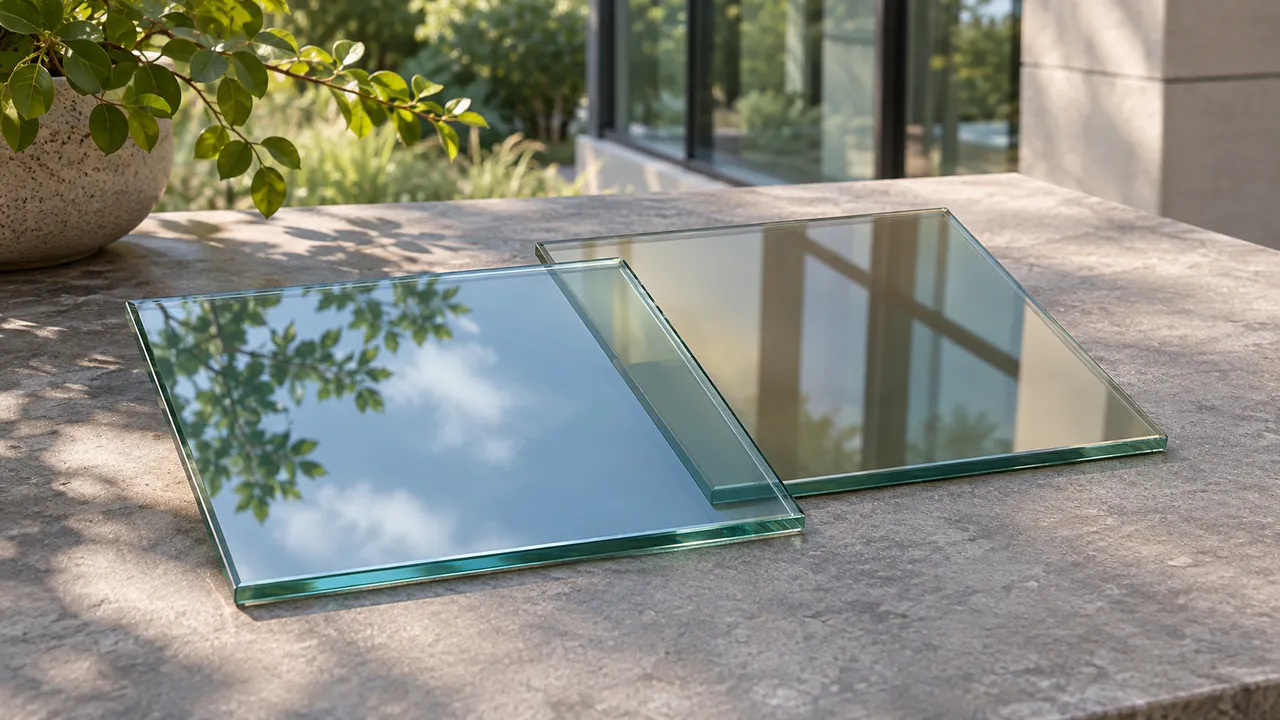
Soft Coat vs Hard Coat Low-E Glass for Window Orders
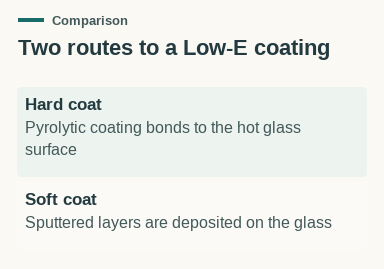
Hard-coat Low-E uses online pyrolytic deposition, while soft-coat Low-E uses offline vacuum sputtering. For products covered by the cited December 2020 magnetron-coating processing guide, final-cut sheets must be processed within 48 hours of pack opening, with storage humidity at most 70% and temperature at least 15°C.
What changes when the coating process changes?
Low emissivity describes the coating's control of long-wave radiant heat exchange. The manufacturing route also affects how the glass moves through cutting, heat treatment and insulating-unit assembly. A purchase described only as Low-E leaves both the optical selection and the processing route unresolved.
SYP's online solar-control hard-coat family uses high-temperature chemical vapour deposition and supports monolithic use, storage, cutting, edgework, toughening and bending. SYP online coating family
SYP's offline family uses vacuum magnetron deposition with silver-containing multilayers and includes selected products suitable for further processing at another factory. The exact coating and final heat-treatment state determine the stock needed for fabrication. SYP offline coating family
Two routes to a Low-E coating
How do SHGC, U-value and visible transmission change the choice?
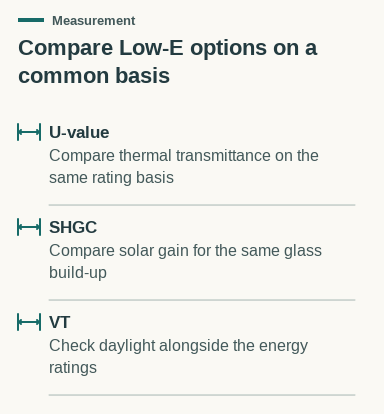
Start with the building's solar-gain and daylight targets. Lower SHGC reduces admitted solar heat, lower U-value reduces heat transfer, and higher visible transmittance admits more daylight. A cooling-led elevation and a winter-sun-facing elevation can justify different solar-gain choices. ENERGY STAR performance-rating definitions
Run the coating alternatives through the same glazing calculation, keeping pane thickness, substrate colour, cavity, gas concentration, coating position and calculation method fixed. State U-value in W/m²K or Btu/h·ft²·°F consistently. Keep SHGC and VT in the same fraction or percentage convention across both columns.
Visible clarity also needs a product-level comparison. Read VT with reflected colour and the finished sample, since a soft-coat label alone supplies no daylight percentage or appearance guarantee. For a heating-led room, evaluate useful winter solar gain alongside summer shading. For a cooling-led room, evaluate solar control alongside the daylight needed inside.
Keep glazing-only ratings separate from whole-window ratings. Frame area, frame sections and edge spacers contribute to the finished window's U-value.
SYP describes lower SHGC across its single-, double- and triple-silver options at approximately matched visible transmission. Select the actual coating and glazing build-up using its U-value, SHGC and VT. SYP offline glass range
Compare Low-E options on a common basis
Can the selected Low-E glass be toughened?
The cited magnetron-coating processing guide separates annealed-only, mandatory-heat-treatment and either-state families. Allocate the exact covered product and its exclusions before heat treatment.
Put the final glass treatment on the schedule before the fabricator allocates stock. A design change from annealed to toughened glass can require a companion coating product and a new optical check. Where adjacent openings mix treatments, review the finished samples together under the intended viewing conditions.
What happens to storage time after opening a pack?
When coating and insulating-unit assembly occur in different factories, schedule transfer and receiving within the selected product's processing window. Opening a final-cut pack starts the deadline given in the guide.
Which edges and glass surfaces need special treatment?
The magnetron-coated products covered by that guide require coating removal at the insulating-unit seal area, with the width set by the seal design and application. one glass maker's cited pyrolytic coating families require no edge deletion. the coated-glass processor edge-deletion guidance the glass maker pyrolytic coating guidance
Match the coating, edge-deletion width and sealant to the glass processor’s approved system. Locate the seal footprint and visible sightline on the fabrication drawing. Use the system’s adhesion procedure to assess the prepared edge.
Number double-glazing surfaces from outdoors towards the room. Surfaces 2 and 3 face the cavity, while surface 4 faces the room. Place a conventional protected-cavity coating in its approved cavity position.
One published UK interior-surface Low-E family permits surface 4 in double glazing, requires heat treatment and specifies no edge deletion. Its exposed-surface instructions apply only to that identified coating family.
Which option suits the production route?
Choose a durable hard-coat family when its optical and thermal results meet the project target and its handling route fits the intended fabrication. Its processing flexibility can matter for distributed production, mixed shapes or small replacement orders.
Choose an appropriate soft-coat family when its measured solar control, daylight and insulation combination better serves the elevation, and the processing chain supports that family. Price the finished assembly with its required treatment, coating protection and edge work.
FAQ
Does triple-silver Low-E automatically give the lowest U-value?
Silver-layer count does not determine the complete glazing U-value. Select the coating against the stated build-up and evaluate SHGC and VT alongside thermal performance.
Is Low-E glass the same as tempered glass?
Low-E describes a heat-control coating. Tempered glass describes heat treatment for a particular strength and breakage behaviour. A specified pane can combine both when its coating product supports the required treatment.
Will hard-coat Low-E always admit more solar heat?
Hard-coat families include solar-control products. Use the SHGC for the selected coating and glass construction to decide how much solar gain the opening will admit.
Let YULUX review your drawings before pricing.
Send us your window schedule, floor plans or photos. We review opening sizes, system direction, glass, hardware, finish and packing scope before quoting.