
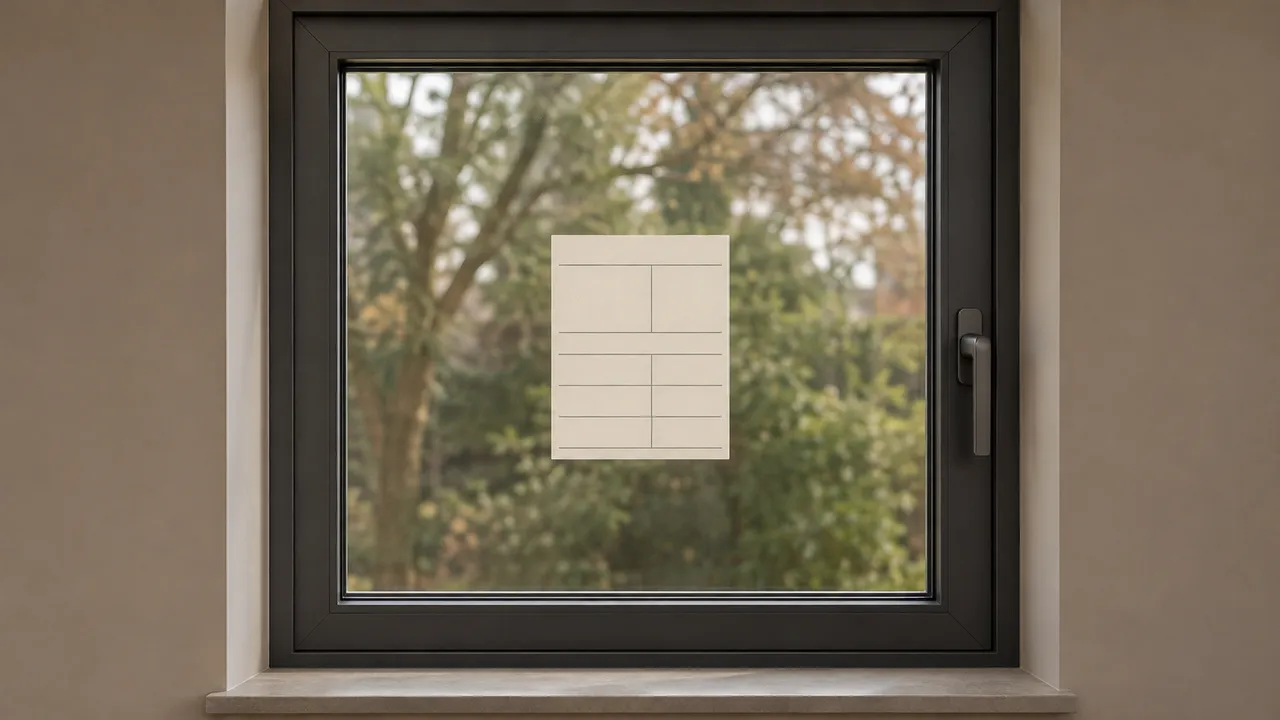
NFRC Label Explained with Ratings, Units and CPD Lookup
An NFRC label explains whole-window heat transfer through U-factor, solar gain through SHGC and daylight through VT, with SHGC and VT expressed on 0–1 scales. A US U-factor of 0.30 Btu/(h·ft²·°F) converts to 1.70 W/(m²·K) using NFRC's 5.678263 multiplier and two-decimal rounding. Lower U-factor reduces heat transfer, while SHGC and VT express separate solar-heat and daylight fractions. NFRC metric-label conversion
Which ratings should I see on the sticker?
The Efficient Windows Collaborative explains that NFRC is the National Fenestration Rating Council, an independent nonprofit certification body. Its core energy ratings are U-factor, SHGC and visible transmittance, or VT. Air leakage and condensation ratings are optional under NFRC 700-2026 E0A0, sections 4.1–4.2.
NFRC’s program-document transition replaced NFRC 700 with the 7000 series from 29 May 2026, subject to stated exceptions. Existing certifications continue for their certification cycles. For current certification paperwork, confirm the applicable 7000-series documents with the certifier.
The product description on the Official NFRC label example identifies the frame and opening type. Its Certified Products Directory number connects the sticker to a rated configuration, with standardized environmental conditions and product size.
What changes when one label value changes?
Assumptions: equal product area, rating method and environmental conditions, changing only the stated metric.
At equal area and temperature difference, reducing U-factor from 0.30 to 0.25 reduces temperature-driven window heat flow by 16.7%. Using the EPA performance definitions, the calculation is (0.30 − 0.25) ÷ 0.30. Annual energy use also includes solar gains, ventilation and the rest of the building.
SHGC 0.30 admits 30% of incident solar energy under the rating definition. Lower SHGC helps solar-heat control, while useful winter solar gain can favour a higher value. The U-value, SHGC and Low-E guide connects the ratings to glazing choices.
| Metric changed | First value | Second value | Reading the difference |
|---|---|---|---|
| US U-factor | 0.30 | 0.25 | 16.7% less temperature-driven heat flow |
| SHGC | 0.40 | 0.25 | Solar-gain fraction falls by 0.15 |
| VT | 0.45 | 0.60 | Visible-light fraction rises by 0.15 |
| AL | ≤0.3 cfm/ft² | ≤0.3 cfm/ft² | Equal stated upper bounds, with no ranking within them |
| CR, same method | 50 | 65 | Resistance index rises by 15 points |
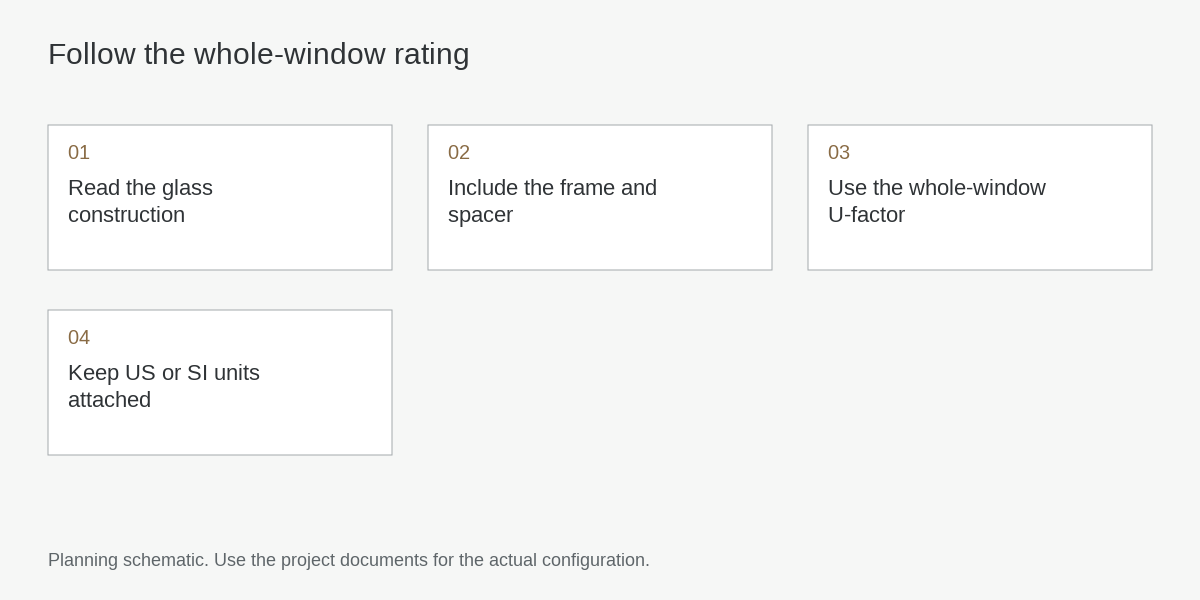
Heat passes through the glass, frame and edge assembly together.
Read each number in its own units
| Label field | Units or scale | What the direction means | Buyer use |
|---|---|---|---|
| U-factor | Btu/(h·ft²·°F) in US units | Lower transfers less heat | Compare insulation |
| SHGC | 0–1 | Lower admits less solar heat | Balance cooling and useful winter sun |
| Visible transmittance, VT | 0–1 | Higher admits more daylight | Compare brightness |
| Air leakage, AL | cfm/ft² | Lower passes less air through joints | Compare tested airtightness |
| Condensation resistance, CR | 1–100 | Higher resists interior condensation better | Compare surface-temperature performance |
Does the U-factor cover the frame and glass?
The Efficient Windows Collaborative explains that the NFRC whole-window rating includes glazing, frame and edge effects. A centre-glass value describes the glazing portion of that assembly. Keep the same scope when comparing complete-window offers.
Ningxia’s published reference table gives 6Low-E+12A+6 glass a Kg of 1.8 W/(m²·K) and its thermally broken aluminium window a whole-window K of 2.3 W/(m²·K). Under DB64/521-2022, Table B.0.4 and notes, the frame Kf is 2.7 W/(m²·K), with ordinary aluminium spacers and a thermal break at least 20 mm wide. Replacing air with argon changes Kg to 1.6 and whole-window K to 2.2.
The 5+20A+5 glazing notation guide explains another pane-and-cavity build-up. Match each build-up to its own whole-window rating.
| Chinese reference construction | Glass Kg, W/(m²·K) | Whole-window K, W/(m²·K) |
|---|---|---|
| 6 Low-E + 12 mm air + 6 | 1.8 | 2.3 |
| 6 Low-E + 12 mm argon + 6 | 1.6 | 2.2 |
Use the U-value converter to compare US and metric units. A unit conversion does not change the rated whole-product configuration or establish compliance.
How do I convert a US U-factor into W/(m²·K)?
A US U-factor of 0.30 Btu/(h·ft²·°F) converts to 1.70 W/(m²·K), using NFRC’s multiplier of 5.678263. The NFRC 700-2026 E0A0 metric-label rule starts with the two-decimal US rating and rounds the converted result to two decimals. SHGC and VT retain their dimensionless values.
| US U-factor | Calculation | SI U-factor, W/(m²·K) |
|---|---|---|
| 0.25 | 0.25 × 5.678263 | 1.42 |
| 0.30 | 0.30 × 5.678263 | 1.70 |
| 0.40 | 0.40 × 5.678263 | 2.27 |
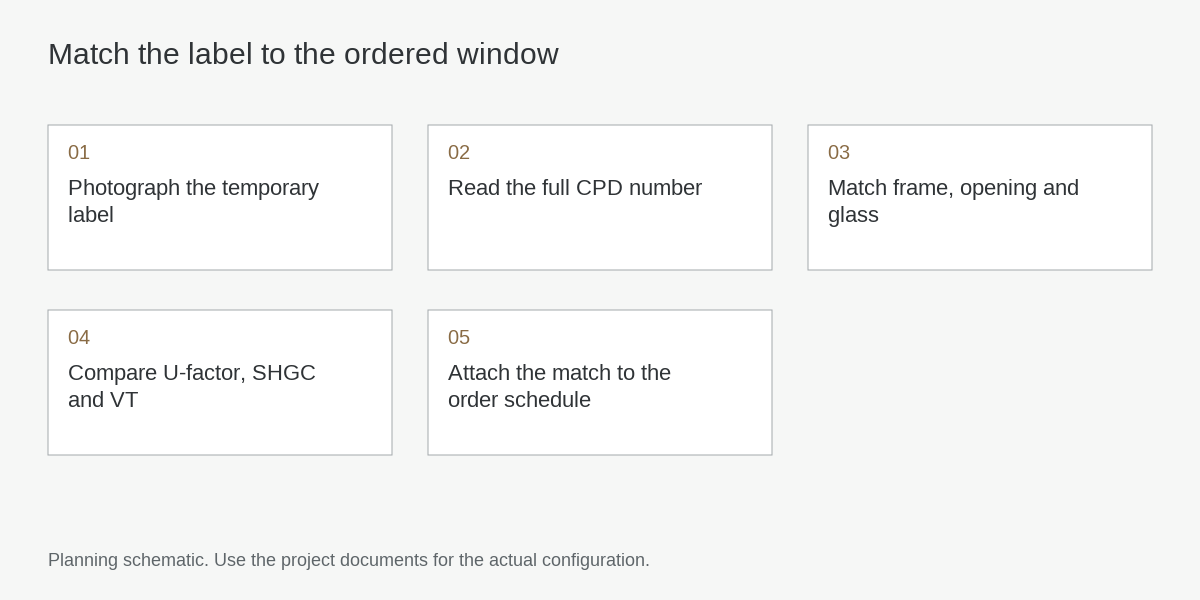
The directory entry connects the label values to the selected configuration.
What happens if an imported window has no NFRC label?
Where a jurisdiction adopts the 2021 IECC, its R303.1.3 and Table R303.1.3(1) provide defaults for a window lacking a certified, labeled U-factor. Its Table R303.1.3(1) assigns double-pane windows and glass doors 0.65 for metal frames with a thermal break and 0.80 for metal frames without one, in Btu/(h·ft²·°F). The table has separate columns for skylights.
Under the 2021 IECC residential component approach, Table R402.1.3 lists a fenestration U-factor limit of 0.30 in Climate Zones 3–8, including Marine 4. Footnote i in ICC’s 2021 IECC table and footnote i permits 0.32 for vertical fenestration in those zones above 4,000 ft elevation, or in windborne-debris regions where IRC R301.2.1.2 requires opening protection.
The 0.65 and 0.80 defaults exceed both 0.30 and 0.32, so they cannot satisfy those component limits. A certified rating establishes the applicable product result for the compliance calculation. The project’s adopted code edition, local amendments and chosen compliance path determine the approval requirements.
How does NFRC relate to ENERGY STAR?
NFRC supplies certified performance ratings. EPA Version 7.0, Tables 1 and 5 apply ENERGY STAR efficiency criteria to the product type and climate zone. For North-Central residential windows, ENERGY STAR Version 7.0 sets prescriptive limits of U-factor ≤0.25 and SHGC ≤0.40. Window air leakage must also meet ≤0.3 cfm/ft² through the accepted labeling routes.
What do missing AL and condensation values mean?
AL and condensation ratings are optional under the NFRC 700-2026 E0A0 optional ratings. Two labels showing AL ≤0.3 cfm/ft² share an upper bound, with their exact leakage rates still unspecified.
The Efficient Windows Collaborative gives condensation resistance a 1–100 scale, with higher values indicating better resistance to interior moisture. NFRC also offers a Condensation Index, so keep the named method consistent. The Efficient Windows Collaborative also explains how indoor humidity and surface temperature affect actual condensation.
The DOE air-leakage guidance explains how product air leakage and air sealing at the installed frame-to-wall joint concern different locations. The window-condensation location guide explains moisture inside, outside and between panes.
How can I match a label to the NFRC directory?
Start with the temporary sticker’s CPD number. The NFRC full-number search gives AAA-X-11-01234-01234 as its format example, with five digits in each trailing group. Preserve leading zeros.
The NFRC CPD search accepts a shorter directory number. Match manufacturer, opening type, frame and glazing option, then align U-factor, SHGC and VT with the offered configuration.
The NFRC 700-2026 E0A0 label requirements describe permanent identification on the frame, spacer or another designated accessible surface. Keep a photograph of the energy sticker with the opening schedule. After the sticker is removed, that record helps connect the installed unit to its ratings.
FAQ
What does an NFRC U-factor of 0.30 mean?
It describes whole-window heat transfer of 0.30 Btu/(h·ft²·°F), equivalent to 1.70 W/(m²·K). Lower values transfer less heat under equal area and temperature conditions.
Is SHGC 0.25 better than 0.40?
For reducing solar heat gain, SHGC 0.25 is better than 0.40. The 0.40 option admits more solar energy, which can support winter heating. Compare VT separately for daylight.
Where is the NFRC number on an installed window?
The temporary energy sticker carries the CPD number. After removal, permanent identification may be on the frame, spacer or another designated accessible surface. Use it with the retained label photo and product details.
Can an imported double-glazed window use an IECC default U-factor?
Where the 2021 IECC is adopted, its default table assigns 0.65 to double-pane thermally broken metal windows and 0.80 to other metal windows without a certified labeled U-factor. Both exceed the 0.30 component limit for Climate Zones 3–8 and the specified 0.32 exception. Local amendments and the compliance path control approval.
Let YULUX review your drawings before pricing.
Send us your window schedule, floor plans or photos. We review opening sizes, system direction, glass, hardware, finish and packing scope before quoting.