
Triple Glazed Aluminium Windows: Is the Upgrade Worth It?
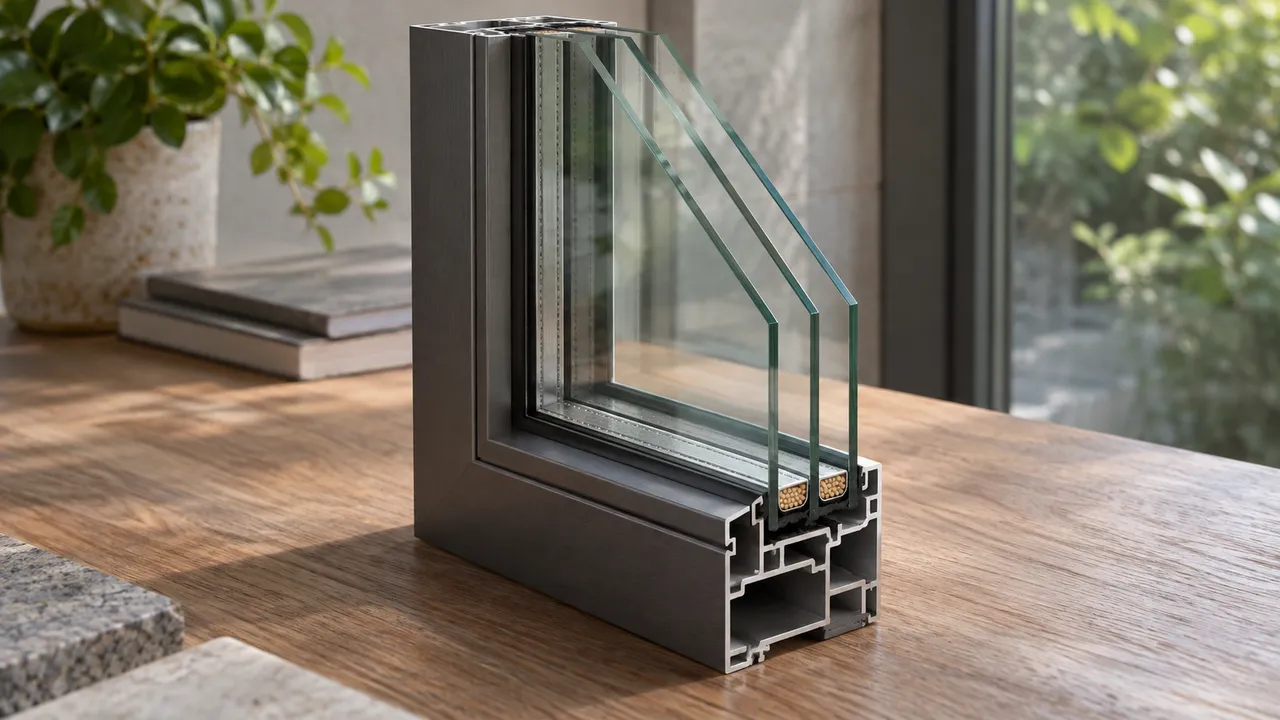
A triple-glazed aluminium window holds 3 panes of glass and 2 sealed cavities inside a thermally broken metal frame. Only pay for that third pane when your whole-window thermal target demands it and your aluminium profile, glazing pocket and hardware are engineered for the extra depth and weight.
| Project priority | Triple-glazing decision | What can change the choice |
|---|---|---|
| Cold-weather comfort | Prioritize a lower whole-window U-value | Frame conduction, air leakage and installation |
| Cooling and strong sunshine | Balance insulation with solar gain control | Orientation, shading and daylight |
| Large opening sash | Design around the actual glazing mass | Pocket depth, hinges or rollers, sash geometry |
How much thicker and heavier is triple glazing vs. double glazing?
Stepping up from a standard 22 mm double-glazed unit to a 39 mm triple-glazed unit adds 17 mm of depth and 50% more glass weight across the exact same window area.
Let's look at a real make-up I see all the time from glass processors: 5 mm glass panes with 12 mm argon-filled cavities. A double unit (5/12/5) is 22 mm thick. A triple unit (5/12/5/12/5) is 39 mm thick. (Note: catalog coatings between these two often vary, so treat this as a physical weight and pocket check rather than a direct thermal test.)
Standard soda-lime silicate glass weighs 2,500 kg/m³ (per Glass for Europe). Every 1 mm of glass thickness adds 2.5 kg/m². So a third 5 mm pane adds 12.5 kg/m² of dead weight before you even count the second spacer bar or primary and secondary edge seals.
Take a typical 1.65 × 1.45 m cut size (about 65.0 × 57.1 in), which gives 2.3925 m² of glass:
- Double (10 mm total glass): 2.3925 m² × 0.010 m × 2,500 kg/m³ = 59.81 kg (131.86 lb)
- Triple (15 mm total glass): 2.3925 m² × 0.015 m × 2,500 kg/m³ = 89.72 kg (197.80 lb)
| Same glass cut size | Double: 5/12/5 | Triple: 5/12/5/12/5 |
|---|---|---|
| Nominal unit thickness | 22 mm / 0.87 in | 39 mm / 1.54 in |
| Total solid glass thickness | 10 mm | 15 mm |
| Calculated glass mass | 59.81 kg / 131.86 lb | 89.72 kg / 197.80 lb |
| Glass mass per area | 25 kg/m² | 37.5 kg/m² |
That is nearly 30 kg (66 lb) of extra glass in a single sash. You can't just drop a 39 mm IGU into a sash extruded for 22 mm glass. It needs a deeper glazing pocket, narrower glazing beads, proper setting blocks, and gaskets that maintain edge pressure. And remember, this math just checks mass—you still have to run wind-load and deflection calcs to verify 5 mm panes are thick enough for that span.
How does the third pane affect whole-window U-value and the operating sash?
Putting a high-performance triple IGU into a mediocre aluminium frame is a waste of money, and hanging an extra 30 kg on standard hinges will ruin an operating sash. You have to specify the glass, the thermal break, and the hardware as one connected system.
Whole-window thermal performance (Uw vs. Ug)
Never buy windows based on center-of-glass U-value ($U_g$). Suppliers love quoting $U_g$ because it ignores the metal frame and edge seals. You need the whole-window U-value ($U_w$), which captures the glass, the spacer, and the thermally broken aluminium profiles together.
Frame-to-glass ratio changes everything. A small operable casement has a lot of aluminium perimeter relative to its glass area, so its $U_w$ will be worse than a huge fixed picture window using the exact same IGU. Always require the rating method, test size, and opening type right next to the number. The thermal performance guide breaks down how we model the complete assembly.
If you're specifying for the US, ask for NFRC-certified whole-product ratings: U-factor in Btu/(h·ft²·°F), Solar Heat Gain Coefficient (SHGC), and Visible Transmittance (VT). Do not mix European center-of-glass metric figures ($W/m^2K$) with NFRC whole-window numbers on the same schedule.
Climate dictates how you balance $U_w$ and SHGC:
- Heating climates (Canada, northern US, southern Australia): Push $U_w$ down so you can sit right next to a large pane in January without feeling that cold radiative draft.
- Sunny or mixed climates: Watch your solar gain. As the Australian government glazing guide points out, conduction and solar heat gain work differently. On Australian jobs, tie your IGU spec directly into the NatHERS or energy report early—our Australia windows and doors guide covers how to align schedules with local compliance.
Operating sash and hardware limits
The 89.72 kg figure we calculated earlier is bare glass. To size hinges, friction stays, or sliding rollers, get the finished IGU weight from the fabricator (including spacers and sealant), then add the aluminium sash extrusions, beads, gaskets, and lock gear.
Take that total moving-sash weight—along with your exact sash width and height—and plot it against the hardware manufacturer's load chart. If the triple unit pushes a casement sash past its hinge limit, don't let the factory secretly shrink the argon cavities from 12 mm down to 6 mm just to fit a lighter sash profile. Starving the cavity kills the thermal benefit you paid for. Instead, upgrade to heavy-duty hardware, step up the profile series, or split the elevation so the big spans are fixed lights and the operable vents are smaller. Keep your gas fills and edge seals locked in; check the argon-filled glazing guide and warm-edge spacer guide for what actually moves the needle at the glass edge.
What about acoustics and condensation?
Three panes of identical 5 mm glass (5/12/5/12/5) will not automatically block more street noise than a well-built double unit; symmetrical panes can actually resonate at the same frequency. To stop traffic noise, you need asymmetric pane thicknesses and acoustic PVB interlayers—see the road-facing acoustic window guide.
Triple glazing does raise the room-side glass temperature in winter, which cuts down interior surface condensation. Just keep in mind that if indoor humidity is high and ventilation is poor, water will still find the coldest spot on the wall or frame edge. (And don't confuse room-side wiping moisture with a blown seal, which traps fog inside the cavity itself.)
What belongs in a matched quotation for double vs. triple glazing?
Ask for two matched, side-by-side quotes—one double, one triple—across the exact same window schedule, with factory supply and on-site installation broken out separately.
A 30 kg jump per lite often tips a residential install from a two-person manual lift into crane or vacuum-lifter territory. If you only compare factory gate prices, the installation bill at the job site will ambush your budget.
Make sure both quotes lock in these exact line items so you're comparing apples to apples:
Glass configuration entries:
- Each pane's thickness and heat/safety treatment (annealed, tempered, heat-strengthened, or laminated interlayer spec).
- Exact Low-E coating type and surface numbers (e.g., Surface #2 and Surface #5).
- Both cavity widths and % gas fill (e.g., 12 mm 90% Argon).
- Spacer bar material and thermal conductivity (warm-edge vs. mill-finish aluminium).
- Nominal overall IGU thickness (e.g., 22 mm vs. 39 mm).
- Glass-only performance ($U_g$, SHGC/g-value, VT).
Whole-window & site entries:
- Aluminium system series, thermal break width, and glazing pocket compatibility.
- Opening type and direction, plus any profile or hardware upgrades required for the triple option.
- Total calculated moving-sash mass for every operable unit.
- Whole-window thermal rating ($U_w$ / NFRC U-factor) for each specific window size and configuration—not a generic "typical" test window.
- Separate site delivery, cranage/lifting gear, and local installation labor costs for both weights.
If you're laying out operable vents now, check the profile limits in our casement window range, then send over your drawings to price the double and triple glass packages for my window schedule. Include your project zip/postcode, elevation sizes, and target U-values so we can price both packages against the exact same brief.
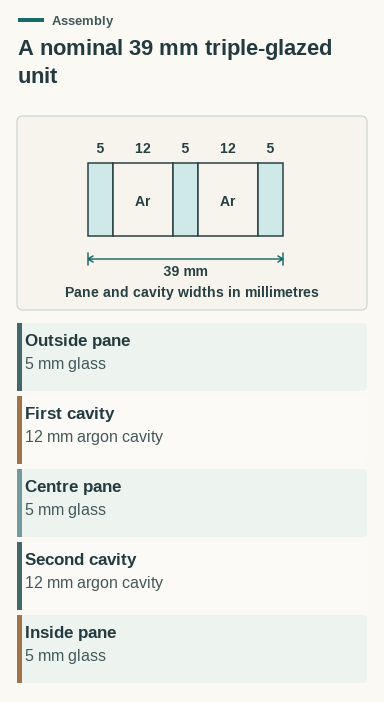
A nominal 39 mm triple-glazed unit
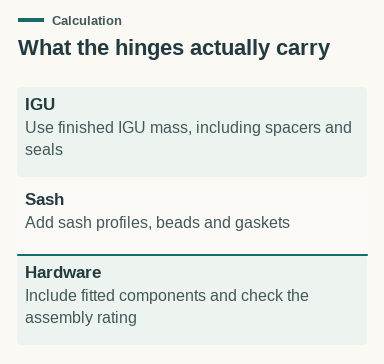
What the hinges actually carry
Let YULUX review your drawings before pricing.
Send us your window schedule, floor plans or photos. We review opening sizes, system direction, glass, hardware, finish and packing scope before quoting.