
Powder Coating Cross-Hatch Tests Across ISO, ASTM and China
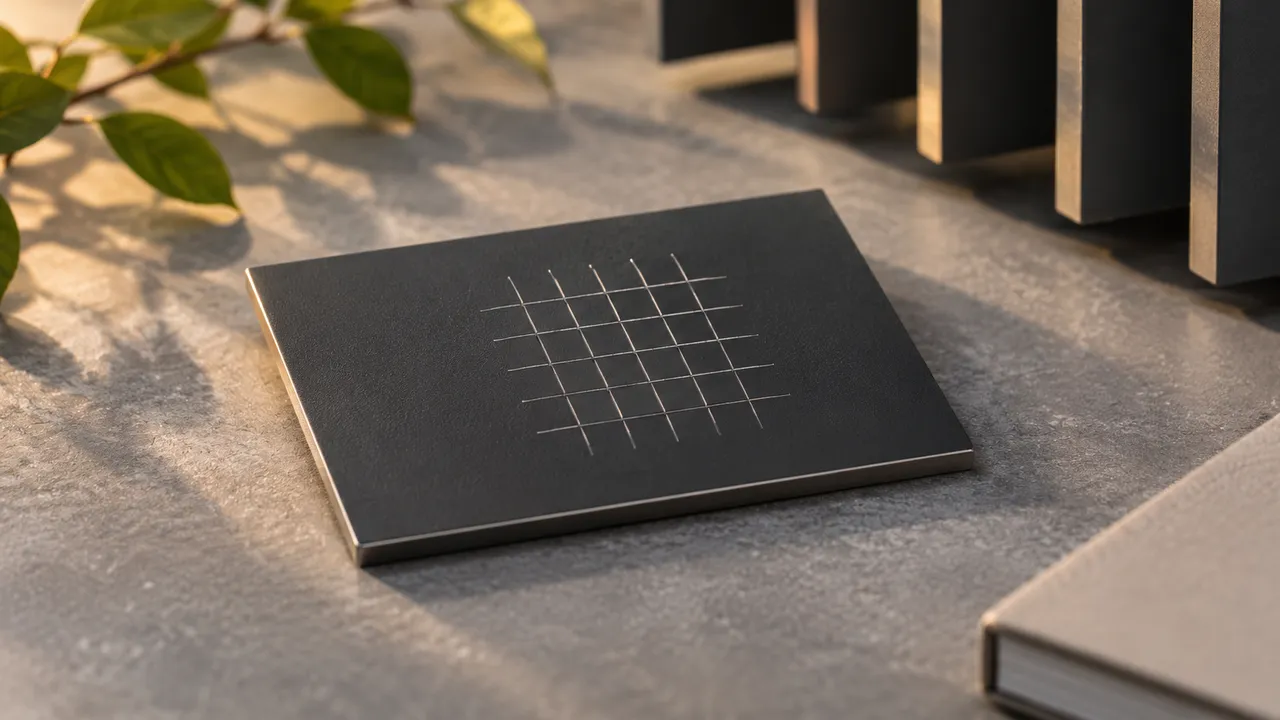
A powder-coating cross-hatch test assesses resistance to separation after cuts reach the substrate, with ISO results classified from 0 for best to 5 for worst. ISO 2409 excludes coatings thicker than 250 µm, while ASTM D3359 Method B is primarily intended for films below 125 µm.
The details behind the answer
Choose the specified method and acceptance grade before cutting a production sample or agreed sacrificial area.
What do ISO 0, ASTM 5B and a Chinese grade 0 result mean?
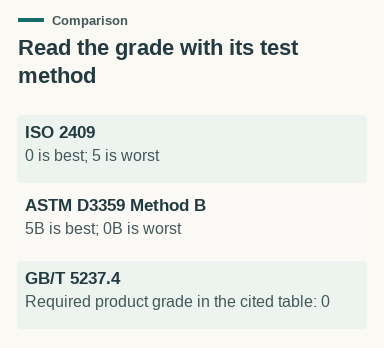
ISO runs from 0 to 5, best to worst, while ASTM Method B runs from 5B to 0B. Each result belongs to the method used, including its specimen preparation and assessment procedure. A project specification sets the applicable acceptance criterion.
| Parameter | ISO 2409 | ASTM D3359 Method B | GB/T 5237.4 |
|---|---|---|---|
| Best classification / required product grade | 0 | 5B | 0 |
| Worst classification | 5 | 0B | |
| Published scope, total thickness µm | ≤250 | <125 | |
| Cut spacing for the 80 µm example, mm | 2 | 2 | |
| Wet water temperature, °C | 38 ± 5 | ||
| Wet immersion, h | 24 | ||
| Post-immersion testing window, min | 5 |
Read the grade with its test method
How do film thickness, cutter spacing and tape change the result?
ISO 2409:2020 excludes textured coatings and coatings with a total thickness above 250 µm. Its empirical classification assesses separation resistance. Quantitative adhesion measurement uses a different test method. The published 2020 edition remains listed while a revision is being developed.
ASTM D3359 Method B is primarily intended for coatings below 125 µm, approximately 5 mils. Thicker films require wider cuts and explicit buyer/seller agreement for Method B use. ASTM also identifies ISO 2409 as technically non-equivalent.
Within the instrument maker's published ASTM cutter ranges, a 40 µm coating uses 1 mm spacing and an 80 µm coating uses 2 mm spacing. The corresponding tools in that guide have 11 and 6 teeth. These examples lie inside the listed thickness ranges, avoiding a boundary choice that needs the full applicable procedure.
The cut must reach the substrate. A line scratched only into the top of the powder film leaves the coating attachment untested at that location. A flat, suitable area lets the tool make consistent cuts through the film. Blade condition, sample support and the visual assessment also affect repeatability.
The Chinese profile procedure specifies 2 mm spacing and tape adhesive force above 10 N per 25 mm. Its removal direction is perpendicular to the surface. That tape-force value characterises the tape used in the procedure.
ASTM D3359 section 5.6 specifies rapid tape removal at an angle as close to 180° as possible. Tape removal rate and angle influence the result, so the stated method should accompany the reported grade.
ISO loose-particle removal has its own procedure. The instrument guidance reviewed describes brushing, adhesive tape or compressed air or nitrogen as options, and explains the removal of a fixed tape specification. A laboratory must follow the chosen edition and procedure consistently across the batch.
What does China require after wet and boiling-water conditioning?
GB/T 5237.4-2017 requires grade 0 for dry, wet and boiling-water adhesion of the powder-coated architectural aluminium profiles it covers. That requirement sits in clause 4.6.5. The SAMR's official version record displayed the 2017 edition as current when checked on 11 November 2026.
For wet adhesion, first cut a 2 mm grid, immerse the specimen in water at 38 ± 5°C for 24 hours, then remove it and wipe it dry. Clause 5.4.5.2 calls for the grid before immersion. After wiping dry, carry out the tape step and rating under clause 5.4.5.1.2 within 5 minutes. The tape covers the grid, is pressed to expel trapped air, then is removed rapidly perpendicular to the coating. The water temperature corresponds to 100.4 ± 9°F.
For boiling-water adhesion, pre-cut the grid, then immerse the specimen for 20 minutes at a water temperature of at least 95°C, keeping it at least 10 mm below the surface and clear of the container bottom. Clauses 5.4.5.3.1–5.4.5.3.4 set this sequence. Replenish with boiling water to maintain a water depth of at least 80 mm. The 10 mm minimum submergence is approximately 0.39 in, and 95°C is 203°F. After removal and wiping dry, apply and press the specified tape, expel trapped air, pull it off rapidly perpendicular to the coating, and rate the result within 5 minutes.
Can a cross-hatch pass establish full cure or corrosion durability?
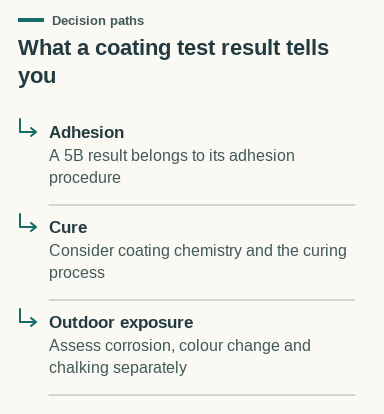
ASTM D5402 measures solvent resistance, so judge full cure against the coating system’s specified process and cure criteria. Select the solvent, double-rub count and acceptance result from that coating specification.
When a sample performs poorly, surface preparation, coating application and curing are areas for investigation. The grade by itself cannot identify which production step caused the result. Colour change and chalking also need their own assessment over the relevant exposure. Powder-coat fading and chalking
What a coating test result tells you
Which test result belongs on the project finish schedule?
Assumptions for this procurement comparison are two 80 µm specimens, a dry ASTM Method B report recording 5B, and a Chinese wet-adhesion report recording grade 0 after the specified immersion.
Both hypothetical specimens use 2 mm spacing. The Chinese wet result includes 24 hours of immersion, while the ASTM dry result records adhesion without that water conditioning.
Use the coating method, conditioning and acceptance grade named in the project contract.
A batch record links the tested specimen to its coating run, substrate, measured film thickness, cutter, tape or other removal procedure, and conditioning. Because the lattice cuts through the finish, a production sample or agreed sacrificial area also needs a disposition after testing. These entries make the result traceable during shipment inspection. Pre-shipment inspection
FAQ
Does a 5B cross-hatch result prove powder coating is fully cured?
A 5B result establishes the reported visual adhesion classification under ASTM Method B. Cure assessment requires the coating system's process and test criteria. Even solvent resistance under ASTM D5402 has a limited relationship to complete cure.
Why can a profile pass dry adhesion and fail after water immersion?
The Chinese wet-adhesion procedure cuts the grid before 24 hours of immersion at 38 ± 5°C. The specimen is then removed and wiped dry, with the tape step and rating completed within 5 minutes. A water-conditioned failure prompts investigation of the coating, substrate preparation and process history.
Can an ISO 2409 report replace an ASTM D3359 report?
The project must accept the reported method. ASTM states that the two methods are technically non-equivalent, and their classification scales run in opposite directions. An ISO 0 result and an ASTM 5B result retain their respective methods and conditions.
Let YULUX review your drawings before pricing.
Send us your window schedule, floor plans or photos. We review opening sizes, system direction, glass, hardware, finish and packing scope before quoting.