
Window Hardware Corrosion Resistance Grades and Test Scope
EN 1670 grade 4 requires 240 hours of neutral salt spray and grade 5 requires 480 hours, each with a +1/−0 hour duration tolerance. Acceptance also includes the specified appearance and post-test operating requirements for the hardware assembly and its supplied fasteners.
What do EN 1670 corrosion grades actually measure?
The current British adoption is BS EN 1670:2007. Its classification addresses building hardware used on windows, doors, shutters and curtain walling. Grade 0 has no specified corrosion-resistance requirement.
The EN 1670 original text sets the neutral-salt-spray exposure periods in clause 5.2. The duration tolerance is +1/−0 hour for each tested grade. Grade selection belongs alongside the component identity and acceptance criteria in a window specification.
Match each handle, friction stay, lock and fastener to its substrate, protective finish and tested assembly. Exterior pivots and protected locking cavities have different exposure conditions.
| EN 1670 grade | NSS duration, h | Duration tolerance, h |
|---|---|---|
| 1 | 24 | +1/−0 |
| 2 | 48 | +1/−0 |
| 3 | 96 | +1/−0 |
| 4 | 240 | +1/−0 |
| 5 | 480 | +1/−0 |
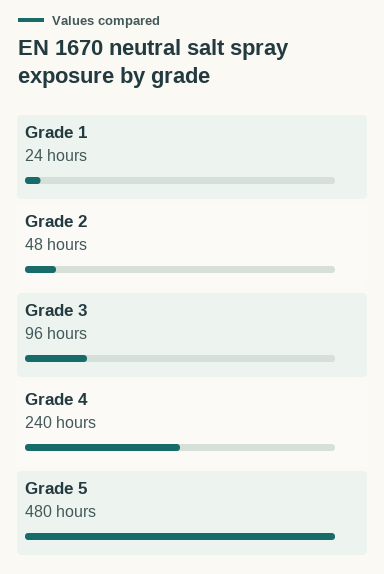
EN 1670 neutral salt spray exposure by grade
How do current Chinese hardware grades change with the substrate?
The SAMR publication record identifies GB/T 32223-2025 as the current general requirements for building-window and door hardware. Its corrosion table groups results by substrate and surface treatment.
For zinc-plated or zinc-nickel-plated carbon steel, Table 2 grade 2 requires 240 hours NSS with substrate protection rating RP ≥8. Grade 3 requires 480 hours with RP ≥6. For the corresponding coatings on zinc alloy, grade 2 requires 96 hours with appearance rating RA ≥8, while grade 3 requires 240 hours with RA ≥6.
240 hours therefore appears against different material-and-rating combinations. An offer stating only that duration leaves the applicable acceptance condition unresolved. RA records appearance and RP records substrate protection, so the rating symbol belongs beside the result.
Table 2 recommends grade 1 for indoor use, grade 2 for outdoor use and grade 3 for high-humidity or high-corrosion locations. Its zinc and zinc-nickel corrosion assessment is limited to the decorative surface. Clause 8.3 requires protection of cut areas and rivet points before testing.
Specify protection at production cuts, rivets and site-cut interfaces, including repair of coating damaged during fabrication or installation. The tested specimen preparation and the delivered protection should describe the same component configuration.
Which differences matter between NSS, AASS and CASS results?
NSS uses a neutral solution, AASS uses acetic acid, and CASS adds copper acceleration to the acid-spray method. Compare NSS, AASS and CASS separately under matching substrate and coating conditions, since GB/T 32223 specifies CASS for 16 hours or AASS for 96 hours with RA ≥8 for nickel/chromium or copper/nickel/chromium coatings on carbon steel or zinc alloy.
GB/T 32223-2025 clause 7.3.1 allows CASS for 16 hours, CORR corrosion-paste testing for 16 hours, or AASS for 96 hours for nickel/chromium or copper/nickel/chromium coatings on carbon-steel or zinc-alloy substrates, with RA ≥8. CORR belongs in its own method entry.
For anodised aluminium hardware, Table 2 specifies CASS durations of 16, 24 and 48 hours for grades 1, 2 and 3 respectively, all with RA ≥8. Matching the substrate and finish first prevents a neutral-spray result from being assigned an acid-spray criterion.
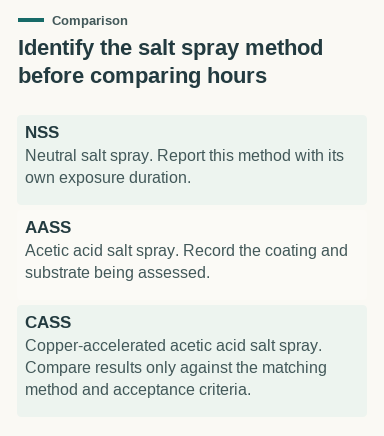
Identify the salt spray method before comparing hours
What must the specimen do after corrosion testing?
EN 1670 acceptance includes appearance and operation. Clause 5.3 requires normal operation after corrosion testing under the relevant product standard where available.
Clause 6.1 addresses products assembled or supplied in their normal form and their orientation in use. Clause 6.2 assigns post-test treatment to the relevant product standard, falling back to EN ISO 9227 where that standard gives no instructions.
Record the specimen condition before judging a stiff handle or binding stay. The report should identify any cleaning, drying, conditioning or lubrication performed under the adopted procedure. The operation result needs the same specimen identity as the exposure record.
Fasteners supplied with the hardware also belong in the EN 1670 scope. Replacement screw material, coating and contact with adjacent metals should stay traceable through the bill of materials. The existing hardware spare-parts guide explains how to preserve that identity for later orders.
How should a buyer read a BHMA finish claim for a window package?
ANSI/BHMA A156.18-2020 establishes architectural finish tests, with specific performance requirements supplied by individual hardware standards. Its listed test families include salt spray, ultraviolet exposure, perspiration, hardness and humidity.
The BHMA materials-and-finishes guidance describes corrosion evaluation through corrosion, staining and blistering, and explains that finish codes identify finish/substrate combinations. A finish code belongs in the material description. The applicable product standard and test result establish the performance requirement.
For a North American quotation, identify the window component and the standard actually used to evaluate it. Door-hardware terminology can appear in a mixed architectural package, so attach the relevant report to the corresponding quotation line.
FAQ
How many salt-spray hours does EN 1670 grade 4 require?
240 hours of neutral salt spray, with a +1/−0 hour tolerance, is the EN 1670 grade 4 exposure requirement. The applicable appearance and functional criteria also form part of acceptance.
Does GB/T 32223 grade 3 always mean 480 hours?
3 material groups can have different grade 3 durations in GB/T 32223-2025 Table 2, including 480 hours NSS for plated carbon steel, 240 hours NSS for plated zinc alloy and 48 hours CASS for anodised aluminium, with their specified ratings.
Can a grade 5 report establish a coastal replacement date?
480 hours is the EN 1670 grade 5 laboratory exposure. A coastal replacement plan uses the installed component condition, exposure and maintenance history to determine intervention timing.
Let YULUX review your drawings before pricing.
Send us your window schedule, floor plans or photos. We review opening sizes, system direction, glass, hardware, finish and packing scope before quoting.