
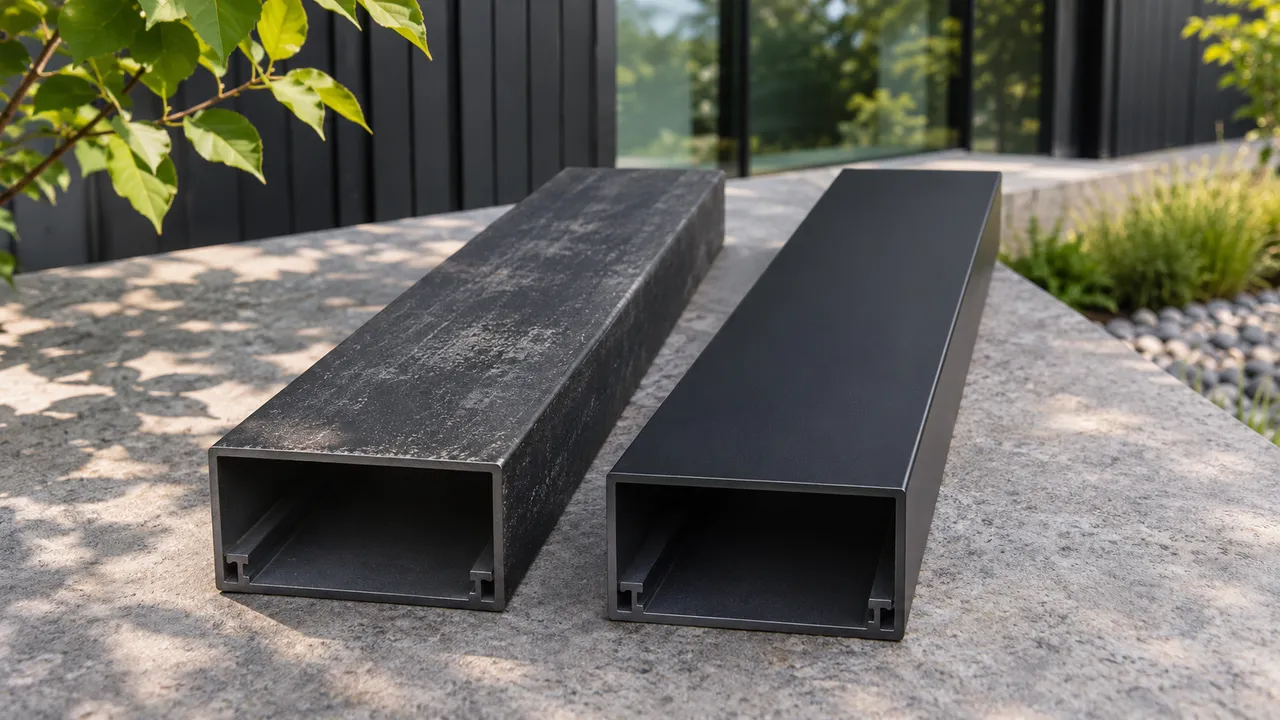
Powder Coat Chalking on Aluminium, Diagnosis and Coating Selection
Powder-coat chalking produces transferable surface powder as UV degrades the binder. QUALICOAT UK & Ireland recommends washing every 1–3 months in harsh coastal or industrial environments and every 3–6 months in standard environments. Clean and dry a small patch first; persistent powder then points to coating deterioration. QUALICOAT homeowner care
Is the white mark dirt, fading, gloss loss or chalking?
Photograph the dry surface and a gentle cloth wipe before cleaning. Wash a neighbouring patch with mild detergent, rinse and let it dry. Deposits that disappear point towards contamination. Continued transfer from the cleaned patch points towards deterioration of the coating surface.
Adhering dirt can resemble early chalking, particularly at low levels. ISO 4628-6:2023 uses a tape method and pictorial references to assess chalking. A casual cloth test helps select the next inspection step. A recorded assessment needs the defined test procedure.
Inspect screw holes, cut edges and sealant junctions as well as the broad exposed face. Photograph the location of each symptom on the elevation drawing so cleaning teams and the repair specialist can revisit the same places.
| Symptom | First check | Possible intervention | Responsible person |
|---|---|---|---|
| Deposit disappears | Cleaner residue or dirt | Gentle cleaning | Maintenance team |
| Colour shifts without powder | Sheltered matching finish | Colour assessment | Coating specialist |
| Dull reflection | Clean reference and gloss | Gloss measurement | Coating specialist |
| Powder transfers repeatedly | Weathered binder | Finish assessment and trial repair | Coating specialist |
| Blisters or exposed metal | Adhesion and corrosion | Preparation, refinishing or replacement | Qualified repair contractor |
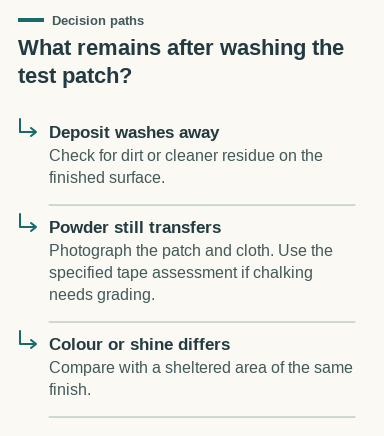
What remains after washing the test patch?
How often should chalky aluminium frames be cleaned?
QUALICOAT UK & Ireland's homeowner guidance specifies cleaning every 3–6 months in standard environments and every 1–3 months in harsher coastal or industrial environments. Its method uses mild detergent, soft tools and thorough rinsing, and advises against abrasive cleaners, strong solvents and pressure washing.
Use the installed coating's maintenance instructions to select the cleaner. Wash frames with the glazing, including sheltered sills where dirty runoff can remain. Dry the trial area before judging colour or transfer. Increasing rubbing pressure can alter the surface and obscure the initial condition.
Which coating specification prevents early chalking?
GB/T 5237.4-2017 specifies accelerated weathering in clause 4.6.18.1, Table 5. Grade I requires 1,000 hours with at least 50% gloss retention, Grade II requires 1,000 hours with at least 90%, and Grade III requires 4,000 hours with at least 75% and colour difference ΔEab* no greater than 3. Clause 4.6.18.2 places the selected natural-weathering grade and agreed test conditions in the order.
FGIA's May 2026 update identifies AAMA 2603-26, 2604-26 and 2605-26 as successively higher finish categories, and the QUALICOAT specifications use class-specific qualification programmes in their 26th edition. The finish schedule names the coating class, colour, texture and agreed edition.
Gloss retention is final gloss divided by initial gloss, multiplied by 100. At the same 1,000-hour checkpoint, GB/T 5237.4 Grade II allows a maximum 10% gloss loss, compared with 50% for Grade I; Grade III extends exposure to 4,000 hours and allows 25% loss. A retained colour panel and coating batch identity make the specified finish traceable after delivery.
Adhesion damage needs its own assessment. The cross-hatch test guide covers that check, while the powder coating versus anodising guide covers finish selection.
| GB/T 5237.4-2017 accelerated grade | Exposure, hours | Minimum gloss retention, % |
|---|---|---|
| I | 1,000 | 50 |
| II | 1,000 | 90 |
| III | 4,000 | 75 |
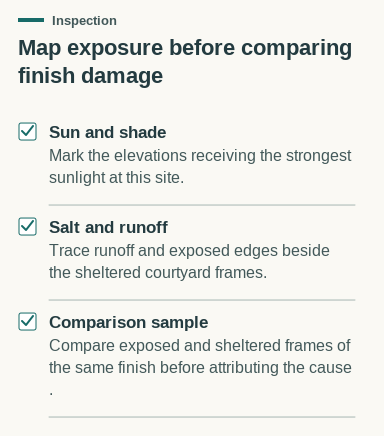
Map exposure before comparing finish damage
Why does one elevation deteriorate before the others?
Map the strongest sunlight, shelter, salt exposure and runoff direction. In northern-hemisphere buildings, start with south-facing elevations and sun-exposed western faces. For an Australian site, map the actual solar exposure and shading. The most exposed frame can reveal a problem earlier than the sheltered courtyard finish.
QUALICOAT UK & Ireland’s Seaside guidance describes molecular porosity, the importance of pretreatment and enhanced preparation with a filiform-corrosion test. Coastal salts and deficient pretreatment can support underfilm corrosion. Thin branching tracks beneath a finish need a corrosion investigation alongside surface chalking.
Compare original and repaired pieces, delivery batches and changes in cleaning products. Localised streaks beside masonry or sealants suggest a contact or runoff pattern. Broad deterioration across the same production batch raises questions about powder selection, preparation and curing records.
Can the finish be cleaned, refinished or replaced?
Cleaning can restore appearance where deposits dominate the problem. Persistent surface weathering needs a compatible trial treatment. Judge the trial when dry and in the same daylight as the surrounding frame. Large colour differences across adjacent pieces may favour replacement of a complete visible assembly.
Blisters, lifting film and corrosion require preparation that reaches sound material. Factory powder recoating involves heat curing, so glass, seals and hardware affect how a component can be dismantled and treated. Drainage outlets must remain functional through the repair.
Set out the repair area, preparation, coating system and inspection points before work starts. Keep a labelled sample of the accepted appearance with the maintenance file. The coastal care guide covers ongoing frame cleaning.
What should the technician leave at handover?
YULUX supplies replacement aluminium windows, while local contractors handle site repair and refinishing. Request a replacement-window quotation with section drawings, a finish sample, dimensions and quantities.
FAQ
How often should coastal powder-coated frames be washed?
Every 1–3 months is the interval in QUALICOAT UK & Ireland's homeowner guidance for harsh coastal or industrial environments. Its standard-environment interval is 3–6 months.
Is powder-coat chalking covered by warranty?
A 1,000-hour weathering result is a coating qualification result, and chalking coverage follows the signed warranty's defect threshold, coverage period and maintenance conditions. Record the affected finish, dates and measured condition when making a claim.
What does GB/T 5237.4 Grade III require for weathering?
Grade III requires 4,000 hours of accelerated weathering, at least 75% gloss retention and ΔEab* no greater than 3 under Table 5. Natural-weathering requirements are specified separately in clause 4.6.18.2.
Let YULUX review your drawings before pricing.
Send us your window schedule, floor plans or photos. We review opening sizes, system direction, glass, hardware, finish and packing scope before quoting.