
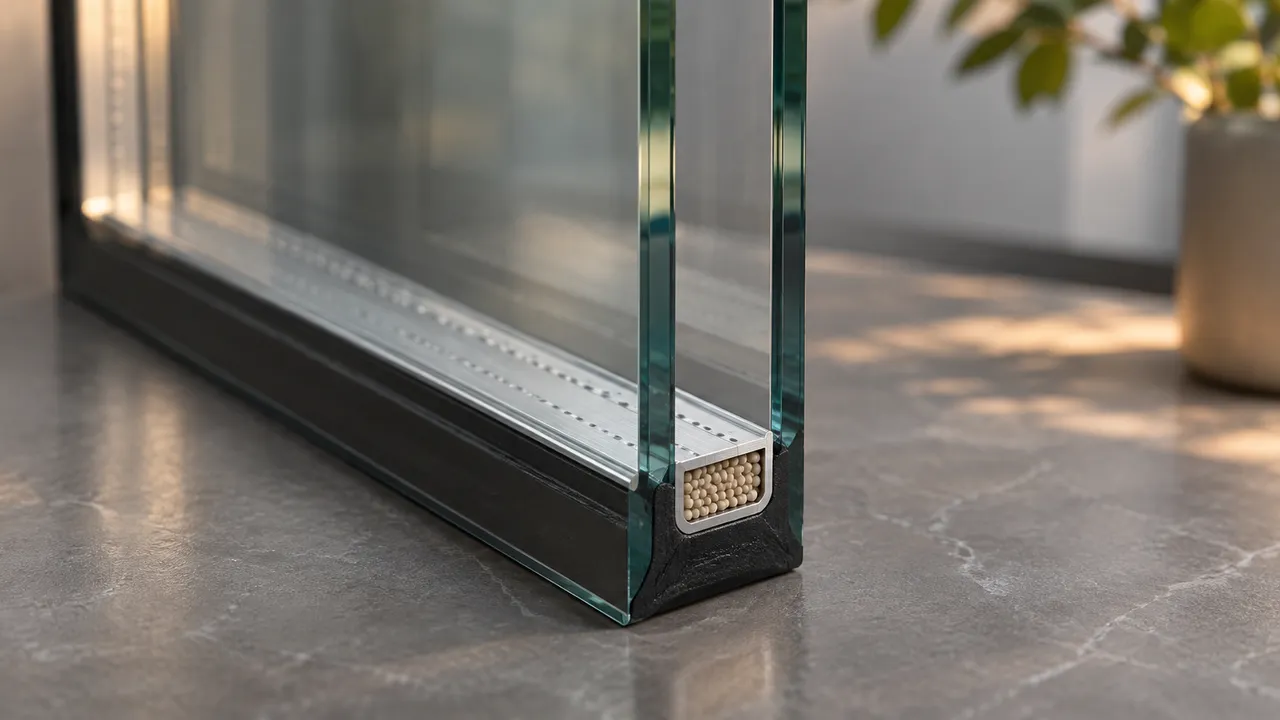
Insulating Glass Sealant Compatibility and Edge-Seal Troubleshooting
Select the compatibility test for the actual material contact. ASTM C1294 evaluates adhesion and cohesion changes when liquid-applied glazing materials contact the IGU edge seal, while ASTM C1087 screens structural-glazing sealants against accessories under heat and ultraviolet exposure through 3 observations of colour and adhesion. Identify the sealants, gaskets, blocks and installation materials before substitution.
Where can incompatible materials reach the primary and secondary seals?
In a conventional dual-seal unit, the polyisobutylene (PIB) primary seal provides the main vapour and gas barrier between spacer and glass. The outer secondary seal holds the panes together and protects that primary seal. Its material and joint design follow the intended glazing arrangement.
Contact can begin outside the factory edge seal. A setting block supports the unit at its base. A gasket bears against the glass or edge region. A bedding or installation sealant fills part of the glazing interface. Their positions determine which materials contact the secondary seal and where migrating substances can travel.
A migrated constituent may cross the secondary seal and disturb the PIB behind it. A manufacturer’s documented IGU failure investigation describes that pathway after an unapproved gasket substitution. Concentrate the investigation on the material combination and contact route visible in the affected openings.
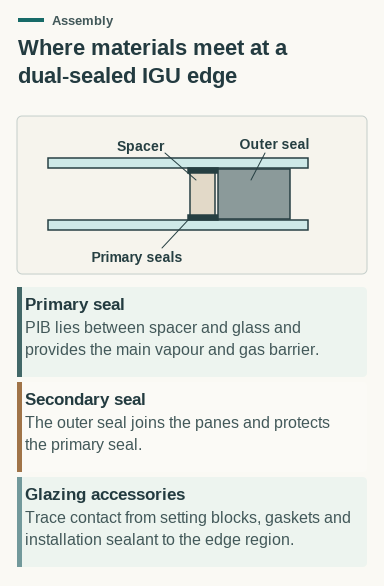
Where materials meet at a dual-sealed IGU edge
Which symptoms point to a material interaction at the IGU edge?
Softening, hardening, weakened cohesion and separation from a bonded surface are effects identified in the ASTM C1294 original scope and significance statement. Changes may appear near a contact material or extend along an edge. Preserve the location and the affected production identity before dismantling.
| Observed symptom | Leading contact path to examine | Next examination and responsible party |
|---|---|---|
| Oily residue, softened seal or PIB flow | Gasket, wet sealant or treatment carrying mobile constituents toward the edge seal | IGU producer and sealant laboratory examine both seals and the actual contacting material |
| Discolouration concentrated beside a block or gasket | Accessory-to-secondary-seal contact | Sealant laboratory screens the identified accessory and sealant combination |
| Clean separation from glass or spacer | Bonded-surface preparation, contamination, primer or material change | Fabricator investigates adhesion on representative production substrates |
| Streaked, soft or unevenly cured secondary seal | Mixing, dispensing or curing during manufacture | Fabricator checks retained samples and production quality-control records |
| Wet glazing pocket with an otherwise similar material set | Drainage and prolonged water exposure | Glazing contractor inspects the pocket and drainage before material substitution |
Which test answers the actual compatibility question?
ASTM C1294 evaluates 2 edge-seal response groups, adhesion and cohesion, after interaction with liquid-applied glazing materials. It applies when a bedding sealant or other wet-applied material contacts the edge seal.
The ASTM C1087 original scope covers structural-glazing sealants in contact with accessories such as gaskets, spacers, shims and setting blocks under heat and ultraviolet exposure. It observes 3 changes, sealant colour, adhesion to glass and adhesion to the accessory.
Compatibility testing evaluates interaction between materials. Adhesion testing evaluates the bond to the particular glass, spacer or other substrate. Structural suitability additionally involves the load path, sealant properties, joint geometry and system design. Each result should identify the material combination and the question investigated.
C1294 leaves hermetic-seal integrity, vision-area change and volatile-induced reaction of the primary seal outside its test scope. A successful edge-seal contact test therefore needs to be considered alongside the primary-seal investigation when PIB flow or internal deposits appear.
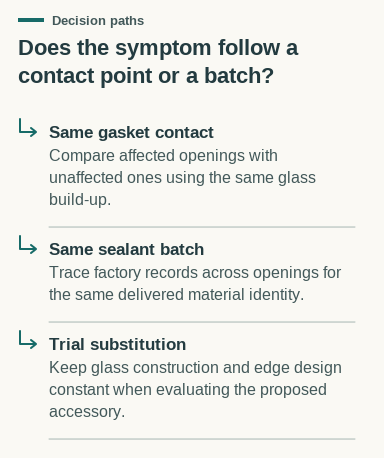
Does the symptom follow a contact point or a batch?
How do Chinese IGU requirements and laboratory sampling instructions apply?
The SAMR record for GB/T 11944-2025 identifies the current Chinese insulating-glass standard. Clause 4.2 requires the secondary sealant to be compatible with glass, spacer and other contacting materials and to have good adhesion. Selection also considers adhesion performance and water-vapour transmission.
For submissions to one Chinese IG-sealant manufacturer's testing service, its guide specifies compatibility specimens at least 100 mm long for each contact material. Butyl may be applied to a spacer. For adhesion testing, that service requires glass pieces larger than 150 × 75 mm and spacer lengths over 100 mm, with at least 3 of each.
For that manufacturer's testing service, the cited guide gives typical turnaround after sample receipt of 21 days for adhesion testing and 36 days for compatibility testing. Submit the production formulations, colours and batches according to the appointed laboratory's confirmed sampling requirements and schedule before fabrication.
Sampling should include the production surfaces that receive the bond. A cleaned trial offcut and a treated production edge can produce different findings. The fabrication record should connect cleaning, primer, material batches, mixing and curing to the units under investigation.
How can a material substitution be investigated without losing the cause?
Begin with a contact map of affected and unaffected openings. Compare delivered material identities, the place and timing of the symptom, sealant batches, fabrication records and installation treatments. A repeated symptom at the same gasket interface directs attention to that pairing. A symptom following a sealant batch across different openings directs attention toward the production record.
Hold the glass build-up and edge design constant while evaluating a proposed accessory change. Examine the current combination and the proposed combination against the same relevant test procedure. Record which material changed and which surfaces were in contact during conditioning.
An affected unit and a retained production sample can answer different questions. The installed unit preserves exposure and contact history. The retained sample can reveal mixing, curing or adhesion problems that existed before glazing. The investigation needs both histories where they are available.
The Canadian IGU standard’s informative user guide identifies prolonged water exposure, material compatibility and chemical exposure as causes of edge-seal failure. Its guidance also calls for drainage and ventilation around the glazing cavity. A wet pocket needs a drainage investigation alongside any compatibility work.
FAQ
What does ASTM C1087 observe in a compatibility screen?
3 changes are observed under ASTM C1087, sealant colour, adhesion to glass and adhesion to the accessory after heat and ultraviolet exposure.
Does ASTM C1294 cover the primary seal’s volatile exposure?
ASTM C1294 measures 2 response groups, adhesive and cohesive properties of the IG edge sealant, while volatile-induced primary-seal reaction and hermetic-seal integrity remain outside its stated scope.
How much accessory material should be supplied for compatibility testing?
One Chinese IG-sealant manufacturer's testing service specifies at least 100 mm of each contacting material for compatibility testing and permits butyl on a spacer. Use the appointed laboratory's current sample requirements for the actual submission.
Let YULUX review your drawings before pricing.
Send us your window schedule, floor plans or photos. We review opening sizes, system direction, glass, hardware, finish and packing scope before quoting.