
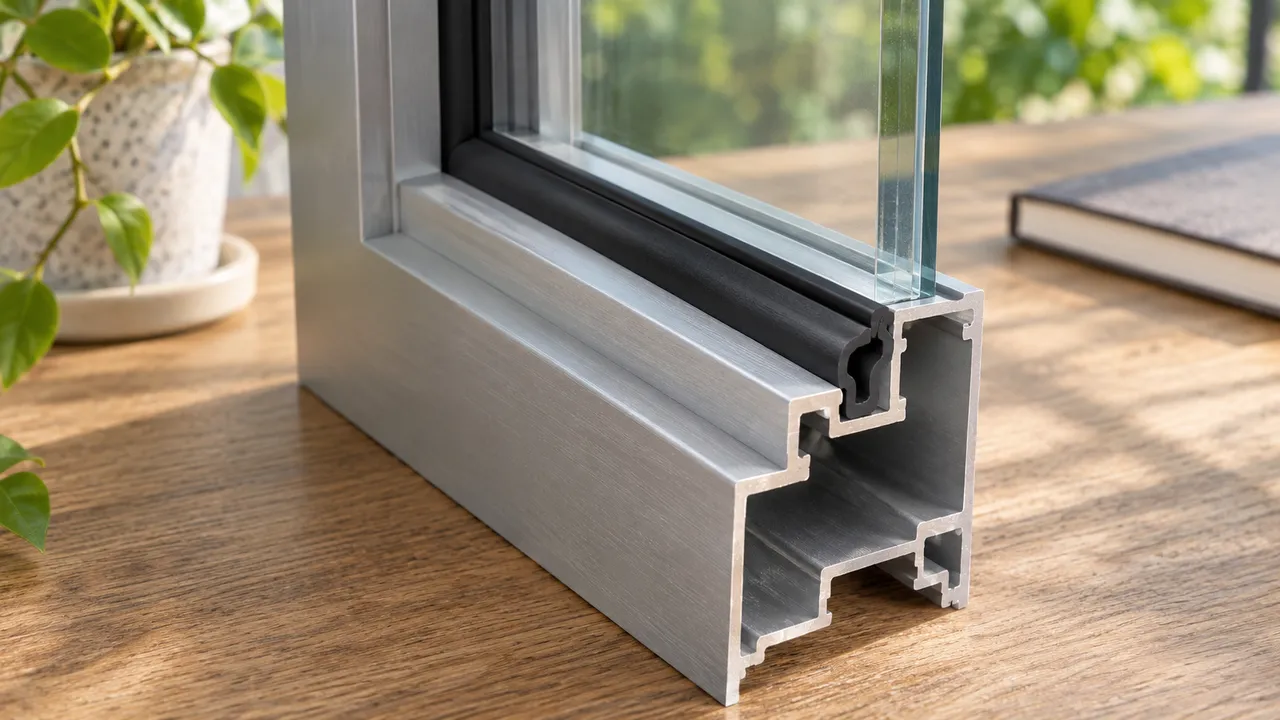
EPDM Gaskets for Aluminium Windows — Profiles, Compression and Fit
EPDM gaskets seal the glass and opening-sash interfaces in aluminium windows. CMHC's curtain-wall guidance gives dense glazing-gasket examples of 55±5 Shore A for a soft compound and 70±5 for a hard compound. Choose the profile by groove fit, contact geometry and closed gap, then select the compound hardness.
Which EPDM gasket cross-section fits an aluminium window?
EPDM means ethylene propylene diene monomer rubber. Glazing seals contact the glass perimeter, while sash seals follow the opening leaf. A dense retaining foot can be combined with a cellular sealing face when the section design calls for secure anchorage and compliant contact.
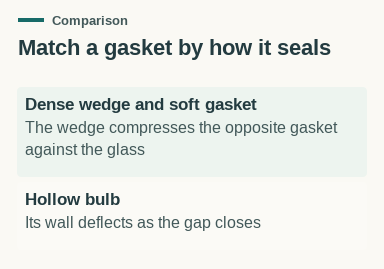
A wedge presses into a glazing pocket, a hollow bulb deforms as the sash closes, and a flipper bends at its lip. Match the retaining foot to the aluminium groove and the sealing face to its mating surface.
| Section arrangement | Sealing action | Dimension that controls selection |
|---|---|---|
| Soft gasket opposite dense wedge | Wedge loading compresses the softer member against the glass | Glass thickness, glazing pocket and opposing gasket sizes |
| Hollow bulb | Bulb walls deform as the sash closes | Free bulb height and closed sash-to-frame gap |
| Flipper lip | Lip bends across the mating surface | Lip reach, orientation and groove position |
| Dense/sponge co-extrusion | Dense portion retains the profile while sponge compresses | Retention-foot dimensions and available compression space |
Match a gasket by how it seals
How hard should an EPDM window gasket be?
CMHC’s 2004 curtain-wall guidance describes dense glazing gaskets at 40–75 Shore A, with soft dense examples at 55±5 and hard dense examples at 70±5. It describes cellular gaskets as very soft, with hardness usually unquoted. CMHC, section 3.5.1
Hardness measures indentation resistance. A hollow dense profile can deform through its wall geometry. Compression set measures residual deformation after a prescribed test. Compare a compound’s set value with its temperature, duration and specimen compression recorded together.
Select a compound whose documented temperature range covers the destination exposure, then check closing force and recovery in the assembled profile.
How much should an EPDM glazing gasket compress?
In the GANA soft-gasket-plus-dense-wedge glazing arrangement, the softer member compresses 25–40% after the dense gasket is fitted, allowing for glass, metal and rubber tolerances. Apply that guidance to this paired compression-glazing construction. NGA GANA Glazing Manual
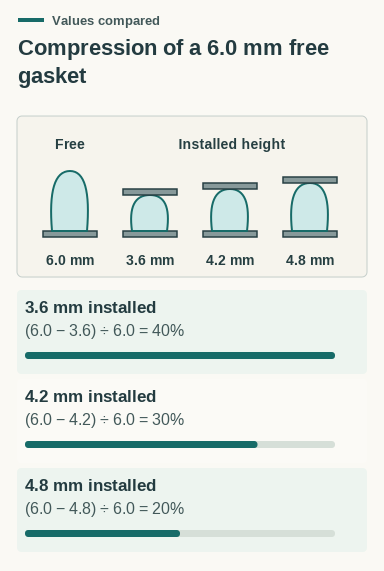
Let h be the free height of the active soft section and g its installed height. Compression equals (h − g) ÷ h × 100%. Exclude the retaining foot from h.
Assumed section dimensions are h = 6.0 mm (0.236 in), with installed gaps of 3.6, 4.2 and 4.8 mm. An assumed 6.0 mm soft sealing section compressed into a 4.2 mm gap has 30% compression. A 4.8 mm gap produces 20%, requiring another paired profile size or a corrected glazing build-up for the cited arrangement.
| Closed gap | Squeeze calculation | Compression |
|---|---|---|
| 3.6 mm / 0.142 in | (6.0 − 3.6) ÷ 6.0 × 100 | 40% |
| 4.2 mm / 0.165 in | (6.0 − 4.2) ÷ 6.0 × 100 | 30% |
| 4.8 mm / 0.189 in | (6.0 − 4.8) ÷ 6.0 × 100 | 20% |
Compression of a 6.0 mm free gasket
What if the groove or glass thickness differs from the order?
If the glass build-up leaves a wider pocket, choose the system’s designated wedge size that restores the back gasket’s working compression. If the glass is thicker, use the compatible smaller wedge or revise the approved glass build-up. Forcing the original wedge can overload the glass edge and make the bead difficult to seat.
A loose retaining foot needs a section matched to the groove width, depth and retaining shoulders. A larger bulb alone leaves the anchorage problem unresolved. For a sash gap that varies around the frame, correct sash alignment first, then select the approved bulb or cellular face for the remaining working-gap range.
Trial-fit a short sample and inspect foot retention, continuous contact and bead seating before ordering full rolls. Record the smallest and largest gaps around the opening so the profile covers both ends of the measured variation.
What does the Chinese gasket standard actually test?
GB/T 24498-2025, effective 1 August 2025, covers gaskets for building doors, windows and curtain walls. Clause 5.1.1 gives dense vulcanized rubber other than silicone five design hardness categories, 50, 60, 70, 80 and 90 Shore A, each with a permitted deviation of ±5. Official GB/T 24498-2025 record
GB/T 24498-2025 Table 3 limits compression set to 35% for dense vulcanized rubber other than silicone rubber, including the relevant EPDM material category. Clause 6.2.4 uses type A specimens under GB/T 7759.1-2015, a temperature of 100°C (212°F) for this rubber category, 22 hours with a +0.5/−0 hour tolerance, and specimen compression of 25±2%. GB/T 24498-2025 official standard entry
GB/T 24498 uses 25±2% compression for the laboratory specimen. For the installed gasket, use the profile-specific working gap and check sash-closing force.
Which ASTM and EN specifications fit the gasket material?
ASTM C864-05(2026) covers dense elastomeric compression gaskets and accessories for glazing and sealing between mechanically restrained surfaces. ASTM C864 scope
ASTM C509-06(2021) covers firm-grade cellular preformed gaskets and sealing materials. Its scope directs softer cellular secondary seals to ASTM D1056. ASTM C1115-17(2026) concerns dense silicone rubber. Select the material route stated in the order. ASTM C509 scope ASTM C1115 scope
EN 12365-1:2003 covers gasket and weatherstripping performance for controlling air, water, noise and energy passage between opening and fixed parts. An EN classification should identify the actual profile supplied. EN 12365-1 scope
Why do corners leak after a new gasket is fitted?
An extrusion stretched during fitting can creep back and open corner joints. Distribute the specified crowd allowance along the run. Support the glass correctly on its setting blocks before fitting the wedge.
NGA describes seating 2–3 in (51–76 mm) lengths at adjacent corners and then the midpoint to distribute excess length. Use the specified corner treatment and keep the weep system open. NGA installation guidance
Inspect twisted retaining feet, interrupted lips and blocked outlets before replacing sound rubber. Wider repair decisions include the glass and frame condition. Retrofit glazing and full-window replacement guide
FAQ
Can I replace the rubber seal on an aluminium window?
A removable seal can be replaced with a profile matching the groove, sealing face and glass or sash gap. Record the fitted location and section shape, then follow the system’s reglazing procedure for glass-contact gaskets.
Does 70 Shore A tell me how much to compress the seal?
70 Shore A describes dense-compound hardness. Working squeeze follows the profile geometry and closed gap. The 25–40% guidance concerns the softer member opposite a dense wedge in the cited compression-glazing assembly.
How do you seal EPDM gasket corners?
Use the corner arrangement specified for the extrusion, such as moulded or vulcanized corners or a compatible corner seal. Seat the gasket without stretching it, distribute the specified crowd allowance and leave the drainage outlets open.
Let YULUX review your drawings before pricing.
Send us your window schedule, floor plans or photos. We review opening sizes, system direction, glass, hardware, finish and packing scope before quoting.