
NZS 4211 Windows for New Zealand Projects
New Zealand's MBIE specification retains conditional NZS 4211:2008 and SNZ TS 4211:2022 routes, with a 2,500 Pa ULS ceiling for the listed specific-design routes. For the E2/AS1 timber-framed building pathway, the scope includes a maximum of 3 storeys and 10 m from ground to the highest roof point, alongside its other conditions.
The details behind the answer
Select the window rating and installation detail within that pathway. MBIE Building Product Specifications, section 4.4.1.1 MBIE E2/AS1 scope
Which version belongs in a New Zealand window specification?
SNZ TS 4211:2022 supersedes NZS 4211:2008 in the standards sequence. The official CodeHub record identifies the earlier version and the later document’s classification role. MBIE CodeHub SNZ TS 4211:2022
SNZ TS 4211:2022 addresses air permeability, water penetration, strength, rigidity and operability in relation to the window exposure and design situation. Standards New Zealand release
The MBIE Building Product Specifications, first edition amendment 1, took effect on 2 April 2026. Under §4.4.1.1(a), the 2008 route needs suitable serviceability, water and strength parameters for engineer-calculated SLS/ULS where specific design is required, with ULS no greater than 2,500 Pa. MBIE product specification
Under §4.4.1.1(b), TS 2022 EM7 covers wind zones through Extra High or engineer-calculated ULS no greater than 2,500 Pa; SED also needs suitable serviceability, water and strength parameters, with the same ULS ceiling.
Paragraph (c) alternatively permits AS 2047:2014 sections 1, 2.1.1, 2.3–2.6 and 8, using an ISO/IEC 17025-accredited facility registered for those tests and ratings meeting Table 4.4.1.2 for the wind zone. The parent acceptable solution’s scope still applies.
The citation path runs from Building Code E2 through the selected acceptable solution to its incorporated product provisions. MBIE lists E2/AS1 fourth edition as effective from 28 July 2025 and explains that the Building Product Specifications operate with the parent document's scope. Put that complete route in the design brief before the purchase order is released. MBIE E2 External moisture
Does E2/AS1 cover the proposed building and opening?
MBIE's E2/AS1 introduction covers hinged aluminium joinery installation and identifies sliding, bifold and other non-hinged profiles as requiring specific design. MBIE E2/AS1 introduction
A hinged window and a large sliding opening need their own sill, track and drainage junctions to the wall cladding. Assign the actual section detail to each opening before fabrication.
TS 4211 addresses discrete window and door units. Perimeter installation, curtain walls, durability, thermal performance, acoustics and fire performance sit outside its stated scope. Assign those matters to the relevant design evidence and trade scope. MBIE CodeHub SNZ TS 4211:2022
A rated unit still needs a continuous route for water to leave the wall assembly. Show how the head flashing, jamb treatment and sill drainage meet the selected cladding. Keep thermal replacement decisions with the New Zealand H1 replacement-window guide.
How do wind pressure and water resistance change the buying decision?
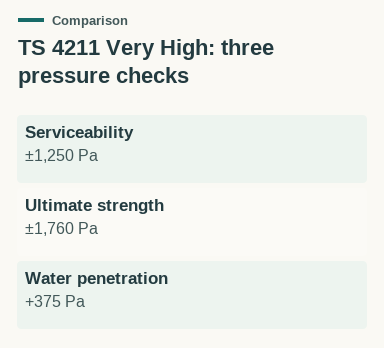
The association's TS 4211 summary gives Very High pressures of ±1250 Pa for serviceability, ±1760 Pa for ultimate strength and +375 Pa for water penetration. The rating follows the weakest relevant result. Window & Glass Association NZ performance guide, version 2.2
Keep serviceability, ultimate strength and water-test pressure in separate columns when evaluating a report. Serviceability concerns deformation under its stated loading. Ultimate testing addresses structural resistance under a different loading condition. Water testing addresses leakage during the specified wetting and pressure procedure. A single prominent pressure figure on a sales sheet cannot describe all of those outcomes.
Allocate the project wind requirement to each opening before choosing frame sections. A protected-looking elevation can still contain openings governed by the project's design assessment. Carry the sign convention and units from the engineer's schedule into the comparison so that an outward load remains distinguishable from an inward load.
| Test outcome | Selection |
|---|---|
| Structural and water results meet the assigned classification | Use the covered construction and dimensions with the matching wall detail |
| Structural result passes, water resistance falls short | Choose an assembly meeting the required water-test pressure |
| Pressure number has no test type or result | Leave the unit unclassified until the test is identified |
TS 4211 Very High: three pressure checks
Can a Chinese test specimen cover the imported production windows?
The association's production-window discussion links coverage to construction, dimensions and documented structural assessment. Larger or coupled assemblies need the applicable extension provisions. Window & Glass Association NZ performance guide, version 2.2
Build the production schedule around the assembly represented in the report. Changes to opening style, meeting stiles, mullions, glazing support or hardware can alter the load path and sealing behaviour. Give a change its own technical disposition before it reaches the cutting list. A product-family name alone leaves these differences unresolved.
Intertek Guangzhou's sample instructions require at least 120 mm between the timber frame's inner edge and the product profile, an externally sealed interface, an unsealed inside face and a planed timber inner edge. These dimensions apply to that laboratory's sample mounting. Intertek sample instructions
A coupled opening changes the location and maker of the final joint. The factory-joined assembly and any transport-split site joint need coverage for their actual mullions, seals and connections.
What should the label tell the receiving team?
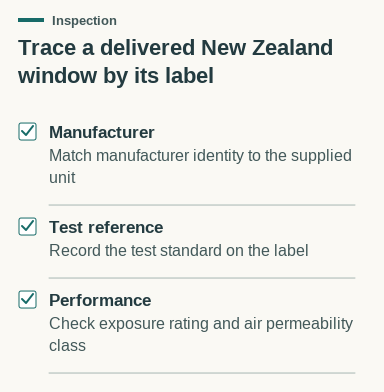
The association's label summary specifies manufacturer identity, test standard, exposure rating and air permeability class. Its listed fields provide a starting point for tracing the unit to the supporting report. Window & Glass Association NZ performance guide, version 2.2
Trace a delivered New Zealand window by its label
FAQ
Can a report to the 2008 standard still support a purchase?
Yes. The current MBIE product specification retains that route subject to its conditions. Match the report to the building's wind requirement and the actual supplied construction.
Does a Very High strength result settle the water rating?
The water result needs its own assessment. Evaluate the applicable test outcomes together before assigning the assembly's project classification.
Can I use the same report for a wider coupled opening?
Coverage needs a documented assessment of the wider assembly and its joints under the applicable production-window provisions. Resolve that coverage before fabrication.
Let YULUX review your drawings before pricing.
Send us your window schedule, floor plans or photos. We review opening sizes, system direction, glass, hardware, finish and packing scope before quoting.