
Customs Documents for Importing Windows: A Consistent Shipment File
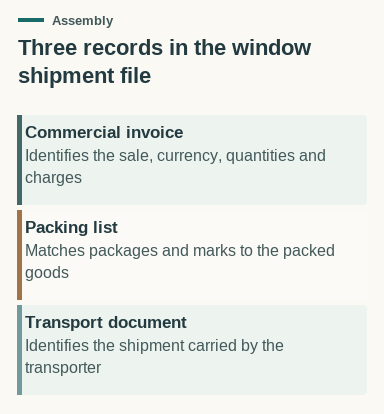
A window shipment needs an invoice describing the sale, a packing list locating the goods and a carrier document identifying the transport. Keep the destination entry and its supporting records after clearance, for 5 years in Australia and 6 years following importation in Canada. ABF record retention CBSA importer records
What belongs in the customs file for a window shipment?
The commercial records describe the sale, the packed goods and the transport. The importer or appointed declarant then uses those records for the destination entry. A pro forma quotation helps arrange the order, but the shipment file should describe what was actually supplied and the final transaction value.
An invoice saying only building materials leaves the frame material, opening type, glazing and supplied condition unclear. Identify finished glazed windows, unglazed frames, loose glass and separately supplied accessories accurately. The local tariff classification follows those goods. Aluminium-window HS classification
A certificate of origin, insurance document, product approval or packing declaration can be required for a particular trade or shipment. They are separate from the three commercial records, and their need follows the destination and the goods.
Three records in the window shipment file
How should the invoice, packing list and window schedule agree?
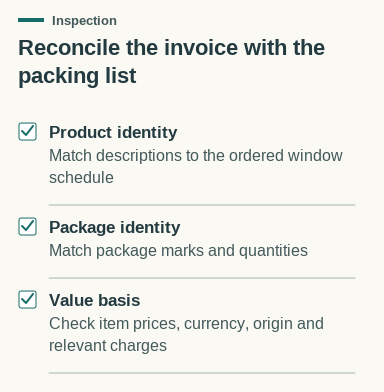
US invoice rules require detailed descriptions and package marks, quantities, item prices, currency, origin and relevant charges. Buyer-supplied tooling or engineering assists can also need disclosure. The commercial invoice should expose the information needed for valuation rather than hide every cost under one unexplained goods total. US invoice requirements
Keep one opening ID for each window and use the same ID on the fabrication schedule and crate contents. An invoice can group identical windows by line, while the packing list splits that line between crates. The reconciliation should still show where every complete unit and separately packed accessory is located.
For an illustrative load of 30 windows in 6 crates, assume 1,050 kg net goods mass and 60 kg per crate for the empty case and protective packing. Packaging adds 360 kg, giving 1,410 kg gross. A freight draft showing 1,050 kg gross has omitted packaging.
A crate containing 5 windows is one package and five products. Changing the packing-list heading to 30 packages would misdescribe the load. Loose handles in the same crate are contents of that package; separate accessory cartons add their own package count. Keep invoice quantity, product count and transport-package count in distinct columns.
Reconcile the invoice with the packing list
Which US ocean-freight information is needed before loading?
For ordinary covered US vessel cargo, the first 8 ISF data elements are due no later than 24 hours before loading at the foreign port.
Stuffing location and consolidator data are due as early as possible, no later than 24 hours before US arrival; for a voyage from the foreign loading port to the closest US port lasting under 24 hours, submit them upon loading at that foreign port.
Paragraph (f) permits best-available initial responses for manufacturer/supplier, ship-to party, origin and HTSUS number. Replace those estimates as soon as more accurate data is available, at least 24 hours before US arrival or upon foreign loading for the stated short voyage.
Paragraph (d) also requires updates when information changes or becomes more accurate before the goods enter US port limits. It creates no general 24-hour grace period. ISF timing, flexible data and updates
What does the Chinese exporter need for the origin-side declaration?
China’s goods-declaration guide requires a broker acting for the exporter to hold the exporter’s signed authorisation. It lists contracts, invoices, transport papers and packing lists among the commercial records supporting the electronic declaration. The guide’s reproduced Customs Law rule generally places export declaration after arrival in the customs-controlled area and at least 24 hours before loading, unless specially permitted. China Customs goods-declaration guide
The trading seller and manufacturing factory can be different legal entities. Keep the manufacturer named in product reports traceable to the goods sold by the exporter.
How do the destination document checks differ?
Australia’s declaration page lists the transport document, invoices, identity and relevant permits or approvals for in-person lodgement. The UK process separates the importer’s EORI, commodity code, value, declaration responsibility and conditional licences. Canada’s records rule preserves the transaction and origin trail after release. Australian declaration documents UK import steps
Under a DDP sale, identify the actual importer and the party keeping the entry records before the goods move. For US carrier evidence, acceptable B/L, air-waybill and carrier-certificate forms are addressed separately from the customs release itself. US carrier evidence of entry rights
Can a test report or origin certificate replace missing commercial papers?
Use the test report for assessed product performance, the invoice for sale value, the packing list for packed quantities and the carrier document for transport rights. Keep building-permit approvals linked to the ordered configuration alongside those commercial records.
Origin evidence serves its stated purpose. A preference claim needs the applicable agreement’s evidence and origin rules, while shipment from a port identifies a transport movement. A generic certificate should not be treated as an automatic duty exemption.
Which records stay with the importer after release?
Canadian commercial-import records include origin, purchase, valuation and payment information within the retention period stated above. CBSA D17-1-21
Store the final invoice and packing list alongside the carrier release, submitted declaration, amendments, assessment and relevant approvals. Distinguish a filing acknowledgment from a release and a carrier delivery order. Keep the final corrected version linked to its earlier amendment trail.
FAQ
Are the commercial invoice and packing list interchangeable for imported windows?
No. The invoice records the sale and value; the packing list locates the goods by package. A load of 30 windows in 6 crates has 30 products and 6 transport packages, which must remain separate counts.
Does every window import need a preferential certificate of origin?
No. Preferential origin evidence follows the applicable agreement and claim. It is separate from the invoice’s country-of-origin information and does not replace product approvals.
When should the factory provide US ocean ISF information?
Provide the first 8 elements at least 24 hours before foreign loading. The two stuffing/consolidator fields and the four initially estimated fields have distinct deadlines under 19 CFR 149.2(b)(3) and (f).
How long should Australian and Canadian window importers retain the paperwork?
Australia requires relevant import-declaration records for 5 years. Canada requires relevant commercial-import records for 6 years following importation, including the purchase, origin, value and payment trail.
Let YULUX review your drawings before pricing.
Send us your window schedule, floor plans or photos. We review opening sizes, system direction, glass, hardware, finish and packing scope before quoting.