
Damaged Windows in a Shipment: Build the Sea-Freight Claim
A sea-freight claim for damaged windows wins or loses in the first hour at the loading dock: put the delivery exception in writing on the spot, lock down photos that tie the container and crate numbers to the specific window unit IDs, and build an itemized loss sheet before anyone cleans up the broken glass.
The details behind the answer
Protect the intact units, keep the damaged crates in place, and open both the carrier notice and the cargo insurance file while the evidence is still sitting on your floor.
What happens the minute the container doors swing open?
Stop the crew from cutting straps or pulling crates until you shoot the container number, the intact seal, the outer doors, and the stowage right as it arrived. If shattered glass or shifted A-frames make the box a safety hazard, your receiving crew's safe unloading plan comes first. Shoot what you can from a safe distance, pull only what is needed to make the area safe, and write down the exact units moved so the surveyor knows what shifted before they got there.
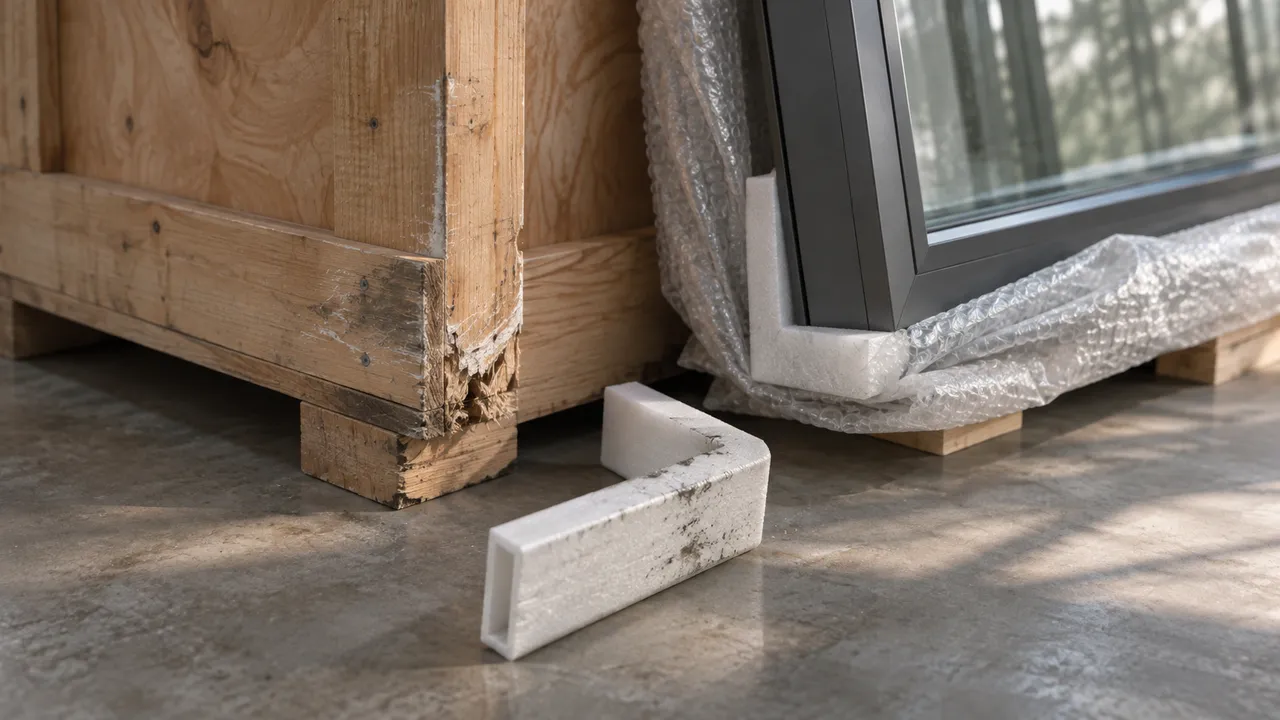
As you unload, keep a hard link between the crate number, the architectural opening ID, and the exact damage. Insurance adjusters treat a crushed crate corner, an intact crate holding spider-webbed IGUs, and a thermally broken aluminum frame bent by a forklift after unloading as three completely different stories. Put the exact physical facts on the delivery receipt before the driver pulls away. Stamping "subject to inspection" or "unchecked" is basically useless—write down "Crate 4 crushed on bottom rail, wet plywood, three broken glazing units heard inside."
Fire off emails to the window manufacturer, the freight forwarder or carrier, and your cargo insurer that same day, and save the sent timestamps. You need the factory immediately to pull the exact glass build-up, frame dimensions, and remake lead times, while your logistics and insurance teams open their reference numbers.
Which notice deadline actually governs your sea-freight claim?
For concealed damage you only find after uncrating, standard ocean carrier terms (like Maersk's clause 9) give you just 3 days from removal, whereas China’s revised Maritime Law (Article 88, effective 1 May 2026, which applies via Article 295 to international sea shipments touching a Chinese loading or discharge port) gives you 15 consecutive days for containerized cargo and 7 consecutive days for non-containerized cargo counting from the day after delivery.
For apparent damage you can see at the dock, both carrier clause 9 and China's Article 88 require written notice at or before delivery/removal (or at the discharge port if no delivery place is named). Under Article 88, if you and the carrier do a joint inspection at delivery, you don't need a separate written notice for whatever damage gets logged in that joint report.
What happens if your warehouse misses the 3-day or 15-day window? It doesn't automatically kill your claim, and signing a clean delivery receipt isn't a fatal trap. Under both the carrier terms and Article 88, missing the notice deadline just creates prima-facie evidence that the windows arrived in good condition as described on the bill of lading. It flips the burden onto you to prove the damage happened while the carrier had the box.
Never wait on a local glazier’s repair quote before sending your damage notice. Send the notice to stop the clock, and track the hard lawsuit time bar separately—under carrier clause 9, your legal team has 1 year from delivery (or the scheduled delivery date) to actually file suit.
| Applicable step | Starting event and timing | Record or action |
|---|---|---|
| Carrier clause 9: apparent damage | Before or at removal | Written notice to carrier/agent at stated delivery place |
| Carrier clause 9: concealed damage | Within 3 days from removal | Written notice describing loss/damage |
| China Article 88: apparent damage | At delivery | Written notice; joint-inspection exception limited to established damage |
| China Article 88: concealed damage | From day after delivery: 7 consecutive days non-containerized; 15 consecutive days containerized | Written notice within applicable period |
| Carrier clause 9: suit | Within 1 year after delivery or when delivery should have occurred | Track proceedings separately from damage notice |
| Formal quantified carrier claim | Follow actual carrier claim procedure | Itemized amount and supporting evidence |
| Separate insurance notification/application | Follow actual policy and insurer procedure | Notify insurer and supply its required documents |
What photo sequence proves the damage happened in transit?
A pile of close-up photos showing cracked glass won't get a claim paid because they don't prove which shipment the glass came from or how it was packed. As the carrier’s cargo-claims guide makes clear, you need photos showing the container number, the packing, the sound cargo alongside the damaged units, and ideally a joint survey while everything is still in delivery condition.
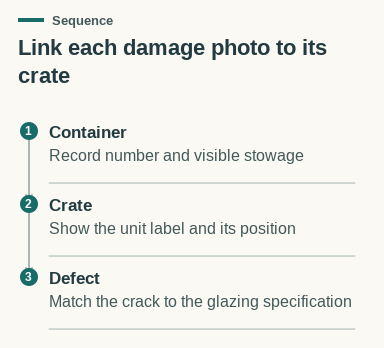
Shoot every damaged window in a strict four-step sequence:
- Wide shot of the crate sitting in the container or on the dock showing which face was exposed.
- Medium shot of the crate stenciling and packaging damage (crushed dunnage, snapped bands, fork tine holes).
- Close-up of the factory unit label on the window sash or frame showing the opening ID and glass spec.
- Detailed shot of the defect—pair cracked glass with its IGU build-up spec, and pair bent frame extrusions with a tape measure held flat against the bow plus the inspector's note on which profile member is twisted.
Do not let the site crew throw away the broken glass, timber crates, or strapping. Keep two linked sets of physical evidence—the damaged window units and their exact packaging/restraints—quarantined in a dry corner until the surveyor and insurer sign off on disposal in writing. If you have to board up an opening or move things immediately for weather or safety, take before-and-after photos and log why and when you touched it.
How do you calculate repair vs. replacement without double-counting?
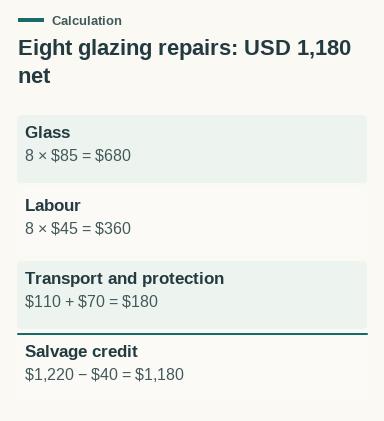
For an 8-unit glazing claim where the window frames are straight and sound, a clean net repair calculation lands at $1,180 USD after salvage.
The fastest way to get a claim rejected or slashed by an adjuster is double-dipping on parts and labor. You have to pick a lane for each opening ID: either the frame is structurally sound and can be reglazed on site, or the frame is racked/twisted (or the factory seal cannot be replicated locally) and the whole window has to be remade. If you claim a whole replacement window unit, you cannot also claim replacement glass or site reglazing labor for that same unit.
Below is how to structure a planning allowance for 8 damaged IGUs before the final vendor invoices come in:
| Loss component | Calculation | Amount |
|---|---|---|
| Replacement glass | 8 × $85 | $680 |
| Removal and reglazing | 8 × $45 | $360 |
| Dedicated local delivery | Documented allowance | $110 |
| Temporary protection | Documented allowance | $70 |
| Recoverable salvage | Deduct agreed value | −$40 |
| Net repair proposal | $680 + $360 + $110 + $70 − $40 | $1,180 |
Keep in mind that $1,180 is your documented net repair proposal, not a guaranteed payout check. Once you replace those planning numbers with hard local glazier quotes, factory commercial invoices, and the surveyor’s sign-off, the adjuster will still run the total through the policy's valuation, deductible, and carrier liability limits. When you attach the replacement quotes, clearly break out ocean/air freight, local site labor, and glass disposal so the claims handler can match the material value against your original commercial invoice and customs entry.
Link each damage photo to its crate
How do you lock down the claim file and get replacement windows moving?
Assign one named person on your team to own both tracks simultaneously: driving the two claim files (carrier and insurer) and placing the factory replacement order so the construction schedule doesn't stall.
First, split your notices from your final claim package. As Crowley's reporting guide points out, your initial loss notice just puts the carrier on alert; the formal quantified claim comes later with the commercial invoice, packing list, bill of lading, delivery receipt, survey report, and repair invoices. At the exact same time, open a separate claim under your cargo insurance policy (see the Maersk cargo-insurance checklist for typical required docs). Filing a carrier report does not notify your insurer, and neither one pauses legal suit deadlines.
To back up your transit investigation, pull the factory's pre-shipment inspection record and the container-loading plan. They won't single-handedly prove who dropped the crate, but pairing factory dispatch photos and crate positions with your arrival photos makes it very hard for a carrier to blame "improper packing."
Second, don't wait for the insurance payout to reorder your glass or frames, and never tell a factory to "remake the broken one in the photo." On US window projects, have your local installer verify whether the site needs temporary weather boarding, glass-only IGUs, or full replacement frames. Ordering from a photo is how you end up with the wrong Low-E coating, wrong thermal break finish, or backward hinge handing.
Pull the exact approved shop drawings for the window units and hand your supplier a complete packet when you price the affected glass or window replacements:
- Action owner: Name and contact of your project manager handling the remake and surveyor access.
- Unit IDs & damage schedule: The exact spreadsheet tying crate numbers and opening IDs to the claim calculation.
- Approved configuration: Glass build-up, frame finish, hardware, and handing from the original production sheet.
- Scope & destination: Whether you are buying IGUs only or complete glazed frames, plus the exact delivery address and unloading needs so the replacement quote works for both the jobsite and the insurance adjuster.
Eight glazing repairs: USD 1,180 net
Let YULUX review your drawings before pricing.
Send us your window schedule, floor plans or photos. We review opening sizes, system direction, glass, hardware, finish and packing scope before quoting.