
LCL Shipping for Windows and Doors Compared by Total Cost
LCL shipping shares a sea container between shippers. Under Maersk's published W/M rule, compare 1 m³ with 1,000 kg and charge the larger quantity. Window crates often reach the volume-based charge first; compare the full LCL and FCL cost through delivery to the same address.
How are window crates measured for LCL shipping?
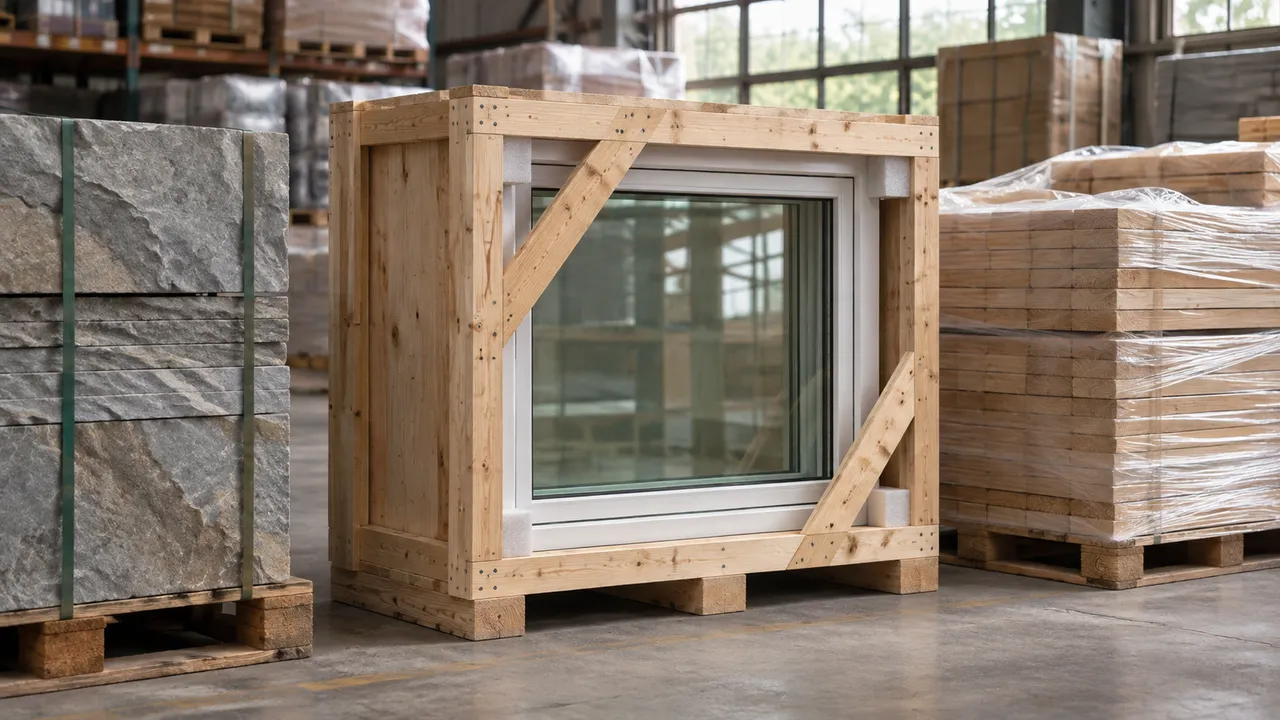
Start with the external dimensions of the packed crates. Include the pallet or base, protective framing and any parts projecting beyond the box. Then total the cubic metres and gross tonnes across the shipment. The carrier's stated density rule determines which quantity becomes the W/M basis.
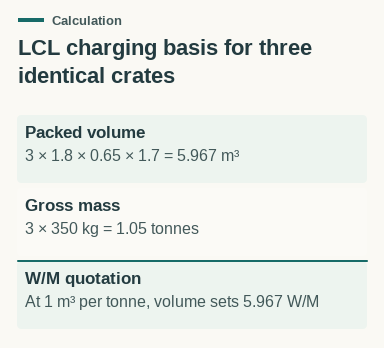
The transport budget uses 3 identical upright crates, each 1.8 × 0.65 × 1.7 m externally, approximately 71 × 26 × 67 in, and 350 kg gross. It assumes an LCL quotation using 1 m³ per 1,000 kg W/M. Illustrative USD inputs are 90/W/M for ocean freight, 35/W/M for origin handling and 60/W/M for destination handling, plus 260 in fixed charges and 420 for final delivery. The base accepts the declared crates without an extra non-stackable or special-handling charge. An alternative adds a USD 250 allowance for non-stackable space or special handling. The FCL comparator is 1 × 20GP at a hypothetical USD 2,000 total covering origin operations, ocean freight, destination operations and final delivery to the same address. Cargo insurance and import taxes are budgeted separately for both options.
The volume calculation is 3 × 1.8 × 0.65 × 1.7 = 5.967 m³. Gross mass is 3 × 350 ÷ 1,000 = 1.05 tonnes. Under the stated rule, volume controls the W/M base. The booked rate's rounding and minimum-charge provisions apply to the commercial invoice.
LCL charging basis for three identical crates
Is LCL cheaper after origin and destination charges?
The volume-linked inputs total USD 185/W/M. Fixed charges and delivery total USD 680. The base calculation is therefore 5.967 × 185 + 680 = USD 1,783.895, rounded to USD 1,783.90. The added handling charge changes the preferred transport budget without changing the goods.
Maersk's Ocean Base Rates definition excludes other charges, and Part 1 clause 9 allows separately charged packing services. Include required repacking, palletisation and lashing in the freight quotation. Carrier terms
| Budget component | Charging basis | LCL amount, USD |
|---|---|---|
| Ocean freight | 5.967 × 90 | 537.03 |
| Origin handling | 5.967 × 35 | 208.845 |
| Destination handling | 5.967 × 60 | 358.02 |
| Documents and other fixed charges | Per consignment | 260.00 |
| Final delivery | Per delivery | 420.00 |
| Base total | Rounded after summing | 1,783.90 |
| Optional non-stackable or special handling | Per consignment | 250.00 |
| Total with additional handling | Rounded after summing | 2,033.90 |
| 1 × 20GP FCL comparator, same endpoint | Complete transport budget | 2,000.00 |
When do fragile or non-stackable crates favour FCL?
At the stated budget rates, the transport-cost crossover moves from about 7.14 m³ to 5.78 m³ when the USD 250 allowance applies. These are the crossover volumes against the assumed 20GP total for the stated delivery scope. A different container budget, destination, minimum charge or delivery arrangement produces a different result.
LCL introduces shared-container consolidation and deconsolidation. A glazed crate's top-load capacity, orientation and handling access therefore matter alongside its measured volume. An upright crate with a restricted top load may need additional occupied space or handling under the selected service's terms.
FCL can reduce exposure to shared-warehouse handling and gives the order a dedicated container. Its unloading arrangement still has to suit the crates and site. Where the LCL saving is small, evaluate that handling exposure against the replacement lead time and value of the glass assemblies.
Keep crates identifiable at consolidation
Which destination costs belong in the comparison?
The carrier lists 4 service scopes, covering door-to-door, door-to-warehouse, warehouse-to-warehouse and warehouse-to-door movements.
A warehouse-ended quote leaves a destination pickup leg to arrange. Door delivery also needs an agreed endpoint and unloading responsibility. The buyer's access road, delivery appointment and receiving equipment can change the cost of reaching that endpoint.
Price destination handling, documents, clearance and onward transport against the quotation. Maersk LCL Part 1, clauses 5 and 8 respectively cover storage beyond free time and the selected delivery endpoint; these determine which costs remain with the importer.
What happens at the Chinese consolidation warehouse?
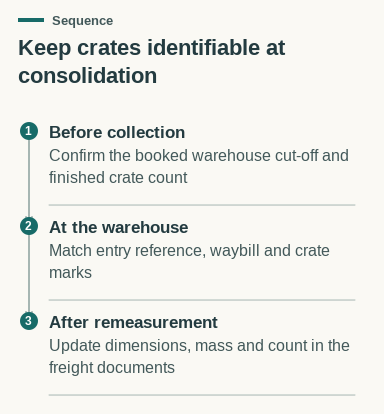
One Chinese forwarder specifies arrival 2–3 days before customs cut-off, with the warehouse-entry number and bill-of-lading number on the waybill.
The entry reference connects the arriving vehicle with the warehouse booking, while the bill-of-lading reference connects the consignment with its transport paperwork. The same provider's marking guidance includes the consignee, destination port and package number, helping warehouse staff distinguish similar crates.
The carrier booking confirmation supplies the actual warehouse cut-off. Arrange factory collection around that date and the finished packing state. If repacking or remeasurement changes the package count, dimensions or weight, those changes need to reach the shipping documents and charging calculation.
How long does LCL take to reach the project?
Schedule LCL delivery across 5 stages—factory collection, consolidation, sea transport, destination release and final delivery—and use the booked warehouse cut-off and sailing milestones to plan installation. Consolidation adds a warehouse handover before sailing, and destination release adds unpacking, clearance and collection arrangements after arrival. Use the selected sailing and warehouse milestones to establish the delivery date.
Book installation after final delivery and crate inspection. Revise that booking when a customs hold, missed warehouse cut-off or changed connection delays the shipment.
Freight allocation across the order
With equal crate volumes, the USD 1,783.90 base transport total allocates as USD 594.63, USD 594.63 and USD 594.64 across the 3 crates. That distribution preserves the rounded shipment total. For unequal crates, allocate volume-based charges by chargeable volume and distribute fixed costs under the buyer's chosen costing method.
The base LCL saving is USD 216.10 against the FCL budget. The added-handling case costs USD 33.90 more than FCL. Carry the selected transport total into the order's landed-cost calculation together with the actual import taxes.
FAQ
Is LCL cheaper than FCL for a small window order?
It can be. The stated budget gives LCL at USD 1,783.90 and 1 × 20GP FCL at USD 2,000. Adding the USD 250 non-stackable or special-handling allowance raises LCL to USD 2,033.90. The complete charging conditions determine the saving.
Why is LCL expensive at the destination?
Destination handling, documents, storage after free time and onward delivery can add to the ocean charge. A warehouse-ended service leaves a different delivery scope from a door-ended service. Price both offers to one named endpoint.
Is LCL sea freight or air freight?
LCL is shared-container sea freight. Urgent replacement glass can be evaluated through the separate air-freight guide for windows and glass, which uses the air-cargo chargeable-weight calculation.
Let YULUX review your drawings before pricing.
Send us your window schedule, floor plans or photos. We review opening sizes, system direction, glass, hardware, finish and packing scope before quoting.