
MOQ for Custom Aluminum Windows from China
Custom-window MOQ is the minimum order accepted under a supplier's stated product and quantity rules. Published finished-window offers include 1 unit for one supplier's existing standard series and 30 m² trial or 100 m² standard quantities for another supplier's listed casement programme, which permits mixed window and door types within one project. YULUX accepts orders from 1 window.
1. Can you order just one custom aluminum window?
Custom sizing and a new profile design involve different production work. A fabricator can cut an established profile to a project dimension within the system’s limits. A new cross-section adds tooling, trial extrusion and material procurement. Colour, glass, opening direction and hardware can also change the production batch.
A single operating window is useful for assessing handle movement, closing pressure and the installation interface. A corner sample shows the joint and finish at much lower shipping volume. Choose the sample that resolves the remaining purchasing decision. The sample-order checklist for aluminium windows covers how to connect sample approval to the production specification.
2. What drives the MOQ on a custom aluminum window order?
One custom-extrusion offer starts at 300 kg, subject to section and finish mix, while a separate window-profile listing specifies 500 kg per model. These are distinct upstream profile commitments for the selected sections.
The cited 500 kg-per-model profile listing adds 7–10 days for new tooling, with a fee refund after an unspecified cumulative order volume. A separate extrusion tooling guide describes small and medium dies as costing a few hundred to a few thousand US dollars, influenced by section size, hollow geometry and trial corrections.
One supplier's published extrusion offer specifies 500 kg per item in its own colours and 1 tonne per item for a custom colour, with stock material exempt from that offer's MOQ. Apply those quantities to the listed material order.
| Production choice | Published quantity or charge basis | Effect on a small order |
|---|---|---|
| Existing series and stocked finish | One supplier's existing standard series accepts 1 finished window | Uses an established section |
| New extrusion section | One custom-extrusion offer starts at 300 kg subject to section and finish mix, another lists 500 kg/model | Each new frame, sash and bead needs a material plan |
| New die | One guide gives a small/medium die cost example, the cited 500 kg/model listing adds 7–10 tooling days | Refund or credit requires an agreed cumulative volume |
| Custom RAL/powder colour | One extrusion offer lists custom colour at 1,000 kg/item and its own colours at 500 kg/item | A separate finish batch can exceed the fabrication quantity |
| Anodising or special glass | Finish, thickness, coating and fabrication batch quoted for the specification | Standard stock options reduce separate procurement |
| Bought-in hardware set | One Chinese supplier lists 100 sets for its concealed tilt-and-turn hardware | Fabricator stock can absorb a component minimum; imported sets need separate terms |
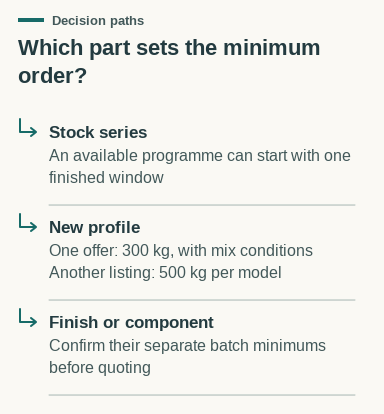
Supplier-specific minimums: 1 window, 300 kg with mix conditions, or 500 kg per model
3. Can mixed sizes and doors meet a 30 m² minimum?
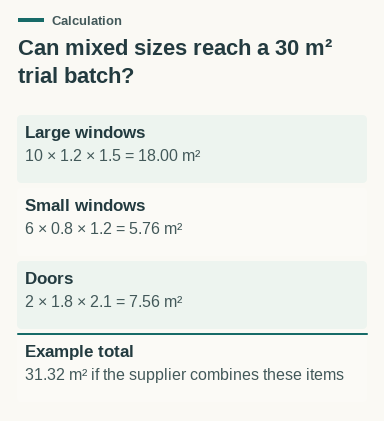
For the schedule below, 10 larger windows, 6 smaller windows and 2 doors total 31.32 m², which is 1.32 m² above a 30 m² trial threshold.
Assumptions: outer-frame dimensions of 1.2 × 1.5 m, 0.8 × 1.2 m and 1.8 × 2.1 m. Count width × height × quantity for each mark. Billing area and mixed-system aggregation follow the chosen supplier’s order policy.
Give every opening its own mark, then group the schedule by frame family, finish and glass option. Retain the individual sizes when presenting the total area. The guide to reading window schedules for quotations helps organise these fields.
Combining unrelated purchases can introduce extra colours, separate destinations and different approval dates. Use the quantity that the actual project needs. Extra windows bought only to reach a threshold still require storage, handling and payment.
| Scheduled item | Quantity × width × height | Calculated area |
|---|---|---|
| Larger windows | 10 × 1.2 m × 1.5 m | 18.00 m² |
| Smaller windows | 6 × 0.8 m × 1.2 m | 5.76 m² |
| Doors | 2 × 1.8 m × 2.1 m | 7.56 m² |
| Project total | 18 units | 31.32 m² |
Can mixed sizes reach a 30 m² trial batch?
4. What makes a small order cost more per window?
Fixed charges fall from $50.00 to $15.00 per window when an assumed $900 setup cost is spread across 18 rather than 60 windows, a $35.00 reduction per unit. Extra windows are worthwhile only if the project needs them.
Assumptions: USD, $900 fixed tooling/setup charge, $1,200 quoted LCL freight for 30 m² and $2,500 quoted 20GP freight for 100 m². Freight figures are calculation inputs. Actual rates require a route, sailing date, crate dimensions and matching origin/destination charges.
The LCL input gives $40/m² and the 20GP input gives $25/m², a $15/m² difference. A 100 m² order fits that scenario only if its packed racks pass the loading plan. The window container-loading calculation covers crate volume, protected loading and usable space.
Compare the total purchase, packing and freight at the same delivery term. A freight-only saving can disappear when destination handling, storage or inland delivery is added. An unused extra batch also ties up cash and can introduce glass or finish differences when the building changes.
| Cost input | 18 windows / 30 m² | 60 windows / 100 m² | Difference |
|---|---|---|---|
| $900 fixed setup ÷ windows | $50.00/window | $15.00/window | $35.00/window |
| Quoted freight ÷ area | $1,200 ÷ 30 = $40/m² | $2,500 ÷ 100 = $25/m² | $15/m² |
5. How should you plan samples, timing and packing?
One supplier's published sliding-window FAQ gives about 20 days for its standard series and 40 days for custom profiles or finishes, with the production-start trigger unspecified. Agree that trigger and schedule approval and transport separately. Delivery planning
For EU-bound regulated solid-wood packaging, treatment, marking and debarking are required, with exemptions including processed wood and wood no thicker than 6 mm. European Commission packaging rules
Identify the wood used in the crate base and braces as well as the outer panels, then follow the export-packing guide. Small consignments need external packed dimensions and gross weight for the forwarder.
FAQ
Can I buy only one aluminum window from China?
One supplier publicly lists 1-window orders for its existing standard series. Separate upstream examples start at 300 kg for custom extrusion subject to section and finish mix, and 500 kg per model for a listed window profile.
Can windows and doors count toward the same MOQ?
The cited casement programme permits mixed window and door types within one project for its 30 m² trial minimum. The illustrative schedule totals 31.32 m² across 18 units under that aggregation policy.
Do I have to pay for a new aluminum window die?
A new extrusion section can carry a separate die charge, with published small/medium-section examples described as a few hundred to a few thousand US dollars. Some suppliers credit the fee after an agreed volume. An existing die can avoid that new tooling charge.
Let YULUX review your drawings before pricing.
Send us your window schedule, floor plans or photos. We review opening sizes, system direction, glass, hardware, finish and packing scope before quoting.