
How to Audit a Window Factory in China Before Ordering
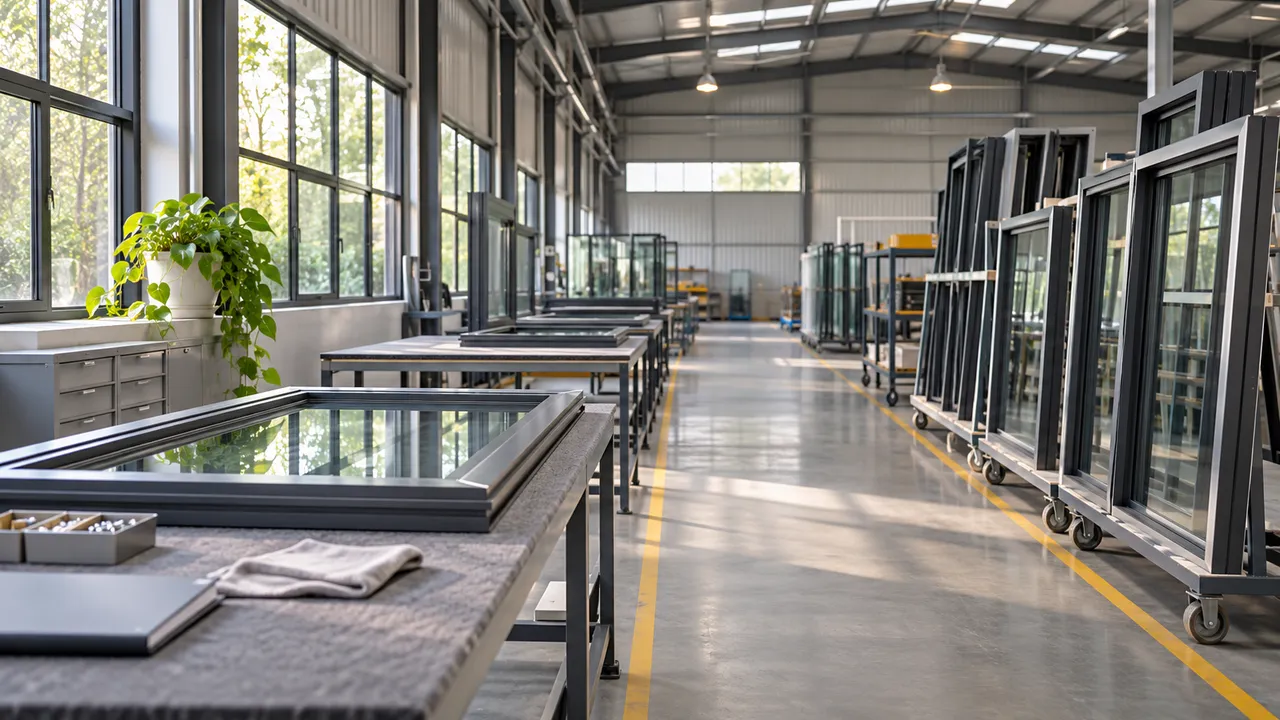
Forget the generic clipboard checklist. A real window-factory audit does one thing: it takes a single identified window unit and follows it through the actual production route—from incoming aluminium profiles and glass down to the packing crate—to prove the workshop can build your exact configuration repeatedly without losing track of the specs.
Before you even look at a saw, verify who you're actually paying and whose floor you're standing on. If you're still shortlisting, we break down the early vetting steps in our China supplier-finding guide.
Who actually owns the workshop making your order?
Match 3 things before you step onto the shop floor: the Chinese legal name and 18-digit Unified Social Credit Code on the business licence, the company name on your proforma invoice, and the actual factory address where the saws are running. Pull their registration up on China’s National Enterprise Credit Information Publicity System.
In Foshan and across Guangdong, it's completely normal for a factory to use a Hong Kong or trading entity to collect USD, or to have their sales office in one district and the assembly line in another. That’s not an automatic red flag, provided they give you a verifiable paper trail—like common ownership records or an explicit export-agent agreement—before you wire a deposit. What you want to catch is a pure middleman pretending a friend's showroom is their own factory.
Once the paperwork makes sense, map out what this site actually builds versus what they buy in. Most window fabricators don't extrude their own aluminium, coat their own profiles, or temper their own insulated glass units (IGUs). They buy those in and control cutting, CNC machining, crimping, assembly, glazing, and packing. Your audit needs to check how they specify those bought-in parts, who inspects the glass and profiles when the truck backs into the bay, and who holds the records when a batch of powder coating comes in scratched.
How do you trace a live order through the workshop?
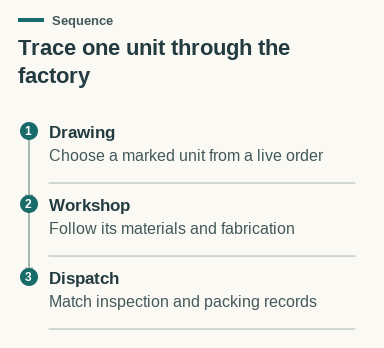
Pick 1 specific window unit from an active production order on the shop floor—not a polished corner sample in the showroom—and follow its reference number from the approved shop drawing all the way to the shipping crate.
At the opening meeting, ask for the current production schedule and pick a live job (ideally an export order similar to your aluminum window configuration). Write down the order number and a specific unit mark, say W-04. Now walk out to the saws and CNC centers. Can the operator show you the cut list or screen program for W-04, and does its revision match the approved engineering drawing? Follow that exact reference through frame assembly, hardware fitting, glazing, and final labeling. If W-04 is only half-built, observe the live stage and pull the completed workshop records for the rest of the route.
Where do orders usually go sideways? At the handovers:
- Drawing revisions after cutting starts: A client changes an opening size, the office updates the CAD file, and nobody pulls the already-cut profiles off the rack. Look for how they quarantine and scrap obsolete cuts.
- Quiet substitutions: The specified thermal break strip or hardware brand is late, so the workshop swaps in a local "equivalent" to hit the shipping date. Check the material rack tags against the bill of materials.
- Bad labels at the end of the line: The window is built right, but a worker prints tags from last week’s opening schedule. When those crates hit your job site, nothing fits the rough openings.
When taking photos or video, always capture the unit tag, the drawing revision block, and the physical part in the same frame so the evidence actually means something later.
What should you make the QC team measure in front of you?
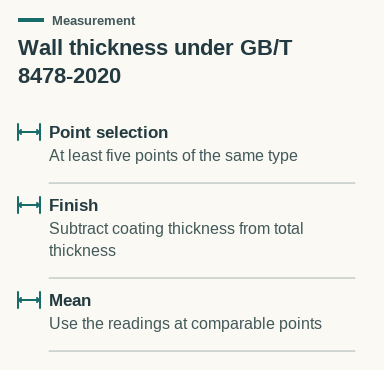
Have the inspector measure bare aluminium substrate thickness across at least 5 points on the same profile section, subtract the coating thickness, and calculate the mean to 0.01 mm, right in front of you.
That isn't an arbitrary torture test—it’s clause 6.1.2.1 of China's national window standard, GB/T 8478-2020. Too many buyers let a factory stick a caliper on a powder-coated flange, read 1.42 mm, and call a 1.4 mm spec passed—ignoring the 60–80 microns of coating sitting on top of the metal. Watch them zero the gauge, see where they place the probe, write down the raw readings yourself, and verify how they deduct the surface layer.
Next, test their incoming material checks (covered under clause 6.1.1). Don't just flip through a binder of neatly ticked QC sheets. Take the order reference you picked earlier and ask to see the incoming inspection record for its exact batch of glass and profiles, plus the supplier mill certificates. If their records claim 100% pass rates for six months straight, be skeptical. Ask them to show you the quarantine area where rejected profiles or scratched IGUs are held, and trace how a real defect was handled and replaced.
Trace one unit through the factory
How do you check each handover on the walk?
Use the single unit reference you chose at the start to connect what's on paper, what the worker is doing, and what gets recorded at four critical handovers:
| Handover | What to watch on the floor | Record to tie back | What to do when the link breaks |
|---|---|---|---|
| Approved drawing to cutting/machining | Operator works from the latest revision; barcode or job card matches | Signed shop drawing + cut/CNC sheet | Halt that batch; check already-cut stock for wrong dimensions |
| Incoming materials to assembly | Profile alloy/coating, IGU makeup, and hardware brand match spec | Incoming QC sheet + supplier cert + BOM | Quarantine unmarked parts; force a formal review for any swap |
| Finished unit to final QC | Inspector demonstrates squareness, operation, and visual checks | Final inspection report + unit ID tag | Rework the defect and re-test before the unit leaves the rack |
| Final QC to crating | Passed window goes into the right crate with matching site marks | Release sign-off + packing list + crate map | Hold the crate until labels and packing maps match the schedule |
Wall thickness under GB/T 8478-2020
Which audit red flags should stop your deposit—and can you see them on video?
A missing coffee room policy doesn't matter; an untraceable glass batch or an uncontrolled drawing revision should freeze your purchase order immediately.
It helps to split what you're seeing into the three audit buckets defined by ASQ (process, product, and system), but keep your buyer hat on:
- Deal-breakers (Hold the order): The factory can't link their NAFS, AS2047, or CE test report to the actual profile series and hardware they quoted you. The CNC operator is working off an old drawing revision. Glass racks have no batch labels, so nobody knows if the Low-E coating is on surface #2 or #3.
- Fixable issues (Assign a deadline): Calibration stickers on tape measures are expired, or QC sheets are messy but the physical checks and tags on the units are solid. Give them a target date to clean it up without derailing the timeline.
What if you can't fly to China? A live video walkthrough works well if you control the camera. Don't let the sales rep walk you through a pre-rehearsed route. Pick a window on the assembly line, tell them to zoom in on the frame sticker until you can read the job number, and then walk backward to the saw and forward to the QC desk following that exact number.
If the Wi-Fi conveniently drops every time they pass the glass storage area, or they won't show you the sub-factory doing the arch bending, note it down as an unverified gap. A video call also won't prove they have the capacity to hit your delivery date—you still need to look at how many lines are running and where the bottleneck is (usually glazing or bespoke coating). And remember, auditing the factory setup doesn't replace checking your actual goods before they go in the container; our pre-shipment inspection guide covers how to handle final cargo release.
How do you close audit findings before wiring money?
Never accept a promise like "we will pay more attention next time" to close an audit issue. Following the standard 4-stage audit loop (plan, execute, report, close), every real finding on your target configuration needs four hard pieces of evidence before you move forward:
- The exact spec or requirement that was missed.
- What you actually saw on the floor.
- Who is responsible for fixing the root cause.
- Proof that the fix works on the shop floor—not just a freshly typed Word document, but video or re-audit proof that the station is now using the updated cut sheet or gauge.
When you're weighing two or three factories against each other, plug these technical gaps directly into your commercial sheet—our supplier-comparison guide shows how to score them side by side. This matters even more on strict code builds like Canadian projects, where a swapped glazing gasket or unverified reinforcement bar invalidates the thermal and structural ratings your project engineer signed off on.
Three decisions to make before your next commitment
Before you sign the contract or release your deposit, sit down with the audit file, the shop drawings, and your quote, and make three cold commercial calls:
- Are the entity and factory boundaries locked down? You know exactly who gets paid, which facility cuts and assembles the frames, and who inspects outsourced glass and coatings.
- Does your specific window configuration have a proven workshop route? You've seen a comparable unit traced from drawing to crate without broken links, mystery materials, or undocumented shortcuts.
- Are the major technical gaps closed or priced into your risk plan? Any deal-breaker found on the walk is either fixed and verified, or you've built a mandatory hold-point inspection into the contract before mass production starts.
If you have an opening schedule, target destination, and glass/hardware specs ready—or an audit report with open technical questions you need a straight answer on—send them over to align a window quotation with the verified production scope. That way, the pricing and lead times you get are tied to a production route that actually exists.
FAQ
How many windows should I trace during a factory audit?
Start with 1 complete unit and trace it deep from raw profile to packing crate. If the paperwork and shop floor tags match up cleanly, you know their system works; if the trail breaks down, pull 2 or 3 more units at that problem station to see if it was a one-off mistake or a systemic mess. Leave statistical batch sampling for your pre-shipment inspection.
Does the window factory need to own its own extrusion presses and glass tempering lines?
No—in fact, most good export fabricators in China buy their profiles and IGUs from specialized upstream mills. You just need to verify two things for every outsourced step: that the technical spec sent to the sub-supplier matches your contract, and that the window factory actually measures and tests the parts when they arrive at the loading dock.
What has to go on the post-audit corrective action list?
Keep it to 4 columns: the original requirement, the exact failure seen on the floor, the specific fix the factory is putting in place, and the verified result after you re-check it. Tie final deposit release to closing the high-risk items on that sheet.
Let YULUX review your drawings before pricing.
Send us your window schedule, floor plans or photos. We review opening sizes, system direction, glass, hardware, finish and packing scope before quoting.