

Window Supplier Payment Terms and Deposit Milestones
A window-order payment schedule defines the deposit, remaining balance and event that releases each payment. Nanjing CCPIT illustrates a 30% deposit with 70% against a bill-of-lading copy, while one Chinese supplier's published terms use 50% at deposit and 50% before loading. Compare the payment event and percentage together. CCPIT payment example
1. What deposit percentage appears in Chinese supplier terms?
One Chinese supplier publishes T/T terms with a 50% deposit and 50% before loading. A separate supplier's supply-only policy requires 50% at order and the balance before shipment. Write the controlling event into the signed payment clause.
Nanjing CCPIT describes a 30% deposit and a 70% balance against a copy of the bill of lading as a trade-payment example. Agree the named document and its payment timing before using this structure.
Assumptions: compare a $20,000 goods order under illustrative negotiated 30/70 and 50/50 structures, excluding freight, duties, taxes and bank charges. The 30/70 example allocates $6,000 at order and $14,000 at the agreed balance event. The 50/50 example allocates $10,000 to each stage. The first transfer differs by $4,000, while both structures ultimately pay the same goods price.
Pair the amount with the approved specification. A late change to a casement-window configuration can change the goods total after the deposit has cleared. The supplier-comparison worksheet helps align scope across quotations.
2. When can the factory request the remaining balance?
One supplier sends a balance-payment notice 1 week before expected completion, and another requires the remaining 50% before loading. Put inspection, corrections and bank-clearance time ahead of the selected contractual deadline.
One Chinese supplier's published process requires a 50% deposit before drawing preparation, starts production after signed approval and closes changes 24 hours after receiving the signed drawings. Finish the size and handing check before that supplier's deadline.
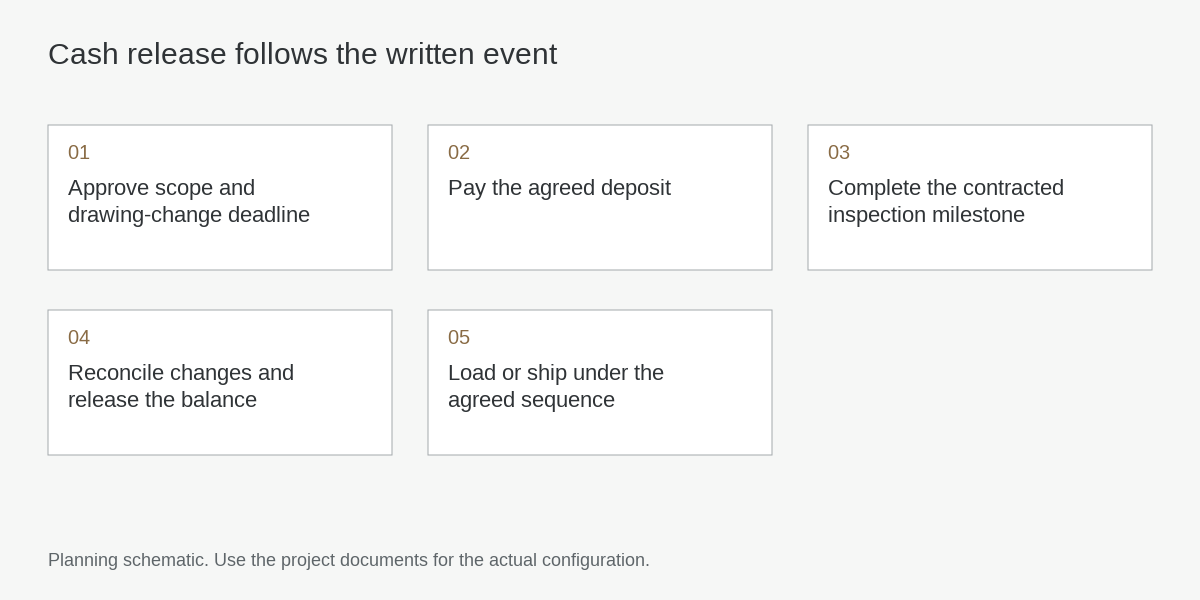
Place the inspection and correction allowance before the chosen balance trigger.
3. Which payment method fits the transaction?
The International Trade Administration's payment-method guide describes five arrangements across advance payment, documentary credit, documentary collection, open account and consignment. A T/T transfer carries money through the banking system. Its timing follows the purchase agreement.
Open-account trade terms can run for 30, 60 or 90 days after the agreed due-date starting event, subject to the seller's credit agreement. A published window supplier separately offers net30 from invoice only after approving credit. An importer planning to pay after arrival therefore needs an accepted credit arrangement in the quotation.
A 50% deposit leaves the other 50% on the agreed payment schedule, while escrow requires its own service arrangement. Price comparison should include bank charges, currency conversion and the agreed amount the seller must receive. Allocate these costs before the payment instruction reaches accounts.
| Arrangement | Payment mechanism | Order detail to settle |
|---|---|---|
| T/T deposit and balance | Transfers at named milestones | Currency, recipient, charges and balance trigger |
| Documentary L/C | Payment against complying documents | Issuing bank, required documents and deadlines |
| Documentary collection | Documents released against payment or acceptance | Sight payment or accepted maturity date |
| Open account | Delivery before payment falls due | Approved credit period and due-date basis |
4. How can inspection be linked to documentary payment?
ITA describes a 5-step L/C workflow in which banks check the required shipment documents before releasing payment. The ITA letter-of-credit explanation describes document review and correction of discrepancies. The goods inspection needs its own agreed scope and responsible inspector.
For an inspection-linked balance, agree 1 named inspection-release document and its issue point before accepting the payment schedule. Name who issues it, which order and drawing revision it covers, and how corrected items are recorded. For T/T, the same inspection milestone can be written into the purchase contract when both parties agree.
An L/C arrangement requires agreement from the seller and banks on its terms, charges and timing. Use the pre-shipment inspection checklist to connect the proposed document to actual unit IDs and inspection results.
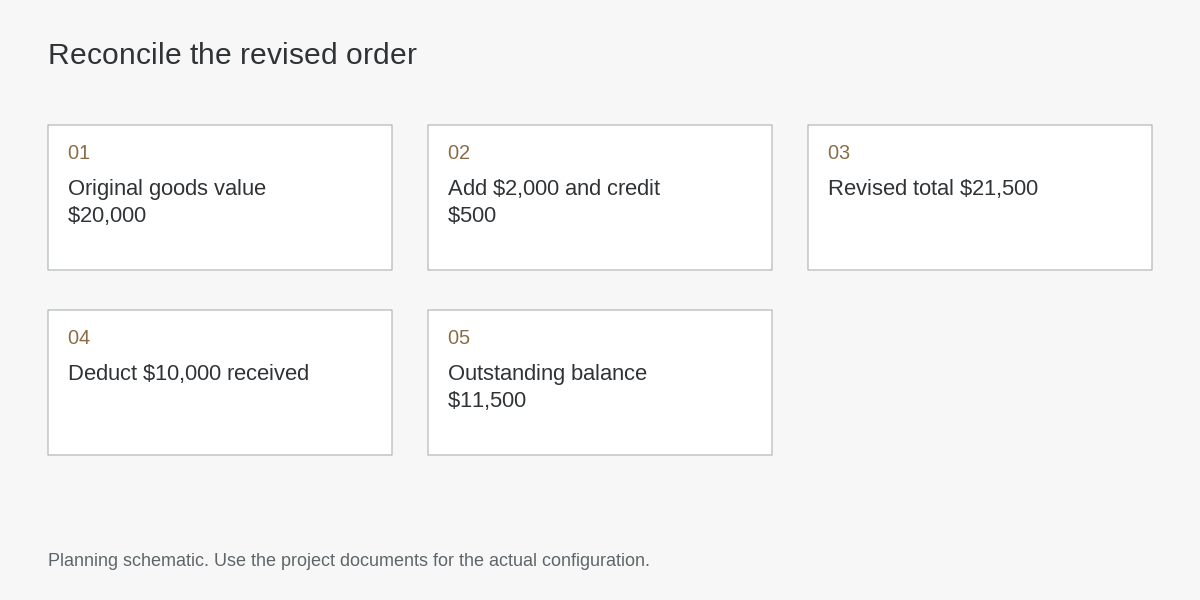
The deposit already paid stays visible throughout the calculation.
5. What is the correct balance after an order change?
A $20,000 order with $10,000 already paid, a $2,000 addition and a $500 credit leaves an $11,500 balance. The settlement ledger is based on the revised contract total and the deposit already received.
Assumptions: the original deposit remains $10,000, both parties approve the addition and credit, and the revised goods price excludes freight, tax and bank charges.
Revised price = $20,000 + $2,000 − $500 = $21,500. Remaining balance = $21,500 − $10,000 = $11,500. Applying 50% to the revised total would produce $10,750 and leave $750 unpaid.
Attach the approved change reference to the balance invoice. If the order ships in separate lots, allocate the goods value, deposit credit and agreed outstanding amount to each shipment before preparing the transfer.
| Ledger entry | Amount | Effect on settlement |
|---|---|---|
| Original order | $20,000 | Starting goods value |
| Deposit received | $10,000 | Credit against the final total |
| Approved additional work | +$2,000 | Raises order value |
| Approved credit | −$500 | Reduces order value |
| Revised order | $21,500 | Agreed amount to reconcile |
| Outstanding balance | $11,500 | Amount due at the agreed milestone |
6. Three checks at the bank-transfer screen
- Match the recipient. Compare the beneficiary name and bank details with the authorised seller record, and resolve a changed payment instruction through an established contact.
- Match the amount. Reconcile currency, deposit receipts, approved changes and allocated bank charges against the invoice.
- Match the event. Establish that the written payment milestone has occurred and that the agreed inspection or shipping record belongs to this order.
Arrange the order's payment schedule
YULUX's stated payment terms are 50% deposit and 50% before shipment.
FAQ
Is a 30/70 split available for every imported window order?
A 30/70 split is a negotiated example. On a $20,000 order it allocates $6,000 to the deposit and $14,000 to the balance. The supplier's accepted quotation determines the actual percentages and payment event.
Can I change the drawings after paying a window deposit?
One Chinese supplier's published process requires a 50% deposit before drawing preparation, starts production after signed approval and closes changes 24 hours after receiving the signed drawings. Other orders follow the change deadline and variation charges in their own signed contracts.
Does choosing an L/C pay for the shipment inspection?
An L/C requires the documents specified in its terms. Inspection scope, charges and who issues the agreed report are separate order arrangements. The bank's document review follows the agreed credit.
How do I avoid paying twice for an added window?
Use 1 revised ledger covering the original price, approved additions or credits, and every payment received. Pay the outstanding amount tied to the current invoice and contract milestone.
Let YULUX review your drawings before pricing.
Send us your window schedule, floor plans or photos. We review opening sizes, system direction, glass, hardware, finish and packing scope before quoting.