
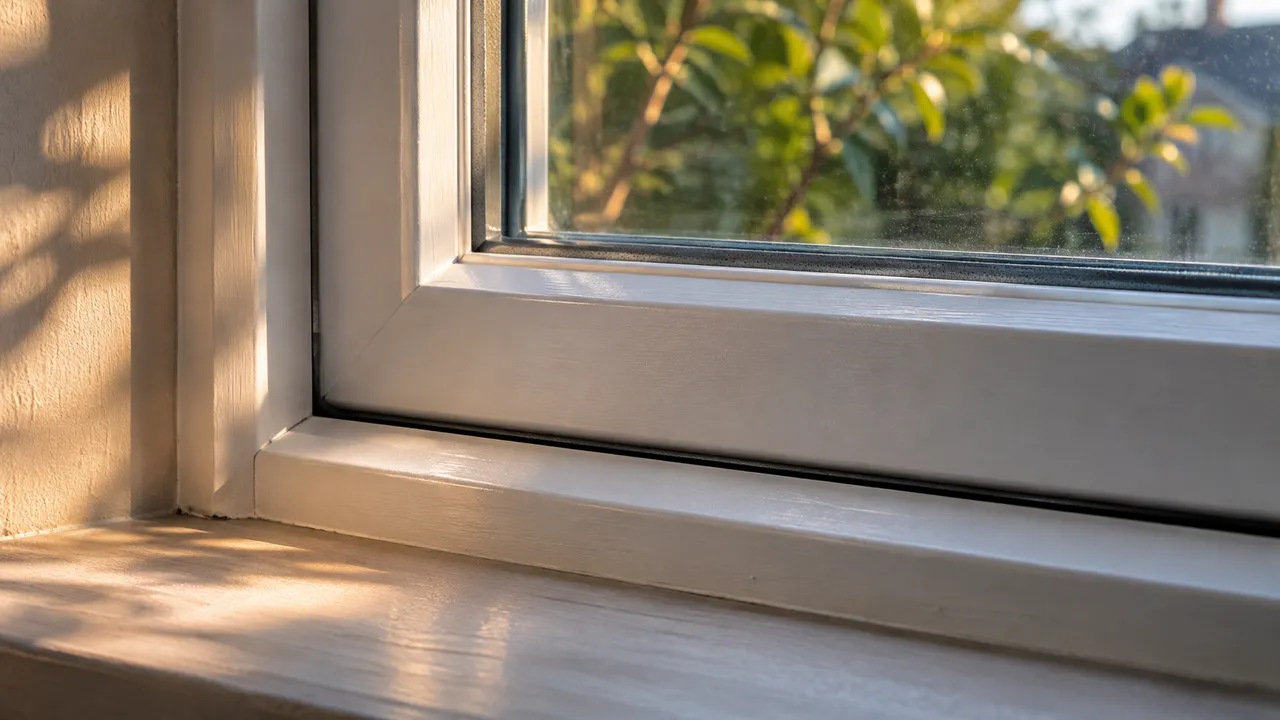
Window Whistling Noise in Wind, Diagnose the Air Path and Configuration
Trace a closed-window whistle to the sash seal, frame-to-wall joint or ventilator before choosing a repair. Geometry matters. In Rofail and Tonin’s partly open window experiment, the typical section produced tones at gaps up to 50 mm, while the tested smooth section produced none above 10 mm under the same through-opening airflow. Original wind-tunnel study
Why does my window still whistle when it is closed?
Close and engage all normal locking points, then listen at the latch side, hinge side, meeting stile, head and sill. Keep the sash closed during strong wind. A note concentrated at a closing edge directs attention to contact and alignment. A buzz localised to an accessible internal accessory directs attention to its attachment.
Trace 3 paths separately with the sash locked, the moving seal contact, the fixed frame-to-wall air seal and the ventilator. Air or sound beside the latch points towards sash alignment and gasket contact. Air emerging at wall trim directs the installer to the concealed perimeter connection. Sound that follows the ventilator’s intended settings directs the ventilation designer to its insert, hood and flow route.
Observe a controllable ventilator only through its intended operating positions and restore the normal ventilation setting afterwards. A change in sound at the vent identifies a component for the ventilation designer to assess. Keep required ventilation and drainage functional. A note at the sill can involve a missing system accessory, an exposed edge or a nearby external feature.
External access, work at height and removal of sashes, glazing or external covers belong to a local qualified technician. If airflow is felt at the wall trim, use the window air leak diagnosis to trace the installation joint before ordering hardware.
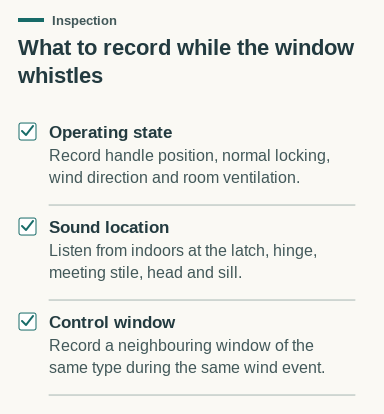
What to record while the window whistles
Why can a narrow window gap produce a loud whistle?
Air passing a narrow edge can organise into repeating fluctuations that generate a tone. A cavity beside that edge can reinforce particular frequencies. Wind direction changes the flow presented to the section, so the same opening can remain quiet in one storm and whistle in another.
A Japanese Society of Mechanical Engineers slit experiment linked the whistle frequency to velocity fluctuations at the slit outlet. Adding an edge plate changed the vortex structure and reduced sound pressure in its test arrangement. The mechanism makes edge geometry relevant alongside the size of the leakage path.
In Rofail and Tonin’s full-size, partly open aluminium-window wind-tunnel experiment, the tested typical section produced tones at gaps up to 50 mm, while the tested smooth section produced no aeolian tones above 10 mm. Those results apply to the two tested extrusions with fan-driven airflow through the opening. The Australasian Wind Engineering Society-hosted original paper reports increasing tone frequency with airflow speed and states that differential pressure was unmeasured. Wind moving across the opening remained for further study.
For a closed window, locate the unintended opening first. A replacement glass unit leaves a whistle-generating sash gap or external section edge in place. Where the complaint is traffic sound through the closed assembly, continue with the road-facing acoustic specification guide.
Which hardware or seal configuration should change first?
Start with the configuration that changed or failed. A recent hinge replacement may alter sash alignment. A seal replacement can introduce a different lip shape or thickness. A missing end piece can expose a small cavity. Photograph the existing section and compare it with an unaffected opening before selecting a corrective part.
The service technician checks that the sash follows its intended closing path and the locking points engage consistently. Adjustment uses the system’s documented range. Excess closing force, a folded gasket or a scraping corner calls for alignment assessment before further tightening. A replacement seal matches the groove, contact face and corner treatment.
| Observed response | Configuration to examine | Corrective route | Follow-up observation |
|---|---|---|---|
| Whistle falls after normal locking | Sash alignment and locking engagement | Restore documented closing geometry | Full locking travel and repeat gust recording |
| Note begins after seal replacement | Groove fit, lip shape and folded corners | Fit the system-compatible seal profile | Even contact with normal handle effort |
| Whistle or air emerges at wall trim while sash is locked | Frame-to-wall air-seal continuity and substrate condition | Installer and wall contractor restore the perimeter connection | Repeat same-location recording and draught check |
| Tone sits at an exposed end or cap location | End closure and cavity-edge geometry | Restore the specified accessory | Repeat recording and drainage inspection |
| Sound follows ventilator operating position | Vent insert, hood and airflow route | Ventilation-compatible component selection | Noise observation in required ventilation mode |
| Buzz follows a loose accessible cover | Attachment and clearances | Secure or replace the correct component | No contact noise through normal operation |
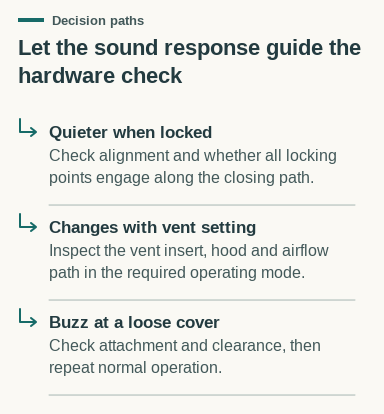
Let the sound response guide the hardware check
Would a higher air-tightness or acoustic rating solve the whistle?
Air leakage, resistance to wind pressure and airborne-sound insulation answer different specification questions. A whistle is generated by airflow interacting with geometry. Procurement therefore needs the reported noise location and operating condition alongside the complete-window test scope. Keep the tested opening type, dimensions and hardware configuration attached to the selected product.
GB/T 7106-2019 calculates classification air leakage at 10 Pa per opening-joint length and per specimen area, takes the adverse results across 3 specimens and treats positive and negative pressure separately. Its SAMR publication record identifies the building-window test standard. Keep the pressure, reporting basis and direction visible when comparing replacement configurations. Pair the leakage results with a separate recording of the whistle, its location and wind conditions.
For replacement procurement, select the opening arrangement around the actual ventilation pattern. A compression-sealed casement and a sliding meeting-stile arrangement place their air paths and hardware differently. A room that needs continuous background ventilation also needs a compatible ventilator selection. Describe the observed whistle in the schedule so a quieter glazing choice does not become the only response.
What belongs on the final configuration selection checklist?
At handover, operate the window through its normal travel, engage the locks, inspect the contact line and check drainage. Repeat the indoor sound recording when comparable wind returns. For a persistent tone, the project team can commission a local acoustic specialist to correlate the frequency with the suspected component and operating condition.
YULUX supplies aluminium windows. Request a configuration quotation with the opening sizes, current seal and frame section, ventilation arrangement and recorded noise location.
FAQ
What should I check when the window whistles even though it is closed?
Check 3 paths with the sash normally locked, the sash seal, the frame-to-wall joint and the ventilator. Record where the tone is strongest, inspect accessible seal contact and wall-joint defects, and compare only the ventilator’s intended operating positions. Keep drainage and required ventilation functional, then repeat the recording after the matched repair.
Can a partly open window whistle through a wider opening?
In the Rofail–Tonin partly open window experiment, the typical aluminium section produced tones at gaps up to 50 mm and the smooth section produced none above 10 mm under the tested through-opening airflow. The results apply to those sections and opening conditions.
What does a 10 Pa window air-leakage report tell a buyer?
At 10 Pa, GB/T 7106-2019 calculates classification leakage per opening-joint length and per specimen area, takes the adverse results across 3 specimens and treats positive and negative pressure separately. Pair those leakage results with a separate recording of the whistle and its wind conditions.
Let YULUX review your drawings before pricing.
Send us your window schedule, floor plans or photos. We review opening sizes, system direction, glass, hardware, finish and packing scope before quoting.