
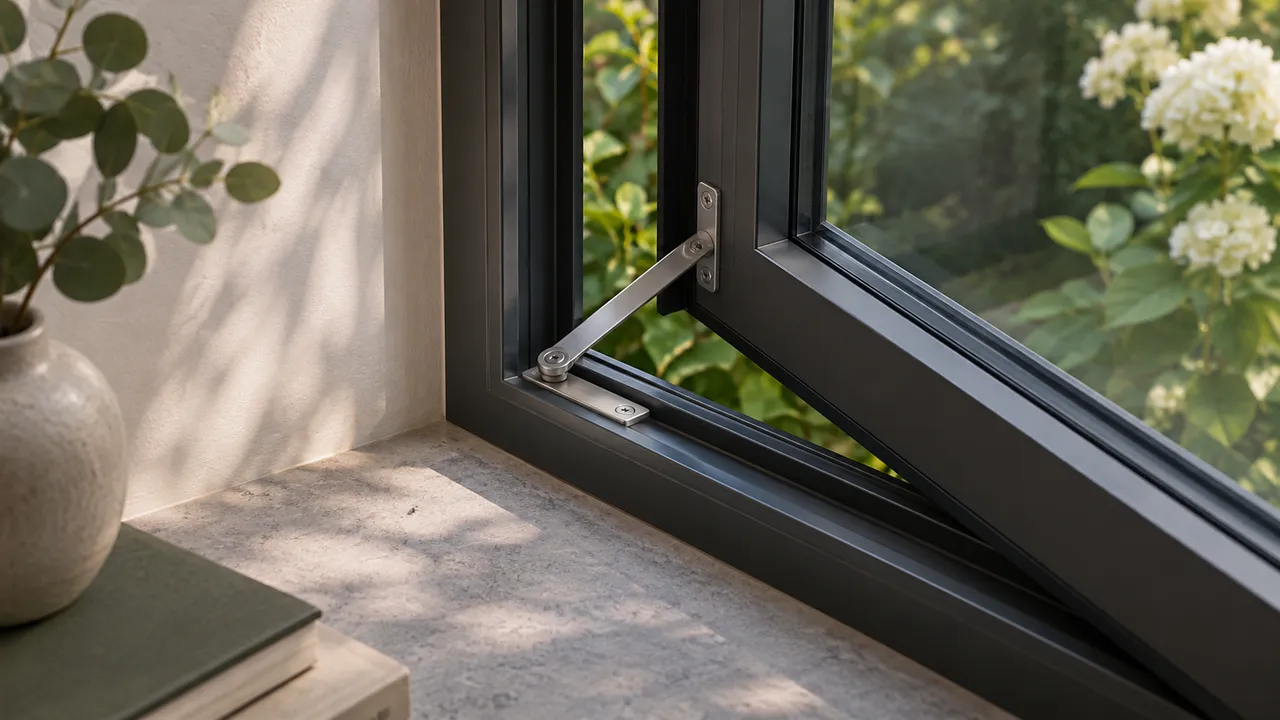
Window Opening Restrictor Specification by Gap, Load and Release
CWCT summarises BS EN 13126-5:2011+A1:2014 restrictor categories as a maximum 100 mm opening under 350 N for safety, and 89 mm under 500 N for child safety. Select the category and release arrangement for the room, then assess the largest aperture on the assembled window. CWCT restrictor guidance
How do the national rules change the specification?
CWCT attributes the British pairs to BS EN 13126-5:2011+A1:2014. Openings extending below guarding height without a separate barrier also need the applicable barrier-load assessment.
Australia's NCC 2022 Volume One D3D29(1)–(3) covers bedrooms in Class 2 or 3 buildings, Class 4 residential parts and Class 9b early childhood centres where the floor is at least 2 m above the surface beneath and the opening starts below 1.7 m. Under D3D29(2)(b)(ii), the device or screen must resist a 250 N outward horizontal action applied to the restrained window or protective screen. A releasable device also brings an 865 mm minimum barrier requirement. If the device can be removed, released or overridden to open beyond 125 mm, its release must be child resistant; the explanation gives a key, tool or two-handed action as examples. NCC D3D29 and explanatory guidance
The 2021 IRC R312.2.1 applies in dwelling units when the clear-opening bottom is below 24 in (610 mm) internally and more than 72 in (1829 mm) above the exterior surface below. Its routes include an opening that excludes a 4 in sphere at maximum opening or an ASTM F2090 opening-control/fall-prevention device. R312.2.2 requires the released device to preserve the emergency escape and rescue opening. 2021 IRC R312.2
The corresponding 2024 IRC provisions are R321.2, with window opening height in R321.2.1 and emergency escape and rescue openings in R321.2.2. The dimensional summary here follows the 2021 edition. ICC 2021–2024 comparison ICC existing 2024 baseline identifiers, RB132-25
New Zealand F4/AS1 section 2.1 applies where the possible fall from an open window exceeds 1000 mm. For housing and areas regularly used by children under six, paragraph 2.1.1 provides a 100 mm sphere restrictor option for openings under 1000 mm wide; wider openings follow 2.1.2 barrier provisions. The 460 mm opening option in 2.1.3–2.1.4 belongs to areas not likely to be frequented by those children and does not apply to housing. F4/AS1 opening windows
Does a restrictor reduce the NCC ventilation area?
Under the ABCB advisory note's sash-area interpretation, a 1.0 m² (10.76 ft²) openable sash contributes 1.0 m² (10.76 ft²) of nominal ventilation area after restriction. Its natural-ventilation explanation measures the openable sash and expressly addresses fitted restrictors. Actual airflow through the smaller gap can still decrease. ABCB advisory note, natural ventilation
A sash area and an air passage around the sash describe different quantities. Use the parallel opening window guide when comparing four-sided airflow with hinged opening geometry.
Where is the restricted gap measured?
Measure the largest accessible aperture around the sash at its restricted position, including changing side gaps on a top-hung window. Bracket position, hinge travel and frame movement all affect the result. A cable length or arm angle alone cannot define the finished opening.
Assumptions: rigid sash rotating about a fixed edge; width measured from that axis. Projection = width × sin(8 degrees). A 600 mm sash projects 83.5 mm, while an 800 mm sash projects 111.3 mm. Rebates and the actual hinge movement then change the clear aperture.
An 80 mm setting leaves 9 mm against an 89 mm limit. Measure installation variation and movement under load on the complete sample, including brackets, screws and frame movement.
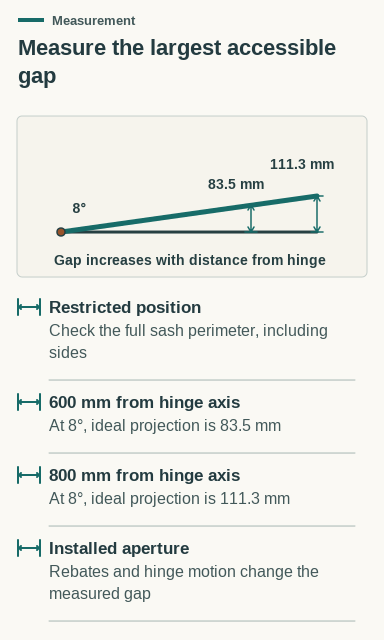
Measure the largest accessible gap
Will a surface-mounted restrictor fit a chamfered aluminium frame?
If a chamfered frame leaves no flat mounting land, a flat-backed surface device cannot sit fully supported. The mounting detail needs a compatible bracket, a different attachment location or a concealed device. For aluminium, establish the screw engagement and reinforcement behind the visible profile face as well as clearance from seals and drainage paths.
An exposed cable suits some retrofit geometries; a concealed arm needs the matching groove and travel; a restricted friction stay combines sash support with an opening stop. On tilt-and-turn windows, both tilt and turn modes need a defined operating sequence so that changing mode does not bypass the intended restriction.
A restrictor selection can distinguish nominal sash widths of 400, 500, 600 and 700 mm, with the opening angle specified separately. A detachable lock seat and arm allow cleaning and maintenance. The appropriate variant therefore follows the sash width, mounting drawing and release arrangement rather than a generic “limiter” description.
Is a key release appropriate for every room?
HSE's health and social care guidance recommends 100 mm or smaller openings, robust attachments and a special-tool or key release for vulnerable service users exposed to fall risks. A restricted hinge that the user can readily override does not meet that guidance for the identified situation. HSE window safety guidance
CWCT distinguishes the 350 N, 60-second holding check from its cited 850 N static-push research recommendation for foreseeable deliberate attempts in health and social care. Repeated wind action requires the applicable cyclic-load assessment.
BS EN 16281:2013 concerns consumer-fitted child-resistant locks for children younger than 51 months; its scope directs professionally installed devices to EN 13126-5. Do not substitute the consumer-device scope for the professional hardware category. BS EN 16281 scope
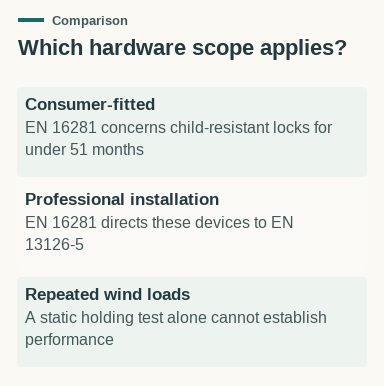
Which hardware scope applies?
FAQ
Is a 100 mm window restrictor automatically a child-safety restrictor?
The cited safety category pairs 100 mm with 350 N, while the child-safety category pairs 89 mm with 500 N. Select the specified category and its release arrangement.
Can the same opening angle be used for every sash width?
At 8 degrees, the fixed-edge model gives 83.5 mm projection for a 600 mm sash and 111.3 mm for an 800 mm sash. The clear aperture must be established on each assembled geometry.
Can an Australian restrictor be released for cleaning?
D3D29 permits a removable or overridable device with a child-resistant release and the applicable barrier protection. Its explanation includes a key, tool or two-handed action as release examples.
Let YULUX review your drawings before pricing.
Send us your window schedule, floor plans or photos. We review opening sizes, system direction, glass, hardware, finish and packing scope before quoting.