
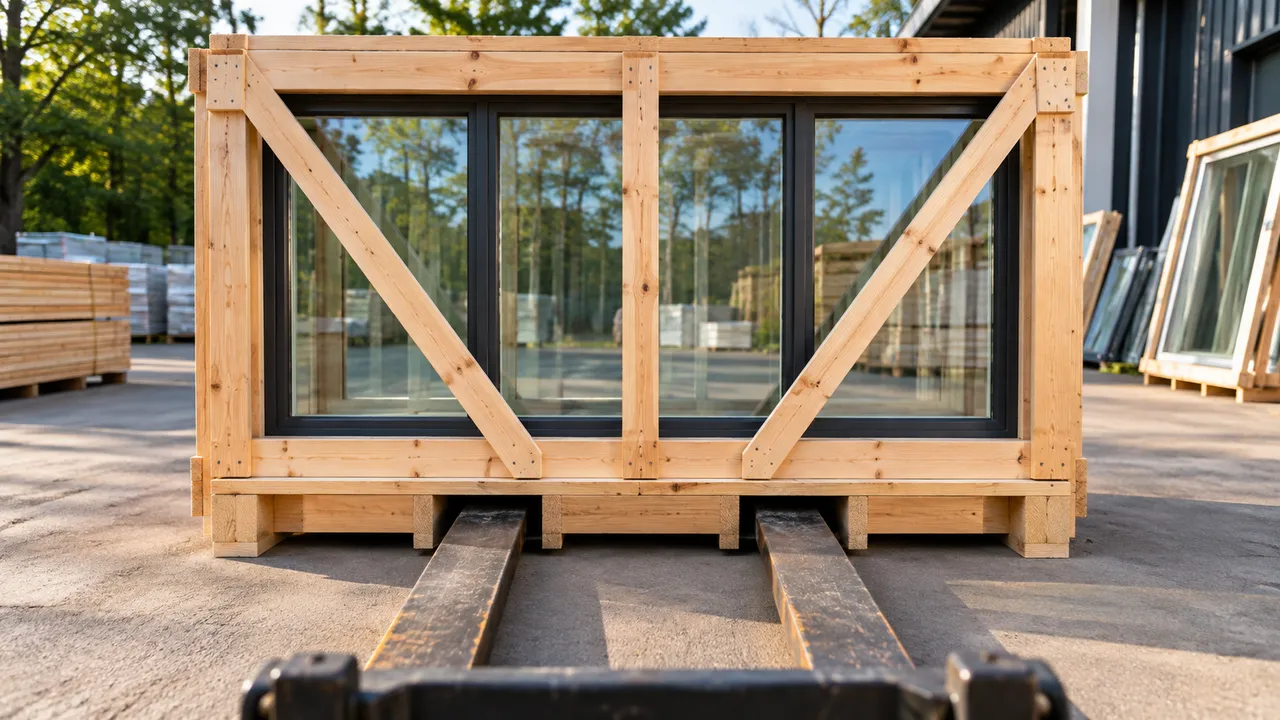
Window Crate Forklift Handling and Delivery Checks
Choose the forklift for the crate's actual load centre and attachment rating. OSHA's teaching example reduces a 4,000 lb rating at 24 in to approximately 2,666 lb at 36 in. This approximate calculation explains the effect of a forward load; the equipment manufacturer's approved rating determines the actual lift.
Why can a window crate overload a forklift below its nominal capacity?
The data plate associates capacity with a load position and equipment configuration. A crate's length, uneven contents or handling attachment can change that relationship. The receiving team needs the package's gross weight, intended pickup direction and centre-of-gravity information to select suitable equipment.
| Symptom | First check | Corrective action | Responsible party |
|---|---|---|---|
| Truck or load appears unstable | Actual load centre and applicable capacity | Reassess equipment and handling plan | Trained operator and equipment supplier |
| Forks cannot enter correctly | Pocket clearances and insertion path | Match equipment to the designed interface | Operator and packaging designer |
| Crate base is damaged | Load-bearing members and package restraint | Isolate the package for an approved recovery plan | Packaging provider and site manager |
| Glass or frames have shifted | Internal support and visible damage | Arrange a supported assessment before unpacking | Receiving supervisor and supplier |
| Receiving surface is unsuitable | Combined load and access conditions | Prepare a suitable unloading location | Site manager |
What does a 24-inch versus 36-inch load centre change?
Read the manufacturer’s load chart at the actual load centre, lift height and approved attachment configuration. OSHA describes 24 in (610 mm) as a common rated load centre; its illustrative 36 in (914 mm) example shows how moving the load forward reduces capacity. OSHA load-composition guidance
Uneven contents can move the crate's centre of gravity away from its geometric midpoint. Show the actual centre of gravity and pickup direction on the crate drawing.
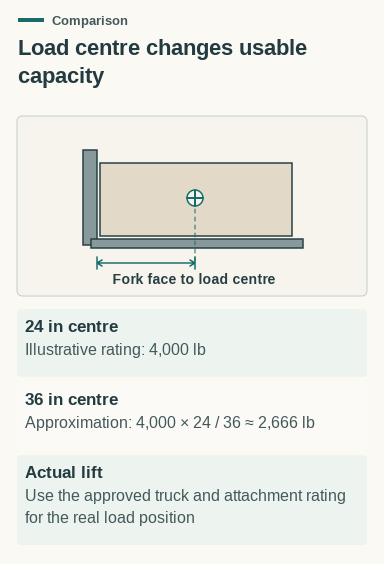
Load centre changes usable capacity
Which fork-pocket dimensions must match the receiving equipment?
The crate drawing should identify the designed entry side and load-bearing base members. The receiving equipment's usable fork geometry must fit that interface while supporting the package as designed. Pocket clearance alone leaves the insertion depth and loading direction unresolved. Match 4 fork-interface dimensions—clear pocket width, clear pocket height, pocket spacing and effective insertion depth—to the receiving forks and the crate's designed support.
For US workplaces covered by OSHA 29 CFR 1910.178(a)(4), modifications or additions affecting capacity and safe operation require the manufacturer's prior written approval and corresponding changes to capacity, operation and maintenance instruction plates, tags or decals. With non-factory front-end attachments, paragraph (a)(5) requires truck markings identifying the attachments and the approximate combined truck-and-attachment weight at maximum elevation with the load laterally centred. Paragraph (a)(6) requires nameplates and markings to remain in place and legible.
| Crate information | Equipment information | Receiving decision |
|---|---|---|
| Clear pocket width | Fork width | Entry fits the designed opening |
| Clear pocket height | Fork thickness and required clearance | Fork travels through the intended path |
| Pocket spacing | Available fork spacing | Both forks align with the base |
| Effective insertion depth | Usable fork length | Designed support is reached |
| Pickup direction and centre of gravity | Applicable rated configuration | Capacity matches the actual load position |
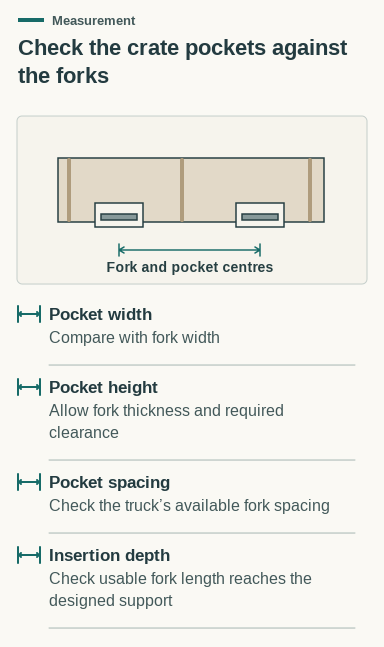
Check the crate pockets against the forks
Can the truck unload on the available slab or loading area?
Add 2 load inputs—the forklift's operating weight and packed-cargo gross weight—before checking the receiving floor's allowable load.
Plan the route from the delivery vehicle to the storage support. Include the available space for the loaded truck, the receiving surface and the location where the package will be put down. Delivery appointments should allow the receiving team to prepare that area before the crates arrive.
How should a tall glazed crate be received and uncrated?
Keep the package in its designed upright transport orientation and use its designated base interface. A trained operator handles the load within the equipment's applicable capacity and the package's support instructions. OSHA's load-handling guidance requires a stable, secured and centred load.
Before unloading, match the crate marks with the delivery list and examine the accessible base, restraints and visible contents. Photograph visible damage or displacement from a safe position. An affected crate needs a supported assessment and an agreed recovery method before its restraints are disturbed.
Place the package on its planned storage support. Fit the supports required for each glass or frame component before releasing its transport restraint. Follow the packaging provider's brace-and-strap removal sequence.
Use the shipping-damage claims guide for the commercial record after a problem is identified. The export packing checklist covers the package identification and protection prepared before dispatch.
Delivery and handover checks
Confirm 5 handover entries—package identity, visible condition, handling compatibility, storage support and the receiving record—before releasing a window crate for unpacking. The container-loading guide connects the receiving order with the loading plan. A crate scheduled for early installation should have an accessible storage position after unloading.
FAQ
What forklift capacity will unload my window crate?
Selection requires gross crate weight, the actual load centre, the handling attachment and the applicable equipment rating. OSHA's common 24 in reference illustrates why the package's weight alone is insufficient. The equipment supplier and trained operator determine the suitable configuration.
Can fork extensions solve a short-fork problem?
For US workplaces covered by OSHA 1910.178, extensions affecting capacity and safe operation require the manufacturer's prior written approval and corresponding plate, tag or decal changes. Apply the relevant attachment-marking requirements and operate to the approved configuration's rating. The crate's pocket geometry and designed support depth must also match the equipment.
When should the crate straps and braces be removed?
Follow the packaging provider's sequence after the crate reaches its prepared, stable position and the contents have the required support. Shifted glass, damaged bases or loosened restraints need an agreed recovery assessment first.
Let YULUX review your drawings before pricing.
Send us your window schedule, floor plans or photos. We review opening sizes, system direction, glass, hardware, finish and packing scope before quoting.