
Window Commissioning Checklist for Operation and Handover
Commission windows by checking movement, locks, restrictors, drainage and seals after installation. For the NSW strata windows within the scope explained below, the restrictor must prevent a 125 mm sphere passing and resist a 250 N outward horizontal action. Record the installed device and its applicable verification alongside the operating checks.
What should be tested after the window is installed?
Check 6 commissioning groups: movement, locking, restrictors, drainage, sealing and demonstration of correct operation at handover. Begin when glazing, final hardware and adjacent finishes are complete enough to reproduce normal operation. Keep the opening mark visible throughout the visit. A change made to one sash can otherwise be recorded against an identical-looking unit in the next room.
| Group | Action at the opening | Observation to record | Close-out |
|---|---|---|---|
| Movement | Move the sash through its intended travel | Binding location, rubbing, drift or obstruction | Adjust to the system instructions and repeat the movement |
| Locking | Close, engage and release each intended locking action | Full engagement, handle travel and keeper contact | Repeat with the sash in its normal closed position |
| Restriction | Operate the intended limiting and release functions | Installed restriction and correct release behaviour | Complete the specified safety check |
| Drainage | Inspect the designed path and its external discharge | Debris, sealant obstruction or trapped water | Clear the approved path and recheck |
| Sealing | Inspect the closed sash and perimeter interfaces | Unseated strip, corner gap or discontinuity | Correct the affected detail and repeat the inspection |
| Handover | Have the receiving person operate the unit | Successful use, remaining difficulty and documents supplied | Record demonstration and outstanding actions |
How do movement and locking checks reveal adjustment problems?
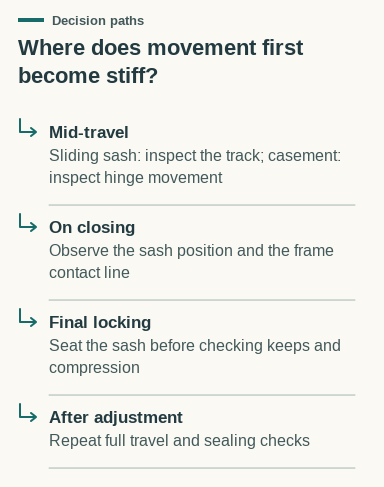
Observe the complete travel before changing hardware. Record where resistance begins and whether it occurs during opening, closing or final locking. A sash that moves freely until the handle turns needs a different adjustment from one that catches the frame halfway through its travel.
For a sliding unit, inspect the track and normal travel path before assessing roller adjustment. For a casement, observe the opening edge, hinge movement and alignment as the sash meets the frame. Operate tilt, cleaning or other modes only where the fitted system provides them. Keep insect screens in their intended position when checking interference.
Locking should be assessed with the sash properly seated. Follow the hardware instructions when adjusting keeps or compression. Excessive tightening can disguise misalignment while increasing operating effort elsewhere. Re-run movement and sealing observations after a locking adjustment because the same change can alter both.
For powered windows, the EuroWindoor commissioning protocol in KB.01, June 2020, section 9 covers learned closed positions, opening travel, collision checks, locking points and protective devices. Record individual and group operation where both are supplied. Electrical and protective-device checks belong with the appropriately qualified commissioning personnel.
Where does movement first become stiff?
Which restrictor measurements belong on the record?
For the residential-strata windows covered by clause 30, check an openable common-property window whose lowest opening level is less than 1.7 m above the room floor, where that floor is at least 2 m above the ground or other external surface below the window. The device must prevent a 125 mm sphere passing through the opening and resist a 250 N horizontally outward action, as specified in the NSW Regulation compilation in force 14 December 2025.
Where the device can be released or disengaged, its release must be child-resistant under the NSW Fair Trading requirements. Record the installed device, measured restriction and relevant verification document. These NSW criteria apply to the covered strata windows.
Use the specified procedure and equipment for required load verification. Demonstrate restricted opening, child-resistant release where fitted, and restoration to the restricted setting.
Drainage and sealing checks at handover
How are drainage and seals checked at handover?
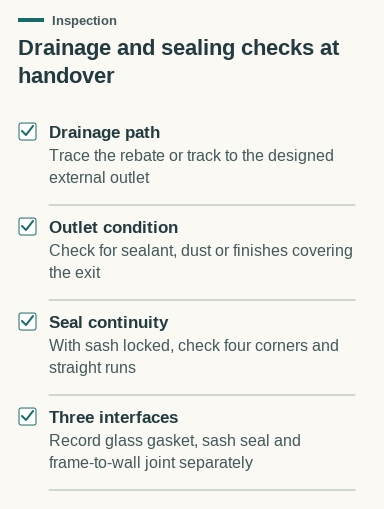
Follow the designed drainage route from the accessible rebate or track to its external outlet. Look for construction dust, packaging, sealant and finish work covering the exit. Identify the intended outlet before clearing anything so that a protective cap or system component stays correctly fitted.
Record whether drainage is visibly unobstructed and whether any agreed functional check discharged externally. A specified field water test has its own method, conditions and acceptance record. Keep that work linked to the same opening through the site water-testing guide.
Examine all 4 corners with the sash closed and locked, then inspect the straight runs for uniform seating. Check the gasket at the glass, the sash contact seal and the frame-to-building joint as separate interfaces. Photograph the particular corner or joint where continuity is lost.
Inspect EPDM corner bends for stretching, twisting or lifting. Retain the corner treatment specified for the fitted seal.
What information makes the handover usable?
Record 8 fields for every scheduled opening: its mark, configuration, test action, observation, adjustment, retest result, date and responsible person. Attach relevant photographs and instrument readings.
Retain the original failed observation alongside the correction and retest. If seal adjustment changes locking effort, repeat both affected checks. Where access prevents a test, record the untested item and assign its completion before accepting that part of the work.
- Demonstrate the actual installed handles, locks, restrictors and any powered controls.
- The receiving person should complete the normal operating sequence and know how to report a problem by opening mark.
- Supply the relevant operating instructions, maintenance information, key details and the remaining defect list with assigned responsibility.
FAQ
What should I see demonstrated before accepting a restricted window?
Handover should demonstrate 3 outcomes: the intended restricted opening, the required child-resistant release where the device is disengageable, and restoration to its intended setting after release. Match the installed device and any required verification to the opening record; use the specified test procedure rather than an improvised load check.
Can one successful opening represent the whole delivery?
Check and record every scheduled opening. Identical-looking units can differ in sash alignment, lock adjustment or drainage obstruction.
How should a failed item be closed?
Record 3 linked stages: the failed observation, the corrective action and the retest result. Repeat any other check affected by the adjustment before closing the item.
Let YULUX review your drawings before pricing.
Send us your window schedule, floor plans or photos. We review opening sizes, system direction, glass, hardware, finish and packing scope before quoting.