
Florida Impact Window Requirements, Approvals and Design Pressure
Florida's 2023 code, as amended by 2024 Supplement 2, requires opening protection in wind-borne-debris regions defined by Vult of at least 130 mph within 1 mile of the coastal mean high-water line, or at least 140 mph within hurricane-prone regions regardless of coastal distance. Approved impact-resistant assemblies or approved protective coverings provide the applicable protection routes.
The details behind the answer
Where does a Florida address need opening protection?
Start with the permit’s code edition, building risk category and mapped ultimate wind speed. For the coastal branch, measure from the coastal mean high-water line. The amended definition restores the coastal wording. The project designer separately establishes wind exposure for pressure calculations. Miami-Dade and Broward form the HVHZ and require the corresponding product-use determination. Florida DBPR product-approval FAQ
Assumptions: an ordinary non-HVHZ project has Vult of 135 mph and lies 0.5 mile from the coastal mean high-water line. It falls inside the coastal branch. A project at 145 mph falls inside the other branch even 5 miles inland. In both cases, the quotation needs an opening-protection solution.
An approved shutter arrangement can protect an opening fitted with non-impact glazing. Its coverage, attachment and installation conditions belong alongside the window selection. Miami-Dade’s window legend expressly associates non-impact glazing with shutters. Miami-Dade window and door legend
Which code edition and building height govern selection?
As checked on November 11, 2026, the applicable current edition is the 8th Edition (2023), including adopted supplements. Florida’s 9th Edition (2026) Building Code takes effect on December 31, 2026. Miami-Dade applies the new edition to permit applications and plans submitted on or after that date, including online submissions after 4 p.m. on December 30. Miami-Dade code-transition notice
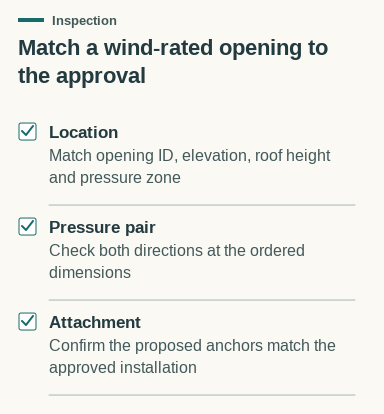
Record each opening’s elevation above grade as well as the building’s mean roof height. The applicable impact-test classification and the design-pressure calculation use different inputs. The designer must select the height-dependent missile requirement under the governing Building or Residential provisions, including the HVHZ rules where applicable. Carry that classification into the selected approval and drawings. The county schedule separately records roof height, pressure zone and product rating. Miami-Dade window and door legend
Does an FL number replace a Miami-Dade NOA?
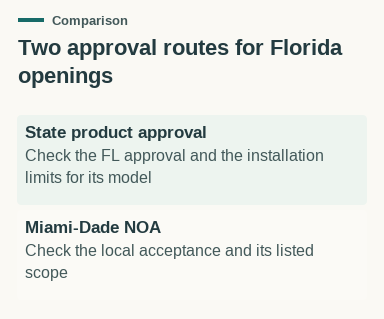
Florida state product approval and a Miami-Dade Notice of Acceptance are separate approval routes. DBPR describes local approval as jurisdiction-limited and state approval as statewide. A state-approved product whose limitations expressly permit HVHZ use can be used in Miami-Dade within those limitations. Florida DBPR product-approval FAQ
The county’s window-permit instructions accept Florida Building Commission product approvals. The buyer can therefore evaluate either applicable route, checking the named manufacturer, exact model, approval status, code basis and limitations of use. For a local NOA proposed elsewhere, establish that jurisdiction’s acceptance before ordering. Miami-Dade window permit requirements
Open the approval’s installation drawings and select the actual glass option, operating style, dimensions and mullion arrangement. A quoted family name leaves these choices unresolved. A larger unit, alternate glazing build-up or different wall connection must remain within the approved configuration. The permit instructions specifically require the glass type/thickness and connection options to be identified. Miami-Dade window permit requirements
Two approval routes for Florida openings
Can the offered model meet both design pressures?
Both pressure directions must pass at the ordered dimensions and approved attachment. Miami-Dade’s legend has separate required and product-rated positive/negative pressure fields, with pressure zones 4 or 5. Use the designer’s required values for each opening and the selected drawing’s allowable product values. Miami-Dade window and door legend
| Parameter | Record for each opening | Acceptance check |
|---|---|---|
| Opening and exposure | Opening ID, elevation above grade, mean roof height, pressure zone | Match the designer’s site calculations |
| Design pressures | Required +psf and −psf, approved +psf and −psf | Satisfy both load directions |
| Size and configuration | Width × height, operating style, glass and mullions | Stay within the selected approval details |
| Anchors | Type, diameter, spacing and end distances | Use the approved substrate-specific detail |
| Wall connection | Substrate, embedment, edge distance, buck connection | Confirm actual wall construction supports the detail |
| Weather interface | Sill, flashing, sealant, drainage and water target | Use the approved installation details at the sill and wall interface; retain drainage outlets |
| Protection and records | Impact or shutter approval, drawing revision, labels | Keep the accepted documents with the opening ID |
Assumptions: opening W07 requires +50/−65 psf. A proposed configuration rated +60/−60 psf falls short by 5 psf in negative-pressure resistance. A +60/−70 psf option passes the pressure comparison when its size, glazing and attachment conditions match.
Hold W07 if the drawing only covers concrete while the intended connection is to a wood buck. Resolve the connection or select an applicable approved option before releasing production. A pressure pass with an incompatible substrate leaves the purchase technically incomplete.
Match a wind-rated opening to the approval
How can a Chinese factory obtain an applicable approval?
A factory targeting the Miami-Dade NOA route develops the exact assembly and installation details for review, uses a county-certified laboratory for required testing, and submits the engineering and production-control package. The county reviews tests, engineering analysis and installation procedures and provides quality-assurance oversight. Miami-Dade product approval process
The April 2026 NOA checklist requires a Florida professional engineer’s sealed compliance statement, laboratory-marked specimen drawings, permanent-label information and a documented quality-assurance system. Section 3 says tests should be no older than 2 years at submittal. Each approval-drawing sheet identifies the manufacturer and product, document number and revisions. These requirements apply to the proposed imported product’s application. Miami-Dade NOA basic requirements, April 2026
For the state route, the factory works within Rule 61G20-3 and the applicable recognized testing, certification or evaluation arrangements, with HVHZ suitability explicitly addressed when needed. DBPR provides a directory of approved organizations. The issued approval must cover the offered assembly and its use conditions. Florida DBPR product-approval FAQ
GB/T 29738-2013 Appendix C provides a report form identifying the producer, specimen specification/model, test basis and impact-performance grade. The appendix is informative. Match those report fields to the offered product, then complete the separate Florida approval and installation review for the order. This gives the importer a practical way to identify a report covering a different model or producer. SAMR GB/T 29738-2013 record
FAQ
Can a Florida order use shutters with non-impact windows?
Yes. An approved protective covering can provide the required debris protection when its permitted use, opening coverage and installation match the project. Miami-Dade’s window legend pairs non-impact glazing with shutters.
Which coastal wind-speed rule applies before the 2026 code transition?
Under the 2023 code as amended by 2024 Supplement 2, the coastal trigger is Vult of at least 130 mph within 1 mile (1.61 km) of the coastal mean high-water line. The other trigger is Vult of at least 140 mph within hurricane-prone regions, regardless of coastal distance.
Does a Chinese impact report establish Florida product approval?
A GB/T 29738-2013 report identifies the tested specimen and its impact result. Florida procurement also needs the applicable product approval, permitted configuration and installation basis. Match the producer and model across the documents.
How should a buyer handle an insufficient negative DP rating?
For an opening requiring −65 psf, a −60 psf rating leaves a 5 psf shortfall. Select a configuration meeting the negative demand as well as the positive demand, dimensions and attachment conditions.
Let YULUX review your drawings before pricing.
Send us your window schedule, floor plans or photos. We review opening sizes, system direction, glass, hardware, finish and packing scope before quoting.