
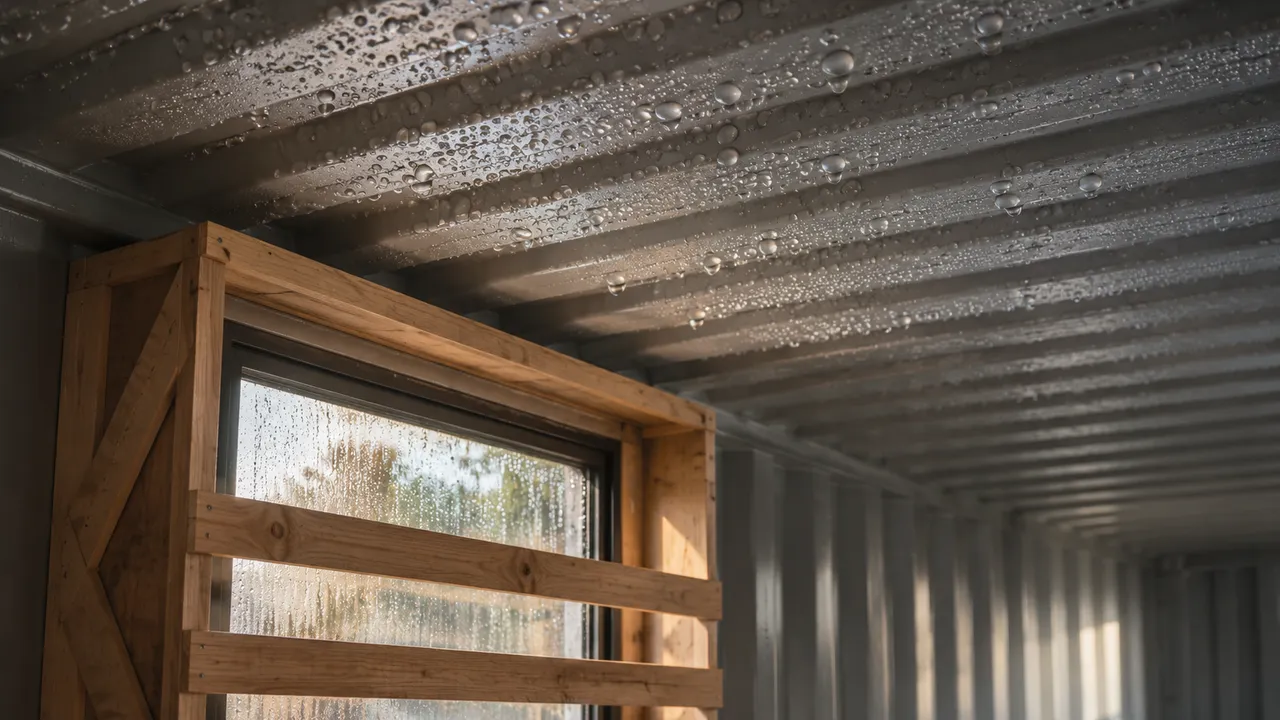
Container Rain on Window Shipments and Wet-Crate Diagnosis
Container rain forms when a container's steel roof or walls cool below the internal air's dew point. The CTU Code explains that dry dunnage and packaging at an estimated 12%–15% moisture content can establish roughly 60%–75% relative humidity inside a closed container. Check material moisture as well as the air and steel temperatures when tracing wet window crates.
Why can a sealed container arrive with wet window crates?
Water vapour can come from the air loaded with the cargo, timber supports, cardboard and other moisture-bearing materials. Container rain is condensation on steel below the internal dew point that drips onto crates or runs down walls, with the CTU example giving a dew point near 20°C at 30°C and 57% relative humidity.
A crate can therefore look dry at loading and still contribute water vapour during a voyage. Factory packing, warehouse storage and the weather during loading all belong in the investigation. Compare crates from different positions in the load to identify whether wetting follows the container walls, the door end or a particular packing batch.
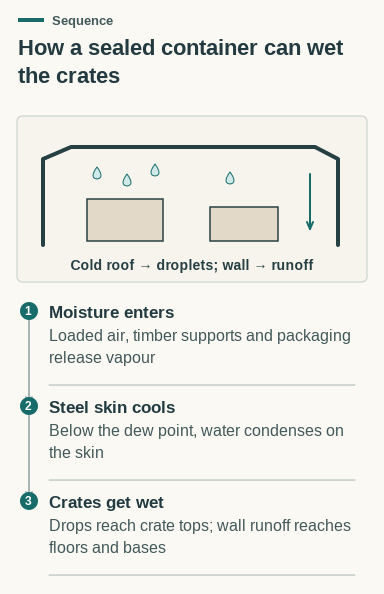
How a sealed container can wet the crates
Where did the water first appear?
Before opening more crates, make 3 checks: trace roof or wall runoff, inspect wet door seals for ingress, and compare cold-glass temperature with ambient dew point. Before disturbing the wrapping, photograph the container roof, floor, door area and affected crate positions. Include close views of water tracks and wider views showing their relationship to the load. The shipping-damage claims guide covers the separate notification and claim sequence.
| Observed condition | First check | Handling decision |
|---|---|---|
| Droplets above crates and wet upper covers | Roof temperature, internal humidity and drip pattern | Move unloading under shelter and prevent further dripping onto exposed assemblies |
| Wet bases beside container walls | Wall runoff and the corresponding floor track | Inspect lower wrapping and separate wet packing material during a controlled opening |
| Local wet trail beside a door seal or damaged panel | Container damage and the direction of the water trail | Document the affected area before changing the packing |
| Clear glass becomes wet after the doors open | Glass surface temperature against ambient dew point | Plan acclimatisation before exposing more cold surfaces |
| Haze remains after accessible surfaces dry | Location of the mark and a small cleaning trial | Refer persistent surface changes for glass assessment |
| Marks appear within the sealed glazing cavity | Which pane surface carries the mark | Arrange glazing-unit assessment with the fabricator |
Should cold window crates be opened immediately?
A cold consignment entering warm, humid air can collect condensation directly on its surfaces. The CTU Code, Annex 3 advises allowing cargo to acclimatise and keeping moisture-barrier packaging sealed until that process is complete. The receiving temperature and humidity determine the timing.
In the Code's illustrative dew-point condition, air at 30°C and 57% relative humidity has a dew point of about 20°C. The temperature equivalents are 86°F and 68°F. A glass surface colder than that dew point can become wet when exposed to the air. Measure the glass and air conditions at the receiving area before exposing additional crates.
Separate an intact moisture barrier around cold cargo from wrapping that already contains free water. The latter needs a controlled drying plan with the packing or glazing specialist. Support the window assemblies safely throughout opening and rewrapping. Arrange a sheltered area where the receiving team can inspect one crate without exposing the whole shipment to rain or humid air.
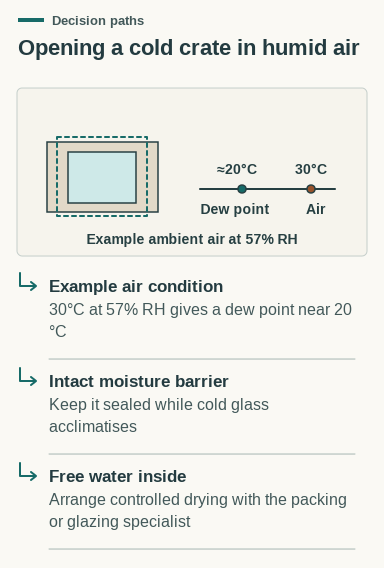
Opening a cold crate in humid air
Will more desiccant prevent the next wet shipment?
Desiccant has finite moisture capacity. The CTU Code warns that hygroscopic cargo with excessive moisture can overwhelm that capacity. Timber and packaging condition therefore enter the packing design before a bag quantity is selected.
For a repeat order, measure moisture in timber supports and packaging after storage and before loading. Size the barrier and desiccant for those materials, voyage duration and consolidation storage.
Keep desiccant identification and placement in the packing record so that the receiving team can relate each bag to the intended system. Any alteration to container ventilation needs the container operator's agreement and a technical basis for that consignment.
Can drying restore cloudy or stained glass?
Drying removes free water, while persistent roughness, patches or sticking between packed panes require a surface assessment. Chinese glass-production guidance describes roughening and difficult cleaning among early weathering symptoms, followed by visible patches and possible sticking between sheets. Use those observations to select an inspection route.
For assembled windows, identify the glass construction and exposed coating before choosing a cleaning method. A small test area can show whether a removable deposit explains the appearance. Continued haze then goes back to the glass specialist with photographs, surface identification and the cleaning result. The sealant-staining diagnosis covers oily films and marks associated with glazing materials. For raw flat glass, one Chinese producer's historical procurement specification prohibits direct reuse of recovered separation powder and requires residue to remain removable by normal cleaning after 5 months of indoor natural storage.
Receiving decisions before installation
Release the affected assemblies according to their inspected condition. Record which crates have completed drying, which panes have passed the agreed surface inspection, and which packages require repair or specialist assessment. Keep the identification visible when units move from the receiving area to storage.
FAQ
Why did the glass become wet only after unloading?
Cold glass can collect condensation when it meets warmer, humid air. Compare the measured surface temperature with the local dew point. The CTU Code's example places the dew point near 20°C for air at 30°C and 57% relative humidity.
Does an unbroken window rule out moisture damage?
An intact pane can still have packing residue, persistent surface haze or wet surrounding materials. Inspect the surface after appropriate drying and a suitable cleaning trial, then allocate any unresolved condition to the fabricator.
How many desiccant bags does a window container need?
Bag quantity follows the packing system's moisture load and the selected desiccant's capacity. Assess timber, wrapping and expected exposure together. A fixed count based only on container size leaves those inputs unresolved.
Let YULUX review your drawings before pricing.
Send us your window schedule, floor plans or photos. We review opening sizes, system direction, glass, hardware, finish and packing scope before quoting.