
Multi-Point Locks for Aluminium Windows and Doors
A multi-point lock drives locking elements at several positions from one handle, key or automatic trigger. For transmission locking gear within JG/T 126-2017, category I specifies 200,000 repeated operations and category II specifies 25,000. Choose the opening mechanism and its profile interfaces before selecting the operation category.
How does a multi-point lock operate?
A handle, key or automatic trigger moves the centre mechanism, which drives the linked locking points. The operation may be lift-lever, key-wind or automatic. Those functions affect whether pulling the door closed merely latches it or fully secures the assembly.
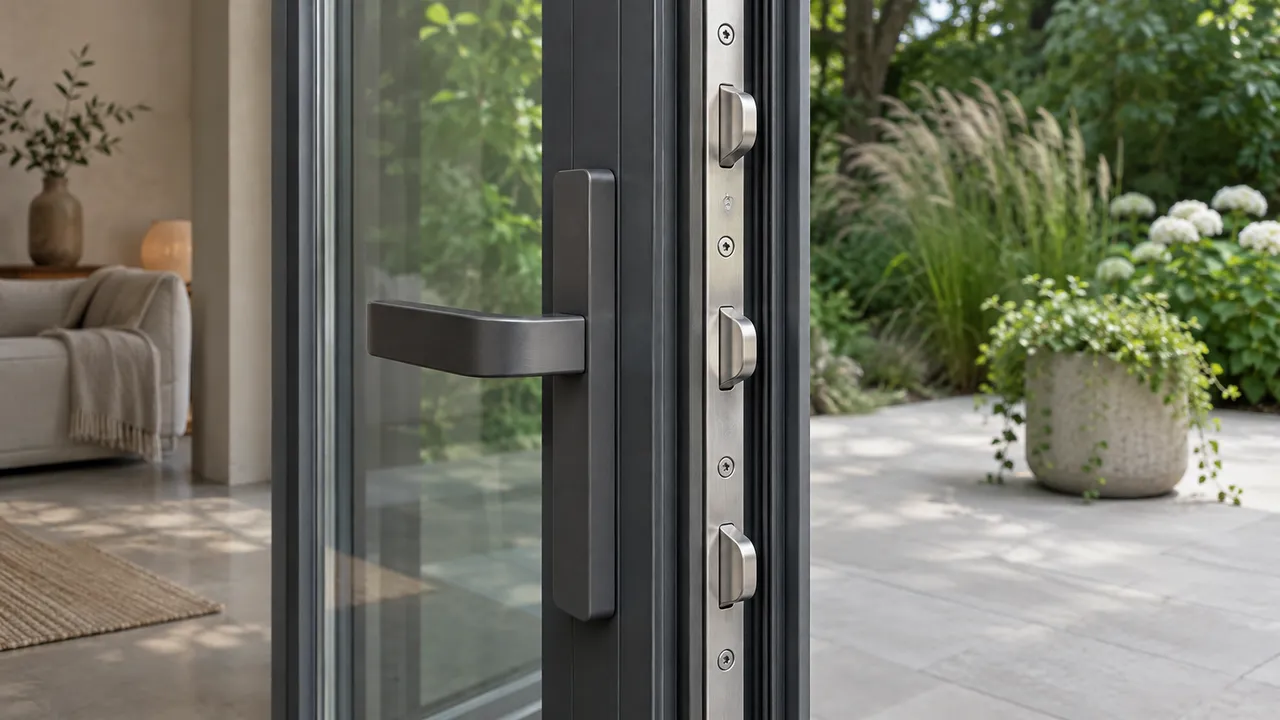
A published aluminium narrow-stile mechanism connects 3 locking points on one forend. Another finished aluminium-door offer includes 7 points made up of 2 hooks, 4 bolts and an upper bolt. These are configuration examples with different component arrangements.
For a double door, map the active and passive leaves separately. The passive leaf needs its specified securing arrangement before the active leaf can lock correctly into it. Folding and sliding arrangements also require a layout suited to their movement and meeting stiles.
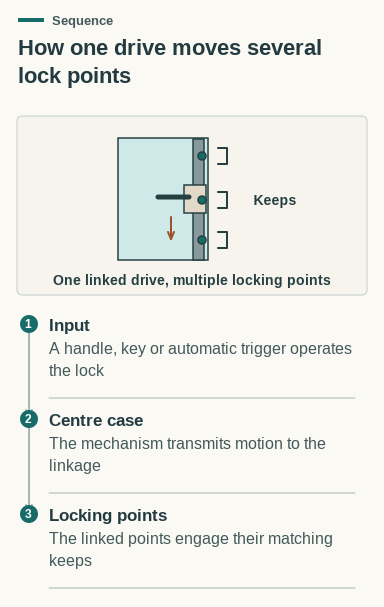
How one drive moves several lock points
Are more locking points always better?
Each moving point needs sufficient engagement with its keep, supported by the frame and its fixings. More points add alignment interfaces. Security performance follows the tested assembly and its specified hardware.
Hooks resist separation through their engagement geometry. Straight bolts enter their corresponding sockets. Compression cams pull a sash or leaf toward the seals. Identify which points provide security engagement and which primarily adjust compression.
Even pressure reduces draughts when the gaskets and frame joints seal continuously. Excessive compression raises handle effort and can mask a dropped leaf. Restore hinge alignment before adjusting lock compression. Hardware selection guide
Which dimensions must match a narrow aluminium stile?
One published aluminium-lock mechanism has a 15 mm-wide narrow case and 85 mm operating-axis centres. These dimensions describe that specific mechanism. Measure the existing case and profile chamber before selecting a replacement.
Backset is measured from the faceplate datum to the spindle axis. PZ centres describe the handle-spindle to cylinder-centre distance. Faceplate form, case depth, spindle size and available chamber clearance each control a separate interface.
Assumed survey values for a replacement decision appear below, with locking-point offsets measured from the spindle datum. A change from 85 mm to 92 mm PZ shifts the cylinder interface by 7 mm. This candidate requires revised handle and cylinder machining before it can be considered for the door.
The candidate also shifts the backset and hook positions. Reject it as a direct replacement. A system redesign would need revised machining, keeps and fixing positions, followed by an assembled-leaf operation check. With matching dimensions, trial-fit the specified mechanism and verify full engagement, comfortable handle effort and clearance from the glass pocket and drainage path.
| Measured interface | Existing assembly | Candidate | Decision |
|---|---|---|---|
| Backset | 35 mm / 1.378 in | 40 mm / 1.575 in | Spindle axis shifts 5 mm |
| PZ centres | 85 mm / 3.346 in | 92 mm / 3.622 in | Cylinder interface shifts 7 mm |
| Faceplate | Flat, 16 mm wide | U-shaped, 24 mm wide | Different routing and seating |
| Hook offsets from spindle | +600 / -600 mm | +650 / -650 mm | Each keep position shifts 50 mm |
| Case width / clear chamber | 15 mm / 17 mm | 18 mm case | Case exceeds chamber by 1 mm |
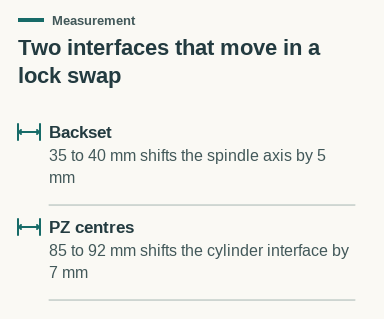
Assumed lock-replacement dimensions and calculated axis shifts
Which standards apply to door locks and window gear?
EN 15685:2024 covers mechanically operated multipoint locks and their locking plates. Its public scope excludes window locks and assessment of contribution to the fire resistance of a specific fire/smoke doorset. Cylinders and handles also have separate scopes. EN 15685 official scope
Chinese JG/T 126-2017 classifies transmission locking gear into category I with 200,000 repeated operations and category II with 25,000. Clause 4.1.3 also requires the actual locking-point count in the marking. Clause 4.1.1 uses M(C)CQ for gear-driven and M(C)LQ for connecting-rod-driven mechanisms. Its scope covers the stated hinged and pivot opening types. JG/T 126-2017, clauses 1 and 4
For UK security specifications, PAS 24 addresses manufactured doorsets and windows. BSI identifies the amended edition as PAS 24:2022+A1:2024. Match the lock, cylinder, glazing and frame to the assessed product configuration. BSI PAS 24 scope BSI amendment notice
US ASTM F476-23 evaluates resistance to forced entry for swinging door assemblies and includes tests involving individual components. Specify which assembly and tests the report covers. ASTM F476 scope
ANSI/BHMA A156.12-2022 concerns interconnected locks, with dimensional, operation, strength, security, cycle and finish requirements. Apply it when the proposed hardware belongs to that category. Component endurance supports hardware selection, while the doorset security report addresses the assembled entry. BHMA hardware scope
Why is the handle stiff after installation?
Compare operation with the leaf open and closed, following the mechanism’s instructions and any mishandling device. If it runs freely open but binds closed, inspect leaf alignment, keep positions and gasket pressure before replacing the gearbox.
Look for rub marks at the latch, hooks and bolts. A dropped leaf can make several points strike below their keeps. Adjust the supports and alignment within the system’s permitted range, then test every engagement through the complete closing movement.
Clean debris from the keeps and use the specified maintenance products. Lubricants for the exposed gear and cylinder may differ. Repeatedly forcing a stiff handle increases the load on the drive and can damage the mechanism when the original fault is misalignment.
FAQ
What is the difference between a 3-point and a 7-point door lock?
Point count describes the number of engagement positions. One published 7-point arrangement uses 2 hooks, 4 bolts and an upper bolt. Select by engagement geometry, fitting dimensions and the assessed door configuration.
Can a multi-point door lock be used as a window lock?
Only where its design and application cover that window. EN 15685:2024 explicitly excludes window locks. Window transmission gear requires the appropriate opening-type specification and compatible profile interfaces.
Do I have to replace the whole strip when the gearbox fails?
A separately available, compatible gearbox can allow a repair. Match the case, centres, operation and connections to the retained strip. Diagnose leaf alignment first, because binding against the frame can damage a replacement drive.
Let YULUX review your drawings before pricing.
Send us your window schedule, floor plans or photos. We review opening sizes, system direction, glass, hardware, finish and packing scope before quoting.