
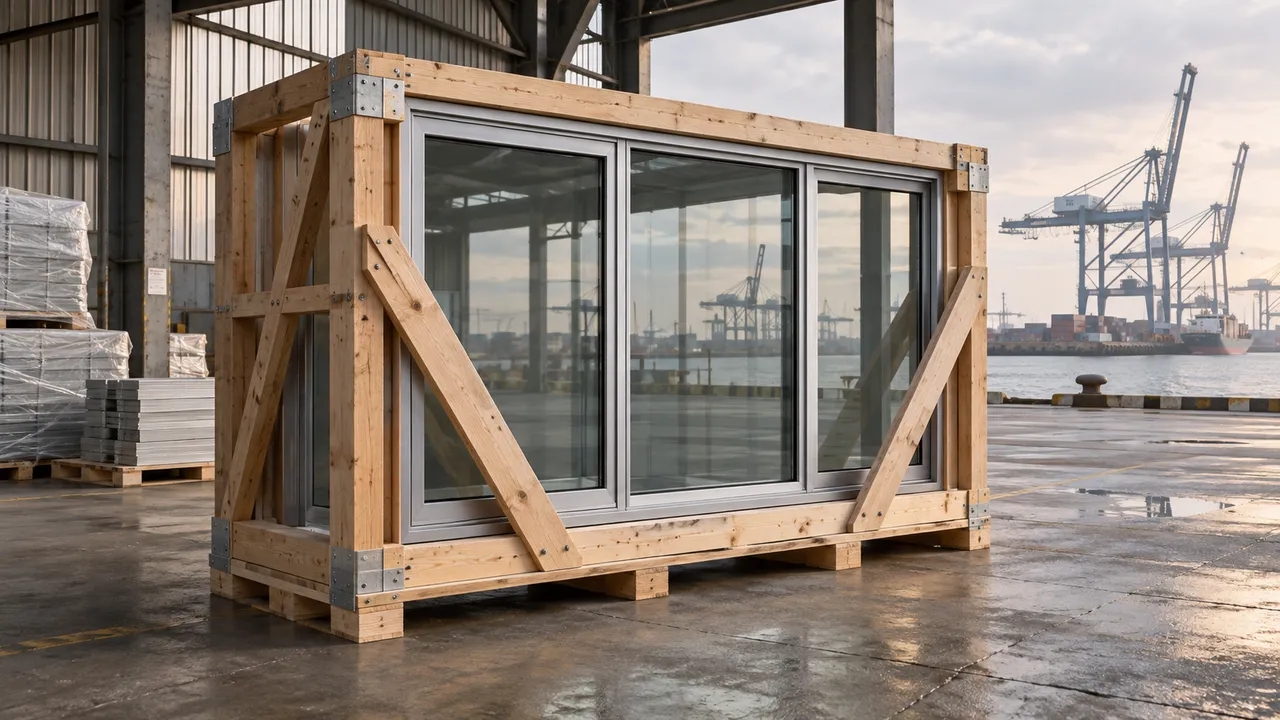
Import Duty on Aluminum Windows for USA Buyers
For the stated Chinese-origin finished-glazed-window scenario under HTS 7610.10.0010, the 10 November 2026 reference rates are 5.7% general duty, 50% full-value Section 232 and 7.5% China Section 301, totalling 63.2%. The calculation assumes non-Russian origin, smelt and cast history, no qualifying US-metal relief or entry-specific China 301 exclusion, and the specified metal-route exception to the newer forced-labor 301 measure.
The details behind the answer
Which duties stack on a Chinese window entry?
The general duty comes from the product classification. For windows and their frames, the U.S. reporting number is 7610.10.0010. A broker then applies the relevant Chapter 99 headings to that same merchandise. The observed general rate appears in USITC Chapter 76.
The June Annex I-A lists 7610.10.00 on the 50% Section 232 route. China's 7.5% measure uses 9903.88.15 and the product list in note 20(s)(i). Keep the dated exclusion explanation beside the product lists in June Annex I-A and USITC Chapter 99.
Chapter 99 note 52(f)(1) provides the 9903.05.90 exception for goods entered under metal heading 9903.82.02 and the other specified metal headings. Thus the stated standard metal route qualifies for that particular exception. The earlier China 301 charge remains separately identified under the exception described in USTR's July action.
How much tax does the $40,000 entry budget carry?
| Budget line | Calculation | Amount |
|---|---|---|
| General duty | $40,000 × 5.7% | $2,280.00 |
| MPF | $40,000 × 0.3464% | $138.56 |
| HMF | $40,000 × 0.125% | $50.00 |
| Base duty and these fees | $2,280 + $138.56 + $50 | $2,468.56 |
| Reference Section 232 | $40,000 × 50% | $20,000.00 |
| Reference China Section 301 | $40,000 × 7.5% | $3,000.00 |
| Dated scenario duties and entry fees | $2,468.56 + $20,000 + $3,000 | $25,468.56 |
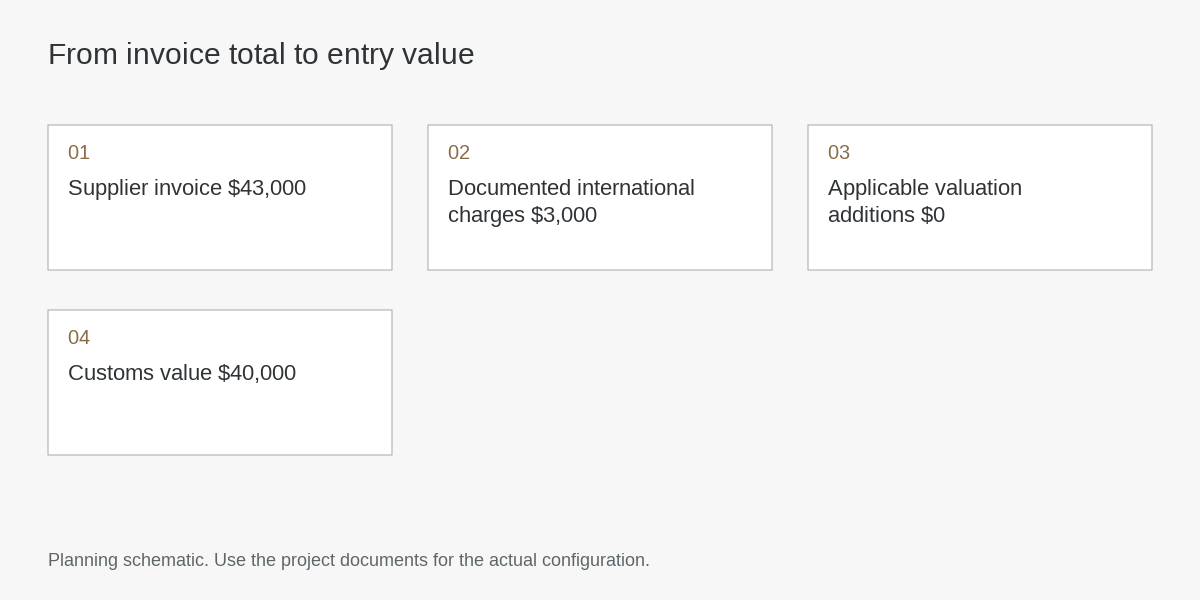
Value reconciliation for the assumed sea entry.
Which invoice amount becomes the customs value?
International freight and insurance may be included in the supplier invoice while excluded from the customs price. Document the qualifying shipment charges under 19 CFR 152.102.
19 CFR 152.103 identifies 5 additions to transaction value, including packing, selling commissions, assists, qualifying royalties and seller resale proceeds. Count additions once. A buyer-supplied production mold can be an assist. Foreign inland freight has its own treatment under 19 CFR 152.103.
For CBP Form 7501 or its electronic equivalent, use the named charges field in the version being filed for aggregate freight, insurance and other charges. Under 19 CFR 141.61(e)(1), designated spaces govern where provided; the column 33 instruction belongs to the branch for information without a designated space. Support the entry with the freight bill and value reconciliation under U.S. entry-data regulations. For the Chinese export declaration, Article 14 requires the declaration agent to review four document groups covering the goods' origin and price and records including the contract, invoice, transport documents and packing list.
What does a $40,000 sea entry cost in duties and fees?
Assumptions: One formal ocean entry dated November 10, 2026 contains 80 comparable Chinese-origin finished glazed windows classified under 7610.10.0010. The $43,000 invoice includes $3,000 of documented qualifying international freight and insurance, leaving a $40,000 customs value with no further valuation adjustments. The scenario assumes no Russian-origin aluminum, no primary aluminum smelted in Russia and no casting in Russia, with no qualifying U.S.-metal relief or entry-specific China Section 301 exclusion. The specified metal-route exception to the newer forced-labor 301 measure applies. The standard 50% Section 232 and 7.5% China 301 charges apply. The port is HMF-covered, and the completed units meet the cited extrusion-order exclusion.
The stated reference scenario carries $25,468.56 in duties and entry fees on a $40,000 customs value. General duty plus MPF and HMF totals $2,468.56; the specified Section 232 and China 301 duties add $23,000.
A $40,000 formal sea entry incurs $138.56 MPF and $50 HMF under the stated fee assumptions, giving $188.56 in these two fees. From October 1, 2026, formal-entry MPF has a $34.58 minimum and a $670.86 maximum, with the 0.3464% rate retained under CBP's FY2027 fee notice.
The separate HMF calculation uses the 0.125% rate for covered vessel cargo. The covered-port and exemption provisions appear in 19 CFR 24.24.
A shipment budget also needs freight, brokerage, bond premiums, inspections, storage and inland delivery. Any separately applicable trade-remedy deposit or unresolved entry-specific measure remains an additional line.
How do glass and metal provenance affect Section 232?
Under the listed Section 232 route, a $40,000 finished-window customs value produces a $20,000 metal duty even when the shipment includes glass and hardware. Chapter 99 note 16(c) places the relevant charge on full customs value. Its 15%-metal-weight condition applies to specified headings outside Chapters 72, 73, 74 and 76. A Chapter 76 window follows the treatment prescribed in USITC Chapter 99.
June guidance lowers the qualifying U.S.-metal threshold to 85% for specified reduced treatment. Eligibility requires the prescribed metal provenance and entry conditions. The calculation uses the 50% heading implemented by CBP CSMS 68855869.
July's investment relief concerns specifically approved U.S. primary-aluminum arrangements. Eligibility requires the approval and metal history prescribed in July's aluminum proclamation.
Russian-origin aluminum, any primary aluminum smelted in Russia, or casting of the aluminum article in Russia triggers the specified 200% treatment under 9903.85.67 or 9903.85.68. The general 50% heading expressly excepts those Russian-aluminum headings. CBP CSMS 68855869 also requires the smelt and cast countries to be reported.
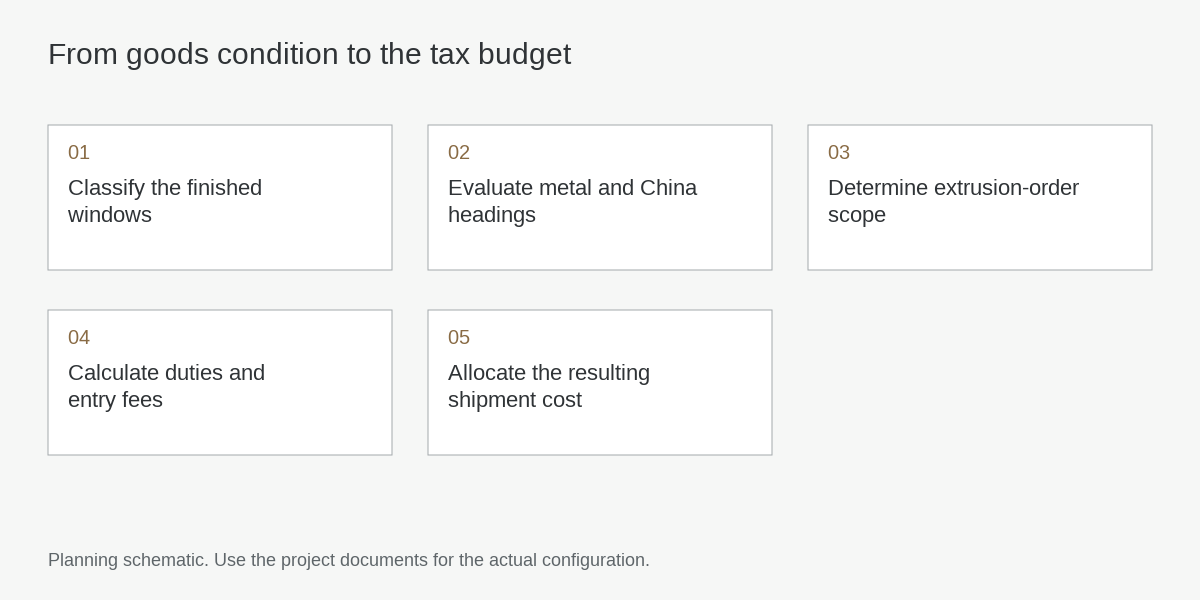
The entry calculation records each rule and its applicable treatment.
When does a glazed window satisfy the extrusion-order exclusion?
The 2011 extrusion order excludes a finished glazed window when its assembly is permanent and the unit is already complete upon entry. The relevant cases are A-570-967 (antidumping) and C-570-968 (countervailing duties). The physical state on arrival controls this particular exclusion. A frame shipped with separate glass needs assessment under the product and kit provisions in Commerce's extrusion-order scope.
A qualifying kit contains the components needed for completion and can be assembled without further fabrication. Cutting or punching still needed after importation changes that assessment. Include the complete assembly components when assessing a kit containing screws and extrusions.
The broker records the order-specific determination against the packed configuration. Applicable AD/CVD deposits need their own order and exporter treatment. The import sequence covers purchasing and shipping.
Tax allocation and the broker's entry result
The modeled tax-and-fee amount spreads across 80 comparable units at $318.36 each after rounding. Adding the assumed $3,000 international shipping charge gives $355.86 per unit for those taxes, fees and international shipment costs together. Mixed-size orders can use a different allocation basis for management costing while preserving the actual customs entry totals.
FAQ
How much does each extra $1,000 of customs value add to the modeled duties?
Within the dated 63.2% reference scenario, each additional $1,000 of customs value adds $632 in duties. The same product, origin, smelt/cast history and exclusion assumptions apply. MPF and applicable HMF follow their separate calculations.
Where does the broker show freight already included in my supplier invoice?
For CBP Form 7501 or its electronic equivalent, use the named charges field in the version being filed for aggregate freight, insurance and other charges. The $43,000 invoice scenario reconciles $3,000 of qualifying shipment costs to a $40,000 customs value using the supporting records.
Does putting loose glass in the same crate establish the completed-window exclusion?
The 2011 order's completed-merchandise language requires the window to be complete at entry. A package needing assembly follows the separate kit assessment, including all necessary components and the absence of further fabrication.
Let YULUX review your drawings before pricing.
Send us your window schedule, floor plans or photos. We review opening sizes, system direction, glass, hardware, finish and packing scope before quoting.